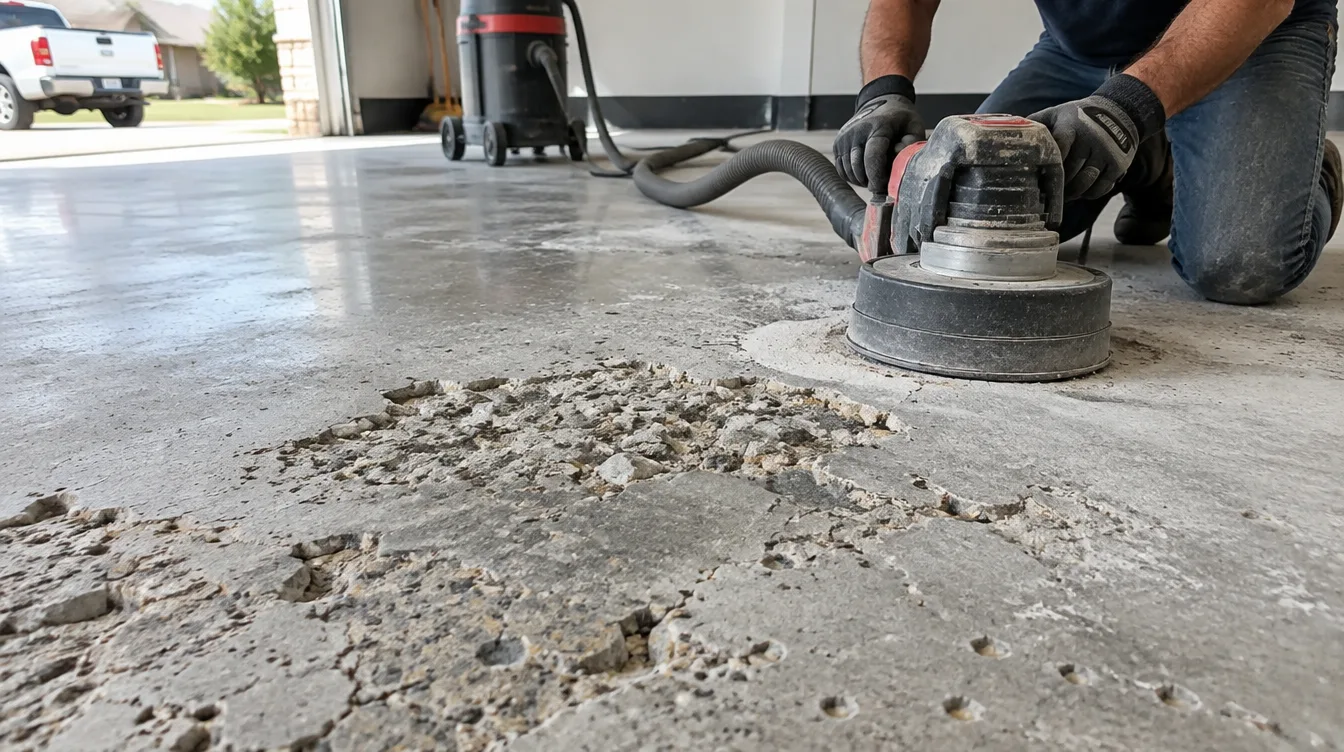
Yes, you can epoxy concrete that is spalled, pitted or already coated, but only when the damage is shallow, the concrete underneath is sound and any old coating is either removed or proven to be bonded. Soundness decides it, not how the floor looks. People often ask whether epoxy flooring can be repaired once the slab itself is damaged, and the answer depends on a short set of measurements taken before anyone quotes. If your floor already carries epoxy that is failing, our epoxy floor repair page covers the repair services themselves, and this guide helps you judge whether the slab qualifies at all.
Quick answer: the substrate conditions that rule a coating in or out
A coating can go over damaged concrete when the damage is shallow, the surrounding concrete is hard and the repair areas are a small share of the floor. It cannot go over concrete that is crumbling, hollow or still moving, because a coating inherits the strength of whatever it is bonded to.
Sort the floor into one of three groups before anything else:
- Go. Shallow spalls, scattered popouts, tight pitting, and old coatings that are tightly bonded. These are patched, ground and coated in a normal sequence.
- Conditional. Deeper spalls, dense pitting across a wide area, or old coatings that are partly bonded. These need a larger repair scope, a leveling layer or full coating removal, and the price moves accordingly.
- No-go. Hollow-sounding slabs, concrete that fails a scratch test, active settlement and cracks that keep moving. Coating any of these only hides the problem for a short time.
This guide does not repeat how to choose between patching, resurfacing and replacing an existing coating, which our post on epoxy floor repair and resurfacing covers, or how to treat cracks, which our guide to epoxy floor crack repair covers. It sits one step earlier, at the question of whether the concrete is fit to receive any repair or coating.
Spalling: how deep is too deep
Spalling is the flaking or breaking away of the concrete surface, and the depth of the loss decides whether it can be patched and coated or has to be repaired as a structural defect. Shallow spalls that stop within the top surface layer are routine. Spalls that expose reinforcing steel or run deep are not.
The usual causes in a San Antonio slab are an overworked surface that was troweled too hard and too early and later delaminates in thin sheets, steel reinforcement set too close to the surface that rusts and expands, impact damage, and years of moisture moving through the slab. The cause matters because a patch applied without removing it will fail the same way again.
A working way to sort spalls by depth:
- Under about 1/4 inch. Treated as surface repair. The loose edges are ground back to sound concrete and the area is filled with an epoxy or polymer-modified patching mortar made for thin sections.
- About 1/4 inch to 1 inch. A patching mortar rated for that thickness, placed after the edges are saw-cut or ground to a vertical face so the patch does not feather out to nothing.
- Deeper than about 1 inch, or showing exposed steel. A concrete repair, not a coating prep. The corroded steel is cleaned or treated, and the section is rebuilt with a repair mortar before any coating is considered.
Those are working thresholds, not code. The patching product's data sheet sets its own minimum and maximum thickness, and it wins over any rule of thumb. A feather-edged patch, one that tapers to a hairline, is a common failure point because the thin edge debonds under traffic, so a proper repair cuts a defined edge.
One more point on depth. Measure it at the worst spot, not the average, and probe the edges with a screwdriver or hammer. Spalling often continues underneath, so the visible hole is smaller than the area that needs to come out.
Pitting and popouts: density and patch strategy
Pits and popouts are small defects, usually cone-shaped, and what matters is not any single one but how many there are per square foot and how deep they sit. A scattering of popouts is patched individually. A surface covered in pits needs a different strategy.
A popout happens when a particle near the surface, often an absorptive or reactive piece of aggregate, expands or breaks and pushes out a small cone of concrete above it. Surface pitting can also come from air voids left in the finish, from acid or chemical etching, from deicing salts brought in on vehicles, or from a previous coating that was torn off and took the surface with it.
There are three ways to deal with them, and density chooses between them:
- Spot patching. Appropriate when pits are sparse and far apart. Each is cleaned, filled with a patching compound and ground flush.
- Skim or grout coat. Appropriate when pitting is widespread but shallow. A thin cementitious or epoxy skim coat is troweled over the whole area and fills the pits in one pass.
- Self-leveling or resurfacing layer. Appropriate when the surface is dense with pits or uneven as well. It builds a smooth plane over the entire slab, and it adds cost and a cure day.
Why does the choice matter? Pits left unfilled show through a thin coating as dimples, and they trap air that rises as bubbles while the coating cures. Filling them is cheaper than seeing them in the finished floor. Our guide to concrete floor leveling before epoxy covers the leveling step in more detail.
Delaminated previous coatings and why they must come off
A new coating is only as well bonded as the layer beneath it, so a previous coating that is peeling, blistering or lifting has to come off completely. A coating that is tightly bonded can sometimes be abraded and coated over, but you have to prove it first.
Old coatings fall into a few types, and each behaves differently:
- Thin garage paint and acrylic sealers. They look bonded but often sit on the surface like a film. Many are removed by grinding, and a sealer that makes water bead up will block the new coating from penetrating the slab.
- One-part epoxy paints. Usually thin and weakly bonded, and they commonly peel in sheets under hot tires.
- Two-part epoxy or urethane systems. Thicker and often well bonded, which makes them harder to remove and harder to judge.
Two quick checks tell you a lot. The cross-hatch tape test, which follows ASTM D3359, cuts a grid through the coating and pulls tape off it, and any squares that lift show a poor bond. A simple water-drop test on bare-looking concrete shows whether a sealer is present, since water that beads rather than darkens the surface points to one.
Where the old coating is failing, the removal method is mechanical, usually diamond grinding, and the guides on shot blasting versus diamond grinding and on how concrete floor grinding works explain what each machine does. If you want to see how a peeling floor is judged and what causes it, our post on epoxy floor peeling walks through it. The point to take away here is that removal is a requirement, not an upsell, when the bond is bad.
Testing soundness: sounding, scratch and ASTM D4541 pull-off
Soundness is tested, not assumed, and there are three tests that run from free to formal. Used together they separate a floor that can take a coating from a floor that only looks like it can.
Sounding. Tap the slab with a hammer or drag a chain across it. Sound concrete rings with a sharp, solid note, and a delaminated area gives a dull, hollow tone. Mark every hollow area with chalk and the survey gives you a map of what has to be removed. The method is standardized for delamination surveys under ASTM D4580.
Scratch test. Drag a hardened screwdriver or a nail across the surface with firm pressure. Sound concrete scratches lightly and leaves a thin line. Concrete that crumbles, powders or leaves a deep groove has a weak surface layer, which grinding may remove or may not, depending on how deep the weakness goes.
Pull-off adhesion. ASTM D4541 bonds a metal dolly to the surface with epoxy and pulls it straight off with a gauge, recording the tensile force in psi. It tests the concrete itself, and it tests it before coating, so you see the strength the coating will be asked to hold onto. Many coating manufacturers ask for a minimum somewhere around 200 psi, and they want the failure to occur in the concrete rather than at the glue line, but the number on the product's data sheet is the one that applies.
Two companion checks belong in the same visit. A moisture reading, covered in our guide to moisture testing for epoxy flooring, because damaged concrete often leaks vapor. And a surface profile check against the ICRI 310.2R scale, which our guide to matching surface profile to coating explains.
Go or no-go table: defect against repair method, cost and feasibility
| Condition found | Typical repair before coating | Relative cost | Verdict |
| Spall under 1/4 in, sound edges | Grind edges, fill with thin-section patching mortar | Low | Go |
| Spall 1/4 to 1 in | Saw-cut or grind to a vertical edge, patching mortar rated for the depth | Moderate | Go |
| Spall over 1 in or exposed steel | Treat steel, rebuild section with a repair mortar | High | Conditional |
| Scattered popouts | Clean and fill each, grind flush | Low | Go |
| Dense pitting across the floor | Skim coat or self-leveling layer over the whole area | Moderate to high | Conditional |
| Old coating, tight bond (cross-hatch squares stay put) | Abrade to a profile and coat | Low to moderate | Go |
| Old coating peeling or blistering | Grind off completely, then repair the surface beneath | Moderate | Go after removal |
| Hollow-sounding areas covering a large share of the slab | Not a coating problem: remove and replace the concrete | High | No-go |
| Crumbling surface, fails scratch test and pull-off | Grind deeper and retest, or replace | Moderate to high | No-go until retested |
| Active settlement or cracks that keep moving | Correct the cause first | High | No-go |
Costs are shown as relative bands on purpose. They depend on the area, the access and the repair mortar chosen, and the only number worth acting on is a written quote after a site visit.
When replacing the slab is the cheaper answer
Replacement wins when the concrete has lost structural integrity, when repair areas add up to a large share of the floor, or when the slab is still moving. At that point a coating buys a short-lived result and the repair spend is wasted.
Look for these signals:
- Hollow or crumbling concrete over a large area. If most of the slab sounds hollow, patching is not repair, it is a series of small rescues around a failing whole.
- Vertical offset at cracks. One side of a crack sitting higher than the other points to settlement, and it will keep telegraphing through any coating.
- Active movement. Cracks that open and close or that reappear after patching show the slab is still shifting. San Antonio's expansive clay soil is a common cause, and it moves with wet and dry seasons.
- Repeated failure. A floor that has been patched and recoated more than once and fails each time is telling you the base is the problem.
The comparison to make is between the full repair scope and the cost of new concrete, and you should ask for both written out. Some floors that look hopeless are rescued by a leveling layer, and some that look salvageable are really money spent on a slab that will not hold. A contractor who recommends against coating, with test results attached, is giving you information worth more than a quote.
What a proper repair sequence looks like before the first coat
A proper sequence repairs the concrete first, preps the surface second and coats last, and it records the test results at each stage. Skipping or reordering these steps is where damaged-concrete jobs go wrong.
- Survey. Sound the whole slab, mark hollow areas, scratch test the surface and take pull-off and moisture readings in several places.
- Remove what is failed. Take off old coatings and cut out unsound concrete back to a hard, vertical-edged substrate.
- Treat the cause. Address moisture, corroding steel or settlement, because repairs over an active cause fail again.
- Repair and fill. Patch spalls and popouts with products matched to their depth, and fill cracks and joints.
- Grind to profile. Diamond grind the whole floor to the profile the coating needs, and vacuum the dust.
- Skim or level where needed. Smooth dense pitting or unevenness and let the layer cure to the data sheet.
- Prime and coat. Only now does the coating system go on, over a surface that has been checked and recorded.
The sequence adds cure days, and a repair-heavy floor may take a day or two longer than a clean one. That time is the cost of building on a sound base, and it is far less than redoing the floor. For the coating systems that go over a repaired slab, see our epoxy floor coating page.
Frequently asked questions
Can you put epoxy over spalled concrete?
Yes, if the spalling is shallow and the concrete beneath is sound. Loose material has to be removed back to solid substrate and the area rebuilt with a compatible patching mortar before coating.
How do you know if concrete is too damaged to coat?
Soundness is the test, not appearance. If large areas sound hollow, crumble under a scratch, or fail a pull-off test, the problem is structural and a coating will only follow the substrate's failure.
Does old epoxy need to be removed before new epoxy?
If it is bonded well it can sometimes be abraded and coated over. If it is peeling, blistering or delaminating, it must come off entirely, because a new coating inherits the bond of what is beneath it.
Can pitted concrete be made smooth again?
Yes, through patching and in many cases a self-leveling layer, though both add cost. Very dense pitting sometimes makes a full resurfacing layer more economical than individual patches.
When is slab replacement cheaper than coating?
When the concrete has lost structural integrity, when repair areas approach a large share of the floor, or when settlement and cracking are ongoing. At that point coating buys a short-lived result.
If you are not sure whether your floor qualifies, call (830) 355-3303 for a free on-site measure and written quote. We sound the slab, test the surface and tell you in writing whether it should be coated, repaired first or replaced.