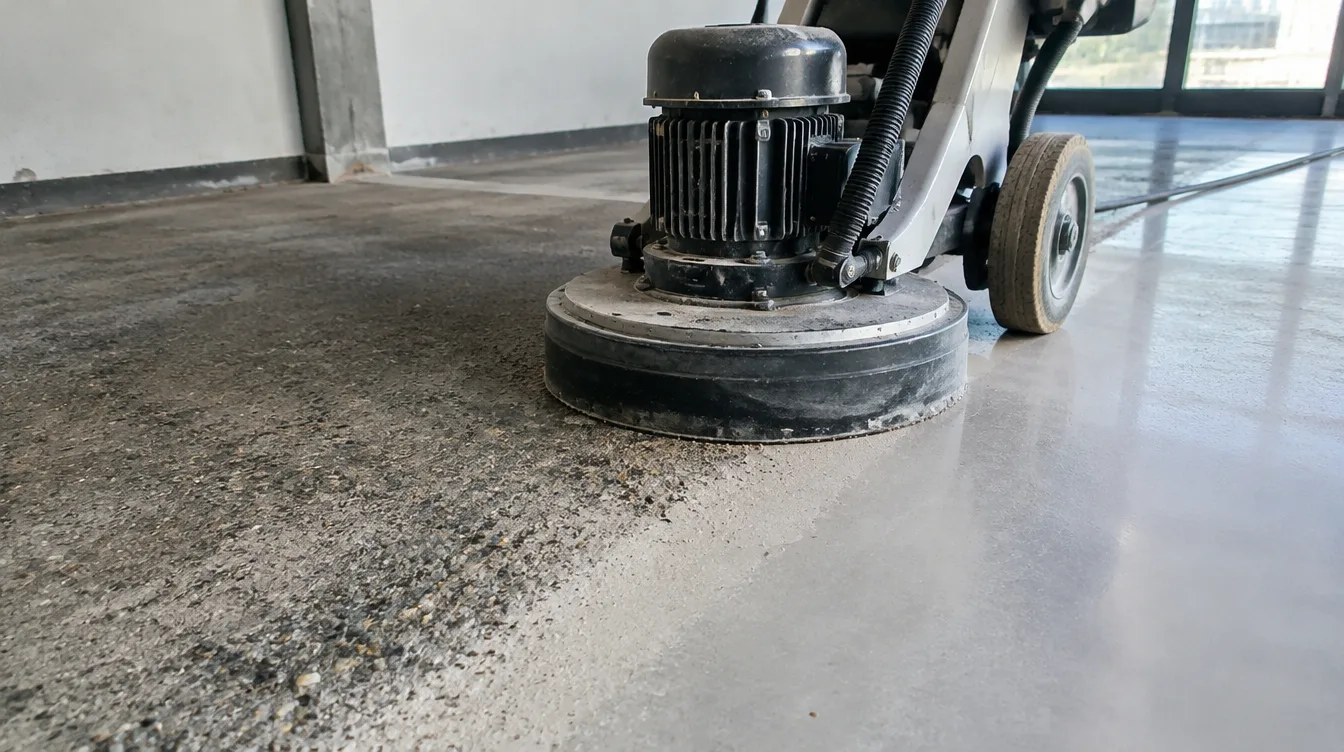
The concrete surface profile you grind or blast a slab to is chosen by the thickness of the coating going on top, not by preference: a thin coating needs a light profile, and a thicker system needs a more aggressive one. The ICRI scale runs from CSP 1, nearly flat, to CSP 9, very rough, and the coating manufacturer's data sheet states the profile each product needs. Get it wrong in either direction and the floor fails, either by peeling from a surface that is too smooth or by showing texture through a surface that is too rough. For the grinding work itself, see our concrete floor grinding page.
Quick answer: profile is chosen by coating thickness, not by preference
Profile is chosen to match the coating: the thicker the film, the deeper the texture it can bridge and the more texture it needs to grip. A thin sealer or a 10 mil epoxy needs only a light profile. A quarter inch troweled mortar needs a much rougher one.
The reasoning is simple. A coating bonds mechanically as well as chemically. It flows into the valleys of the prepared surface and cures around the peaks, so the roughness is what locks it in. If the peaks are taller than the film is thick, they poke through. If the valleys are too shallow, there is little to lock into and the bond depends on surface energy alone.
This post treats the CSP scale as a selection tool. It deliberately does not explain how grinding works as a process, which our guide to how concrete floor grinding works covers, or compare shot blasting with diamond grinding as methods, which our post on shot blasting vs diamond grinding does. The question here is narrower: which number do you need, and how do you know you have it.
What the ICRI CSP 1 to 9 scale actually describes
The ICRI scale describes the roughness of a prepared concrete surface in nine steps, defined in ICRI Guideline 310.2R. CSP stands for concrete surface profile. CSP 1 is nearly flat, similar to an acid-etched or lightly scrubbed surface. CSP 9 is very rough, the kind of texture left by heavy scabbling or milling that removes a significant depth of concrete.
The scale is not measured with a gauge in the usual sense. ICRI supplies reference coupons, molded replicas of surfaces for each CSP number. The installer compares the prepared slab to the replicas by sight and by touch, usually under raking light, and finds the one that matches. That makes the number repeatable between contractors and between a specification and the field, which is the point of a standard.
The profile is a different thing from cleanliness and from soundness. A slab can be ground to the right CSP and still be contaminated with oil, or ground to the right CSP on top of weak, laitance-covered concrete. Profile is one of three checks, alongside a clean surface and a sound one, and a floor needs all three. The governing document for slab construction itself is ACI 302.1R, which covers finishing and the hard-troweled surfaces that often need the most aggressive preparation.
Matching profile to system: thin-mil, broadcast, self-leveling and mortar
Each common system family sits in its own band of the scale, and the bands step up with film thickness. The ranges below are commonly used guidance, and the manufacturer's data sheet for the specific product controls.
Thin-mil roll-applied coatings. Primers and sealers sit at CSP 1 to 2, and thin epoxy in roughly the 10 to 20 mil range needs a light profile, commonly CSP 2 to 3. A rough profile is a problem here, because the film is too thin to bury it.
Broadcast flake and quartz systems. Systems that build to a higher film, with a base coat, broadcast aggregate and topcoats, can use a somewhat deeper profile, commonly around CSP 3 to 4, because the build covers it. Our guide to industrial epoxy floor thickness explains how total build is calculated in dry mils.
Self-leveling systems. Self-leveling epoxy and urethane, applied at roughly one sixteenth to one eighth of an inch or more, are commonly specified at CSP 3 to 5, since they are thick enough to bury it and need a firm bond over a larger area.
Troweled mortar and overlays. Systems a quarter inch thick or more move into the more aggressive range, commonly CSP 4 to 6, and cementitious toppings and bonded overlays can go higher.
The common thread is proportion. The profile should be deep enough to anchor the coating and shallow enough that the film buries it. When two products in the same family list different requirements, follow the data sheet for the one being installed.
Which equipment produces which profile: grinder, shot blaster, scarifier
The profile you need decides the machine you use, because each method has a typical range. This section stays on that mapping and leaves the method comparison to the post linked above.
Diamond grinders with coarse metal-bond or resin tooling produce the lighter end of the scale, typically CSP 1 to 3, and give a flat, clean surface with good dust control. They are the standard choice for thin and mid-build coatings on garages and commercial floors.
Shot blasters throw steel shot at the surface and recover it, and they typically produce CSP 3 to 5 depending on the shot size, the travel speed and the number of passes. They suit self-leveling and thicker systems, and they are efficient on large flat areas.
Scarifiers and scabblers cut and chip the surface and cover the aggressive end, roughly CSP 5 and above, used for removing thick coatings, leveling high spots and preparing for overlays. Our guide to concrete surface preparation for epoxy flooring covers the full preparation sequence, including cleaning and repair.
Acid etching sits at the low end of the scale, but it gives an inconsistent profile and leaves residue that has to be neutralized, which is why it is widely discouraged for coating work. A mechanical method gives a measurable, repeatable result.
Reference table: CSP number against coating type, mil build and method
| CSP range | Typical coating | Typical film build | Typical method |
| CSP 1 to 2 | Sealers, thin primers | Under 10 mils | Fine diamond grinding |
| CSP 2 to 3 | Thin-mil roll-applied epoxy | 10 to 20 mils | Diamond grinding |
| CSP 3 to 4 | Broadcast flake or quartz, high-build | 20 to 40+ mils | Coarse grinding or light shot blast |
| CSP 3 to 5 | Self-leveling epoxy or urethane | 1/16 to 1/8 inch | Shot blasting |
| CSP 4 to 6 | Troweled mortar | 1/4 inch or more | Shot blasting, scarifying |
| CSP 5 to 9 | Toppings, bonded overlays | Varies, thick | Scarifying, scabbling |
Treat the table as a planning aid, not a specification. Ranges overlap, because two manufacturers can ask for different profiles for similar films, and the data sheet decides.
Too smooth: adhesion failure and how it shows up
A profile that is too smooth fails because the coating has nothing to grip, and the failure shows up as peeling or delamination, usually first at traffic lanes, door thresholds and edges. The coating may look perfect for weeks or months and then lift in sheets.
The classic cause is a slab that was never opened up. Hard-troweled and burnished concrete has a dense, glassy surface that resists bonding, and so does concrete that was polished or heavily sealed. A previous coating that was not fully removed can have the same effect. In each case the surface looks clean, and the coating bonds weakly to it.
The fix is to re-profile and recoat, which means stripping the failed film first, so the cheapest approach is to get the profile right at the start. Our guide to concrete grinding and densification is worth reading here, because a densified, polished surface is the clearest example of a floor that needs to be re-opened before a coating will bond to it.
A pull-off adhesion test under ASTM D4541 is how a bond is measured when a specification requires proof. A coating that fails the test with a clean break at the interface points to profile or contamination, while a break inside the concrete means the slab surface itself was weak.
Too aggressive: telegraphing, extra material cost and a rough finish
A profile that is too aggressive does not usually cause adhesion failure, but it causes three other problems: telegraphing, extra material use and a rough finish. It is the less dangerous error and still an expensive one.
Telegraphing. When the profile is deeper than the coating is thick, the peaks show through. You see the texture of the grind pattern in the finished floor, and tiny high points can poke through the film as pinholes or dull spots, where the coating is too thin to cover them.
Extra material. Deeper valleys need more material to fill them. A floor profiled to a heavy CSP for a thin coating consumes more resin to reach the same smooth surface, which raises cost without improving adhesion.
A rough finish. Where the system is meant to be smooth and easy to clean, a texture that shows through makes the floor harder to clean and harder to keep sanitary. That matters most in food, medical and cleanroom spaces.
The lesson is to profile to the system, not to the maximum. More aggressive is not safer. It is a different failure, and it shows up as cost and appearance rather than peeling.
Reading a data sheet for the profile it requires
The coating manufacturer's technical data sheet is where the required profile is stated, and it is worth reading before the quote is signed. Look for three things: the CSP range the product requires, the minimum and maximum film thickness it is rated for, and any note about the substrate, such as a requirement for a sound, clean, dry slab.
Check that the profile and the film build agree. If the data sheet asks for CSP 3 to 5 but the system you are quoted builds only 12 mils, one of the two numbers is wrong, and the question to ask is which. A system quoted on a thin build over a heavy profile is the setup for telegraphing, and a thick build over a light profile is the setup for delamination.
When a quote lists only a method, such as grinding or shot blasting, and not a CSP, ask for the number. The method does not fix the profile, because the same machine produces a range depending on tooling, speed and passes, and a quote that names the target is a quote you can hold the contractor to.
Verifying profile on site before the first coat
Verify the profile before any material is mixed, because it is far cheaper to regrind than to strip a failed coating. Four checks cover it.
First, compare the prepared slab to the ICRI CSP replicas under raking light and confirm the number matches the data sheet. Second, test a patch: apply the coating to a small area and run a pull-off test under ASTM D4541 where the specification requires it. Third, check the surface is clean and absorbent. A drop of water should soak in rather than bead, which also shows the surface is not sealed or contaminated. Fourth, test for moisture under ASTM F1869 (calcium chloride) or ASTM F2170 (in-situ relative humidity), since a slab with the right profile can still fail from moisture below. Our guide to moisture testing for epoxy flooring explains the tests.
Ask the installer to state the target CSP in writing and to show how they will verify it. A contractor who says only that the slab will be ground has not told you what profile you will get, and the answer should be a number.
Frequently asked questions
What is concrete surface profile?
It is a standardized measure of surface roughness after preparation, defined by ICRI as CSP 1 through 9 with reference coupons. The number describes how much texture the coating has to key into.
What CSP does an epoxy floor need?
Thin coatings need a light profile and thicker systems need a more aggressive one, because the profile must be proportionate to the film thickness. The manufacturer's data sheet states the required CSP for each product.
What happens if concrete is ground too smooth before coating?
The coating has nothing to grip and can delaminate, often showing up first as peeling at traffic areas or edges. A polished or burnished surface is the clearest example of a profile that is too smooth.
Can a floor be profiled too aggressively?
Yes. An over-aggressive profile shows through a thin coating as visible texture and consumes more material to fill, which raises cost without improving adhesion.
Is acid etching an acceptable way to profile concrete?
It is widely discouraged for coating work because it produces an inconsistent profile and leaves residue that must be neutralized. Mechanical methods give a measurable, repeatable result.
If you are specifying a floor and want the profile confirmed before coating, call (830) 355-3303 for a free on-site measure and written quote, or review our concrete floor grinding page to see how we prepare slabs.