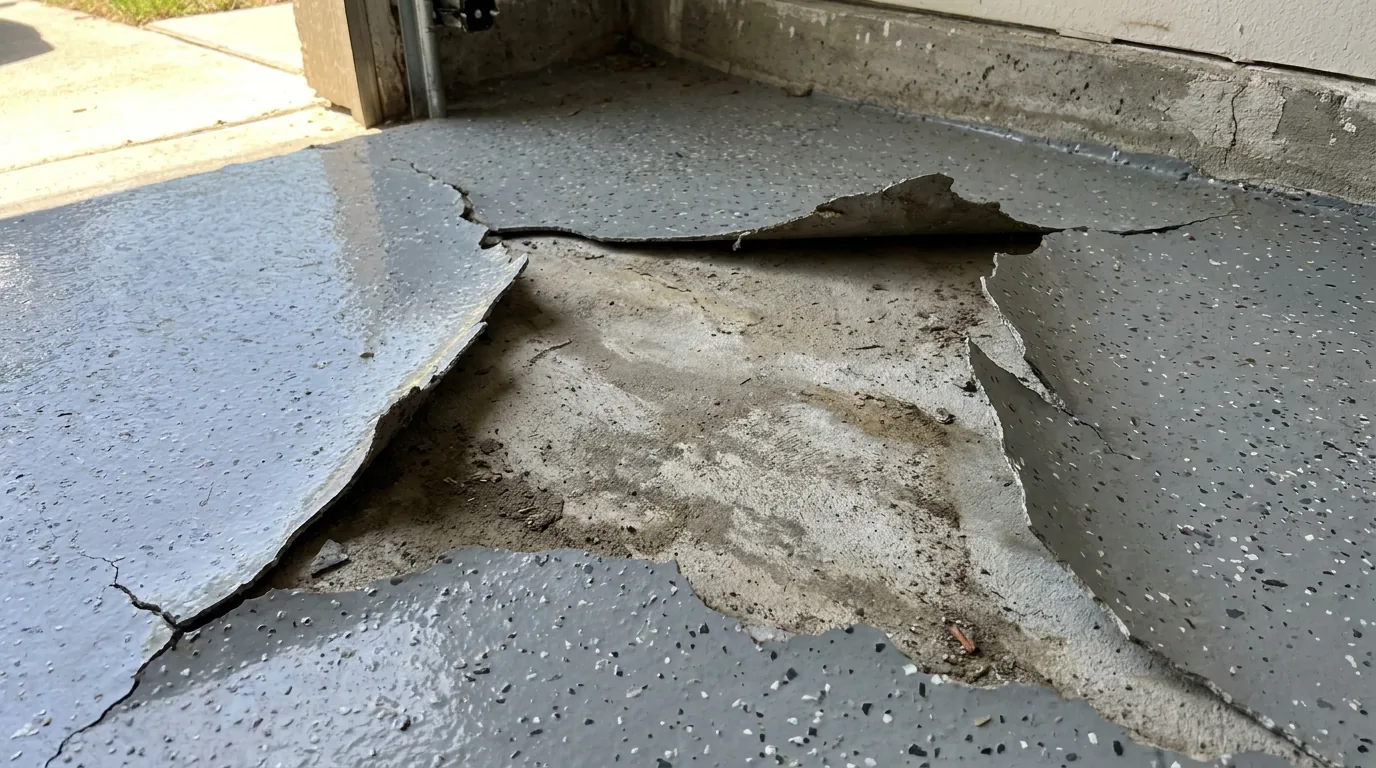
Epoxy floor peeling in San Antonio is more common than most homeowners expect - and in almost every case, it traces back to one of a small number of preventable causes. Understanding why peeling happens, and what an honest contractor will do about it, saves you from paying for repeat repairs on a floor that was never installed correctly in the first place.
This guide covers the warning signs, the root causes specific to San Antonio's climate and soil conditions, when patching works versus when you need a full recoat, and what proper professional epoxy floor repair San Antonio actually looks like.
Signs Your Epoxy Floor Is Failing
Epoxy delamination rarely happens all at once. It starts at the edges and corners, around anchor bolts or floor drains, and in areas that see repeated moisture or chemical exposure. Catching it early gives you repair options that a fully failed floor does not.
- Bubbling or blistering: Small domes in the coating surface, typically caused by moisture vapor pushing up from below.
- Edge lifting: The coating peels back from walls, thresholds, or expansion joints - often the first visible sign of delamination.
- White haze or milky patches: Moisture trapped between the coating layers, a process called blushing. Common when epoxy is applied in high humidity or when moisture mitigation was skipped.
- Hollow sound when tapped: Knock on the floor surface with your knuckle. A dull, hollow sound versus a solid thud indicates the coating has separated from the concrete beneath it.
- Peeling sheets: Large sections lifting in one piece - typically indicates the original concrete was not properly profiled before coating.
Floors installed between June and September face the highest peeling risk. Concrete surface temperatures routinely exceed 90°F in afternoon sun, which shortens pot life and can cause epoxy to cure before proper bonding occurs. A contractor who applies epoxy at 3 p.m. in July on a sun-baked garage slab is cutting corners.
Top 5 Causes of Epoxy Peeling in San Antonio
San Antonio-Specific Risk Factors
San Antonio creates conditions that push epoxy floors harder than most of the country. Caliche - the calcium carbonate hardpan found 12 to 36 inches below grade across much of Bexar County - creates a moisture trap. When rain or irrigation water hits caliche, it pools and migrates laterally, eventually creating upward vapor pressure in garage slabs and basement floors. This is why floors that appeared fine in spring begin peeling by October after the summer rain season.
Ambient temperatures during installation matter as much as concrete surface temperature. Dew point in San Antonio exceeds 60°F on most summer mornings, which can cause blush hazing if epoxy is applied before the concrete surface temperature has risen above the dew point. Contractors who test surface temperature but skip dew point measurement are missing half the equation.
Can a Peeling Epoxy Floor Be Patched?
Spot patching works only when delamination is genuinely isolated - under 10% of the total floor area, not caused by active moisture vapor, and surrounded by coating that is still tightly bonded. In those cases, a professional will grind the failed zone to clean concrete, feather the edges of the surrounding coating, apply a penetrating primer, and recoat the patch area.
The honest limitation: patches are almost always visible. Color and texture consistency between new and old epoxy is difficult to achieve, especially when the original floor has UV exposure or color shift from floor traffic. If appearance uniformity matters, a full recoat is the only real solution.
For garage floor epoxy that is peeling in more than two or three spots, patching is typically a short-term fix. The root cause - usually inadequate prep or moisture - will affect adjacent areas within 12–18 months.
When Full Removal and Recoat Is Necessary
Full mechanical removal (shot blasting or diamond grinding down to bare concrete) followed by recoating is necessary when:
- Delamination covers more than 20–30% of the total surface
- The hollow-sound test reveals extensive disbonding beneath visually intact coating
- Moisture vapor test results exceed 6 lbs per 1,000 sq ft per 24 hours (requires moisture-mitigating primer system, not standard epoxy)
- The original coating was a water-based product with known adhesion limitations
- The concrete shows structural cracking or slab movement
A full recoat done correctly - with shot blasting, moisture testing, primer selection matched to vapor rate, and 100% solids epoxy - is not a repeat of the original failure. It is a different installation process that addresses what went wrong the first time. Expect it to last 8–15 years with proper maintenance versus the 2–3 years of a bad original install.
How to Prevent Epoxy Peeling on Future Installs
The three non-negotiables for epoxy that stays bonded in San Antonio:
- Moisture vapor test before any coating: ASTM F1869 (calcium chloride) or F2170 (in-situ probe) conducted at least 48 hours ahead of application. Vapor rate determines primer selection.
- Mechanical surface prep to CSP 3: Shot blasting is the gold standard; diamond grinding is acceptable if the concrete is hard enough that the grinder tracks fully. Acid washing is not adequate for professional epoxy.
- Schedule around temperature: Target concrete surface temperature of 55–75°F, at least 5°F above dew point. In San Antonio, this means early morning installs in summer or scheduling for October through April for problematic slabs.
If you are evaluating contractors for a new install or repair, our epoxy floor coating page covers what a proper multi-coat system looks like and what questions separate a professional from a paint-and-pray operation.
Is Your Epoxy Floor Starting to Peel?
We assess the extent of delamination, test for moisture vapor, and tell you honestly whether patching or a full recoat is the right call - before you spend money on the wrong solution.
Get a Free Assessment