The #1 Reason Epoxy Floors Fail in San Antonio
If you've ever seen an epoxy floor that's bubbled, blistered, or peeled up in sheets within a year of installation, moisture is almost certainly why. It's the leading cause of epoxy delamination nationwide - and San Antonio's geology makes it a more pressing concern here than in most U.S. cities. This article explains what's happening underground, how moisture gets through concrete, and what a responsible contractor does about it before laying down a single coat.
Why San Antonio Slabs Are High-Risk
The Edwards Aquifer
San Antonio sits directly above the Edwards Aquifer recharge zone - one of the most prolific aquifers in the United States. The aquifer feeds water through the region's porous limestone geology, and that water table creates a persistent upward pressure on concrete slabs. Even on a perfectly dry summer day, slabs in large parts of Bexar County - particularly in the northern and northwestern portions over the recharge zone - are transmitting vapor at rates that would fail a standard moisture test.
Expansive Clay Soils
Much of the San Antonio metro sits on expansive clay soils (Vertic Ustolls and similar series). Clay absorbs water and expands; it releases water and contracts. This cyclical movement isn't just a foundation concern - it keeps subgrade moisture in flux. After San Antonio's seasonal rains (typically May and October), clay soils in the Southside, Southeast, and parts of the Westside hold significant moisture within a few feet of the surface. That moisture migrates upward through capillary action.
Seasonal Condensation
San Antonio's high summer humidity - dew points regularly hit 70°F+ from June through September - means that when a cool, conditioned garage slab meets warm, humid exterior air, condensation forms on and within the slab. This isn't the same as groundwater vapor, but it contributes to elevated moisture readings and can trigger adhesion failures if not accounted for in the coating specification.
How Moisture Destroys Epoxy Adhesion
Epoxy bonds to concrete through a mechanical and chemical adhesion process. The concrete surface must be open (properly profiled by grinding or shot blasting) and dry at the time of application. When moisture vapor transmits upward through the slab after the epoxy is applied, it collects at the epoxy-to-concrete interface. This trapped vapor creates osmotic pressure that literally pushes the epoxy away from the concrete from below. The result is bubbles first, then blistering, then full delamination - often in the pattern of the slab's highest-moisture zones.
This failure mode is insidious because it typically doesn't appear immediately. A floor installed in November when the slab reads dry may perform fine through winter and spring, then begin showing bubbles in August when vapor pressure peaks. By then, the homeowner assumes the contractor did something wrong - and they're right, but the error happened before the first coat went down.
The Tests We Use: ASTM F2170 and ASTM F1869
ASTM F2170 (In-Situ Relative Humidity)
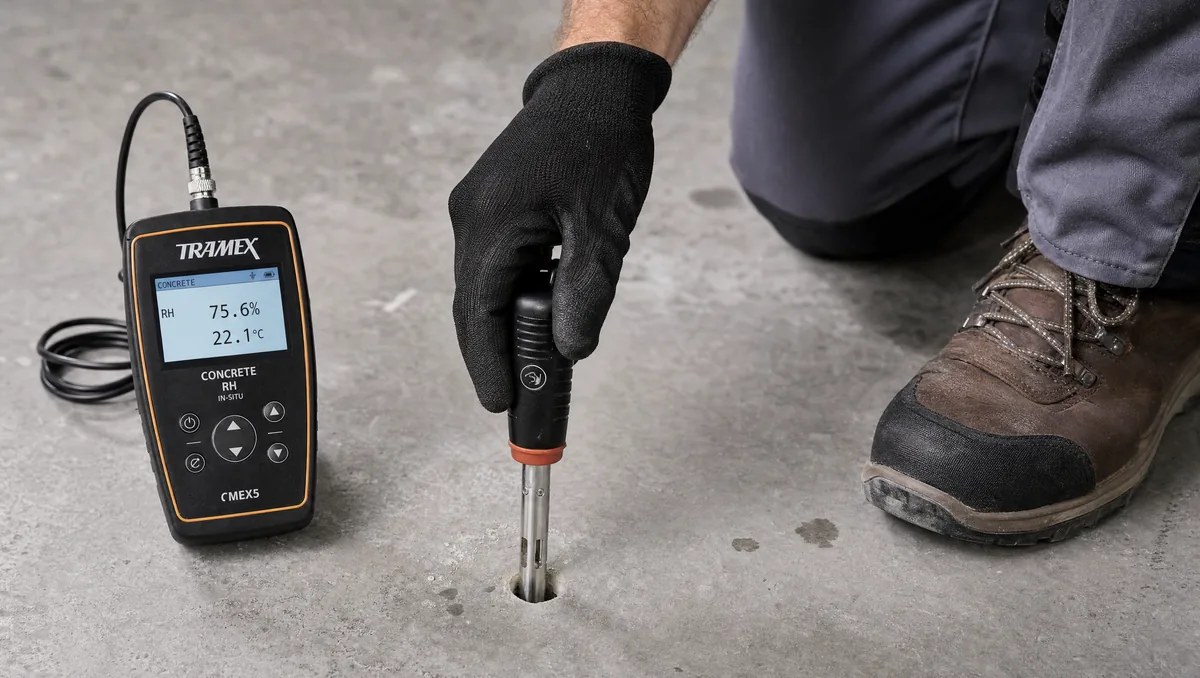
This is the current gold standard for concrete moisture testing. We drill 40% depth holes in the slab (per ASTM protocol) and install calibrated probes that measure relative humidity within the concrete itself. The reading comes from inside the slab, not just at the surface. ASTM F2170 tests must equalize for at least 24 hours before reading. The generally accepted threshold for epoxy application is 75% RH or below - above that, a moisture mitigation primer is required.
ASTM F1869 (Calcium Chloride Test)
An older method that measures moisture vapor emission rate (MVER) at the slab surface. While still in use, it has been largely superseded by F2170 for accuracy. We use calcium chloride as a secondary check when slab conditions are borderline or when we're evaluating a slab that's had previous coatings.
pH Testing
High-moisture slabs often have elevated pH at the surface due to alkaline vapor. Standard epoxy adhesion begins to weaken above pH 9 and fails rapidly above pH 11. We test pH at multiple points across the slab and include this data in our pre-install report.
What Happens When the Test Fails
A slab that tests above 75% RH doesn't mean you can't have an epoxy floor - it means the spec needs to include a moisture mitigation system. The standard approach is a moisture-tolerant epoxy primer (also called a moisture barrier primer) that's formulated to bond at higher vapor pressures. Applied at 4–6 mils, it creates a barrier between the slab's vapor and the decorative coating system above. Cost: approximately $0.75–$1.25 per square foot added to the project total.
For very high readings (above 90% RH or MVER above 10 lbs/1,000 sq ft/24 hr), more aggressive mitigation is required - typically a two-part moisture mitigation membrane system. These are more expensive but allow coating in conditions that would otherwise make epoxy impossible.
What to Ask Your Contractor
Before signing any epoxy flooring contract in San Antonio, ask these questions:
- "What moisture test method do you use, and when do you test?" (Answer should be: ASTM F2170 or F1869, performed after surface prep, minimum 24 hours before coating.)
- "What happens if the slab tests high?" (Answer should include: moisture mitigation primer, adjustment to the quote, and documentation of the test result.)
- "Do you provide test results to the customer?" (Answer should be yes - you should receive a copy of the probe readings or calcium chloride test cards.)
- "Is moisture mitigation included in your warranty?" (If the warranty excludes moisture-related delamination with no moisture test requirement, that's a red flag.)
ProEpoxy tests every slab before we quote the coating spec and again on installation day. Our written proposals include the moisture test protocol and what system we'll use if the slab tests above threshold. Call (888) 275-7078 or request a free evaluation - we'll bring the probes.
Get a Free Quote for Your San Antonio Floor
ProEpoxy installs epoxy, polyaspartic, urethane cement, and polished concrete in the San Antonio metro - using our own crews, not subcontractors. We test every slab before we quote and back our work with a written warranty.
Request Free Estimate →