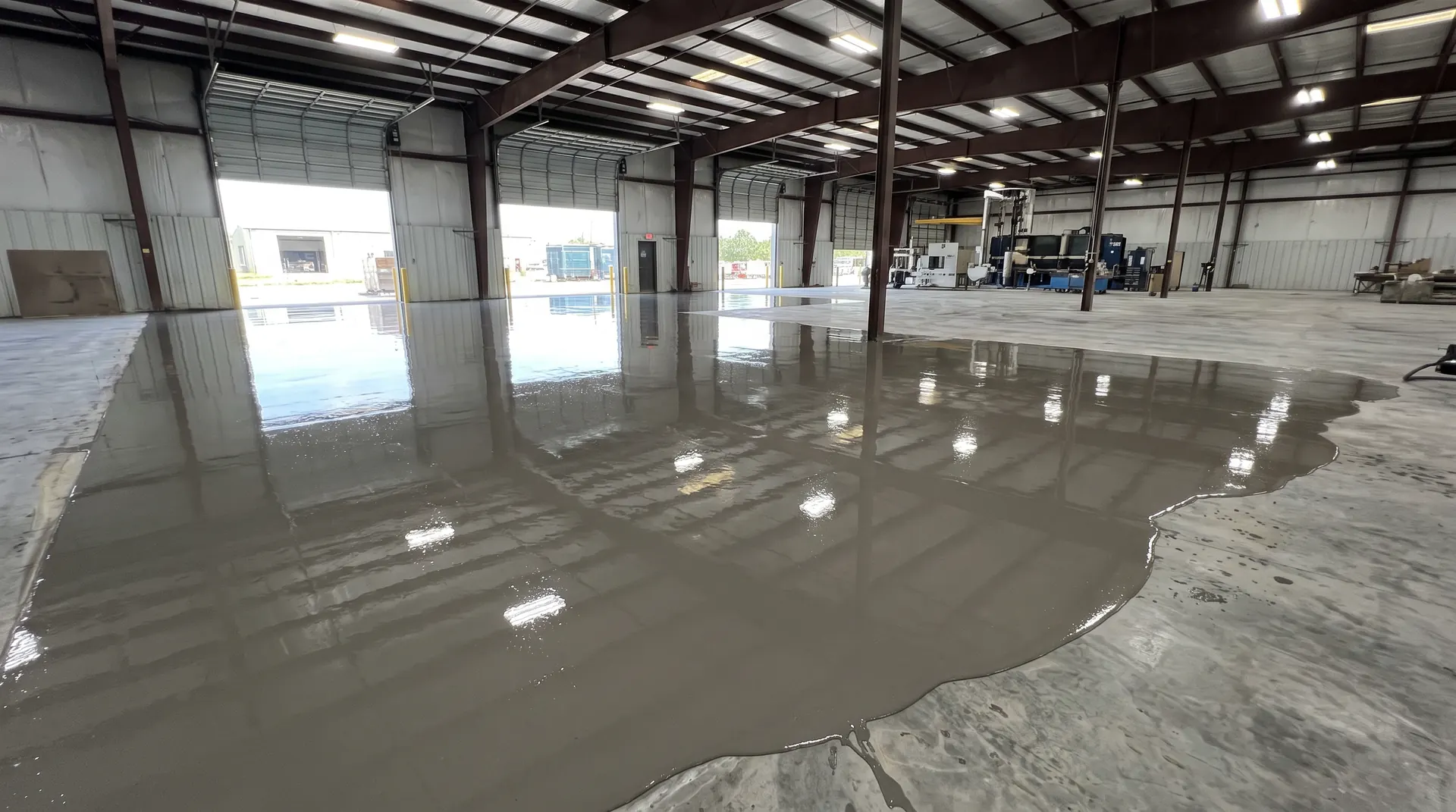
Not every concrete slab is flat enough for epoxy straight out of the gate. Low spots, birdbaths, and uneven pours are common in older San Antonio slabs and even some newer construction, and skipping the leveling step means the coating just follows the existing dips and high spots - including the puddles that form in low areas after every cleaning. Here's when self-leveling underlayment is actually required and what the process involves.
What Self-Leveling Underlayment Does
Self-leveling compound is a cement-based or polymer-modified material poured onto the prepped slab, where it flows and settles into a flat, level plane before curing. It's applied after mechanical surface prep (grinding or shot blasting) and before the coating system goes down, correcting elevation problems the base slab has that no amount of coating thickness will fix on its own.
Signs Your Floor Needs Self-Leveling Before Epoxy
- Standing water after cleaning: If water pools in specific spots after a mop or hose-down instead of draining evenly, those are low spots that need correction.
- Visible dips or birdbaths: Low areas that catch water are easy to spot by eye, especially right after a rain or wash-down.
- Uneven wear patterns on old flooring: If a previous coating or sealant shows more wear in certain areas, that's often a sign of an uneven substrate underneath.
- A straightedge test reveals gaps: Laying a long straightedge across the slab and checking for light gaps underneath is the standard way to confirm flatness before committing to a coating plan.
When Self-Leveler Is Required vs Optional
| Condition | Self-Leveler Needed? |
|---|---|
| Minor surface texture variation | No - standard coating handles this |
| Low spots deeper than 1/8" over a few feet | Yes - required for proper coating performance |
| Standing water after cleaning | Yes - indicates a drainage-affecting low spot |
| Old expansion joints or patched cracks | Often - depends on depth and location |
| New, properly poured and finished slab | Usually not - but worth checking |
Not Sure If Your Slab Needs Leveling?
We assess your floor's flatness with a straightedge test before quoting, so you know exactly what prep work is actually required.
Get a Free AssessmentThe Self-Leveling Process
- Surface prep: The slab is mechanically ground or shot blasted to remove contaminants and open the pore structure for bonding - self-leveler needs the same prep as any coating.
- Primer application: A primer coat improves adhesion between the concrete and the leveling compound.
- Mixing and pouring: Self-leveling compound is mixed to a specific consistency and poured across the low areas or the full floor, depending on the extent of the unevenness.
- Spreading and settling: The material is spread with a gauge rake and allowed to self-level and flow into a flat plane before it begins to set.
- Cure time: Most self-leveling compounds are ready for coating application within 24-48 hours, depending on thickness and product.
What Happens If You Skip This Step
Coating directly over an uneven slab doesn't fix the underlying problem - it just adds a glossy layer on top of the same dips and high spots. Low areas will still collect water and debris, and uneven coating thickness across high and low spots can lead to inconsistent wear and premature failure in the thin-coated high points.