Home About Us
Services
Epoxy Floor Coating Garage Epoxy Commercial & Industrial Concrete Polishing Epoxy Repair Metallic Epoxy Basement Epoxy Parking Garage Epoxy Restaurant & Kitchen Warehouse Flooring Concrete Floor Grinding
Floor Coatings
Polyaspartic Coating Polyurea Coating Urethane Cement ESD Anti-Static Epoxy Epoxy Flake System Get a Free Quote

Epoxy Floor Repair
& Resurfacing in San Antonio

Peeling, cracking, chipping, or bubbling? Our crew diagnoses and repairs failing epoxy floors across San Antonio and the surrounding metro - restoring performance and appearance without a full replacement. Free on-site assessment included.

Why Epoxy Floors Fail - and What We Do About It

A lasting epoxy repair in San Antonio starts with a diagnosis, not a bucket of patch material. When a floor does let go, it almost always traces back to one of three things: prep that was skipped, moisture driving up through the slab, or a coating that was never right for the room it went in.

Our repair crew won't just skim over the symptom. We chase down why the floor failed first, so you're not paying us again in six months for the same spot. Every job opens with a real assessment: adhesion pulls, moisture readings, coating thickness, and pinning down the exact failure mode. Only then do we write a scope that actually solves it.

We fix floors installed by us. We take on plenty of other people's floors, too - box-store DIY kits and rushed installs from crews that skipped the grinding. Our team has brought back floors in warehouses, garages, kitchens, service bays, and shops all over the San Antonio metro.
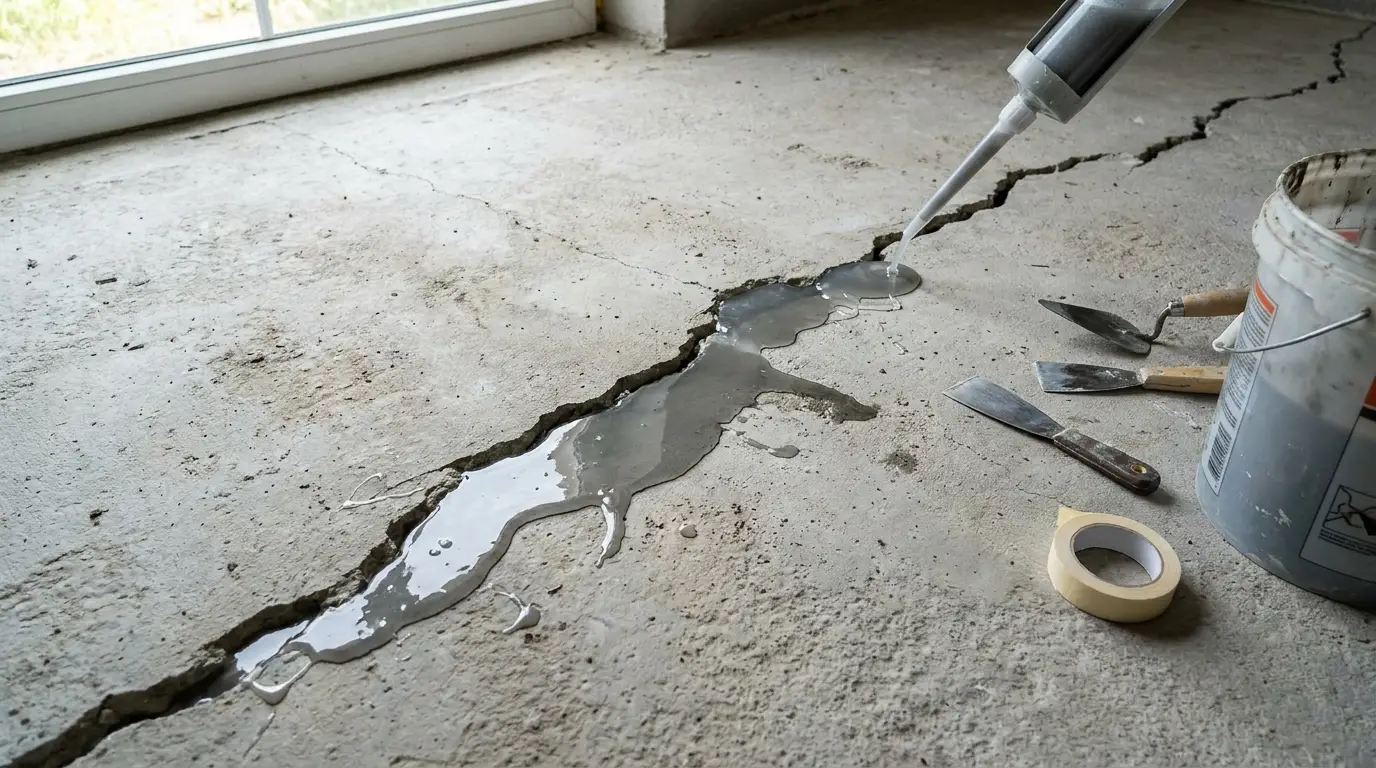
Epoxy floor crack repair with filler compound on concrete

The Repairs We Handle

A failing epoxy floor rarely needs to be ripped out. Plenty of failing floors can be brought back to full strength and looks with targeted repair - often for a third to half the price of tearing it out and starting over. Here are the specific repair services our crew provides:

Peeling and Delamination Repair

Delamination - the coating letting go of the concrete beneath it - is the failure we're called out for most. It nearly always comes down to weak prep (the coating stuck like tape instead of bonding into the pores) or moisture vapor pushing up from underneath. We cut out the loose sections, fix what caused it - a vapor barrier, a bonding primer, more aggressive grinding - and lay fresh epoxy onto concrete that's actually ready for it. On solid colors we can usually blend it so you'd never spot the repair.

Crack Filling and Joint Repair

Concrete never sits still - it swells in Texas heat, shrinks when it cools, and settles over the years. Once a crack telegraphs up through the coating, moisture gets in, the bond loosens, and the failure spreads outward. We fill with a flexible crack resin that flexes with the slab instead of fighting it. Where control or expansion joints were botched or ignored on the first install, we route them out, treat them the right way, and rebuild the coating across them.

Chip and Impact Damage Repair

A dropped die, a forklift fork, or a pallet corner can knock a chip clean through to the slab. Leave those and they wick in moisture and turn into trip hazards. We grind the spot to clean concrete, rebuild any lost substrate with filler, and bring the system back to full thickness, feathering the edge so it disappears into the floor.

Epoxy Resurfacing and Recoating

Some floors aren't broken, just tired - gone dull, lost their grip, scratched up, or faded. If what's down there is still well bonded, we can resurface right over it. That means a light scarify to open a bond profile, then a fresh broadcast, color coat, and UV-stable topcoat. You get a floor that looks new again with its protection restored - usually in a single day.

Fixing Poor Contractor Work

We get the after-the-fact calls all the time - a contractor's or a homeowner's install that didn't hold. The usual suspects: bubbling from solvent coats laid too thick, fisheyes from a dirty slab, streaky color from bad mix ratios, and quick wear from a skimpy topcoat. We've got a repeatable way to diagnose and correct these, and most times we can save the floor without stripping it to bare concrete.

Concrete Substrate Repair

Often it's not the epoxy at fault - it's the slab beneath it. Spalled, crumbly, or deeply cracked concrete has to be rebuilt before any coating will grab. Patching, leveling, and densifying the substrate are part of our repair scope - we make the concrete sound first, then coat.

Signs Your Epoxy Floor Needs Professional Repair

Floor problems rarely wait; they get bigger and pricier the longer you sit on them. If you're seeing any of the following, call us for a free assessment:

  • Bubbles, blisters, or raised sections in the coating
  • Peeling, flaking, or sections that lift when pulled
  • Visible cracks - especially ones that have grown over time
  • Yellowing, chalking, or significant color fading
  • Loss of anti-slip texture (a safety issue)
  • Pooling water or areas that won't dry - indicating delamination
  • Sections that sound hollow when tapped
  • Chemical stains or burns that have penetrated the topcoat

Repair vs. Replace: Which One Actually Pays Off?

It's the single biggest question we settle on the free site visit. Targeted repair usually saves real money - but only when the existing system still has enough left to bond to, and the damage is in pockets rather than everywhere.

A full tear-out is the honest call when delamination is past 40–50% of the floor, the slab itself is structurally shot, the old coating won't play with the new one, or the floor's 15-plus years old and failing all over.

Repair buys you more years out of what's already there. Replacement resets the clock on a properly built floor. Our assessment tells you straight which one your floor is worth.

Our Epoxy Repair Process

We run the same disciplined sequence on every repair, big or small. That's how we know we're solving the problem instead of hiding it.

  • Step 1 - On-site assessment: We walk the floor, pull adhesion samples, read the moisture, and name the failure mode. You get the scope in writing before we lift a grinder.
  • Step 2 - Remove failing sections: Anything loose, bubbled, or compromised comes off - ground back to solid concrete. We never bury bad adhesion under a patch.
  • Step 3 - Address root cause: Moisture, substrate damage, and contamination all get handled here - before a drop of coating goes down.
  • Step 4 - Substrate repair: Cracks, chips, spalls, and low spots are filled and brought flush with epoxy mortar.
  • Step 5 - New epoxy system: The right primer, base, and topcoat go down in the correct order. We hold every cure window between coats - no rushing it.
  • Step 6 - Quality inspection and handoff: We run a 12-point check, walk the finished repair with you, and hand over documentation of what we did.

Epoxy Repair Costs in San Antonio

What a repair costs depends on the failure, how much floor it touches, and how much prep it takes to fix right. Rough guide: spot crack and chip work usually runs $8–$15 a square foot; resurfacing a sound existing coating tends to land at $6–$12; and localized delamination swings on how much has to come off and how bad the substrate is underneath.

You get a free written quote once we've seen the floor. No surprise line items - we document exactly what we're doing and why - so you can make an informed decision about repair vs. replacement.

Repair Types

Every type of epoxy floor problem, solved.

Our crew covers the whole range of epoxy failures, from a scuffed topcoat to a floor that's letting go everywhere.

🔧

Delamination & Peeling

Loose sections cut out, moisture checked, a real bond primer laid, and a full recoat blended to your existing finish.

⚡

Crack Filling

A flexible filler that flexes with the slab instead of cracking again. Edges feathered back until the repair vanishes into the floor.

🛡️

Impact & Chip Repair

Ground to clean concrete, substrate rebuilt with filler, then recoated to full thickness and color-matched.

✨

Resurfacing & Recoating

A light scarify, fresh color and broadcast, and a UV topcoat over the still-sound coating below. Floor looks new in one day.

🔍

Contractor Repair

We diagnose and correct other crews' and DIY failures - bubbling, fisheyes, weak adhesion, wrong products for the room.

🏗️

Concrete Substrate Repair

Spalls, deep cracks, and low spots rebuilt before any new epoxy goes down. We never coat concrete that isn't ready.

Our Process

Diagnosis first, then the fix.

Step 01

Free On-Site Assessment

We pull adhesion, gauge moisture-vapor transmission, and name the root cause before a tool touches the floor.

Step 02

Removal of Failed Sections

Everything loose or compromised gets ground to solid concrete. No patching over bad adhesion.

Step 03

Root Cause Treatment

Vapor barriers, contamination cleanup, or densifying the slab - we treat the cause, not the symptom.

Step 04

Substrate & Crack Repair

Cracks, chips, spalls, and dips filled and brought flush with epoxy mortar.

Step 05

New Epoxy System & Handoff

Primer, base, and topcoat laid in the right order, cured between passes. A 12-point check and written sign-off at handoff.

FAQ

Repair questions we get a lot.

Will you fix a floor another company installed?
Yes - fixing other crews' and DIYers' failed floors is a big part of what we do. We grade the existing system and decide whether we can build on it or it has to go. More often than not, we save the floor without a full replacement.
Repair or replace - how do I tell?
That's exactly what the free assessment settles. As a rule, if delamination is under 40–50% and the slab is solid, repair is the better buy. If it's failing everywhere or the cause (say, chronic moisture) can't be fixed affordably, replacement wins out. Either way you'll get a straight recommendation.
Why is my epoxy floor peeling?
Peeling comes down to two culprits nearly every time: prep that didn't open the concrete (so the coating stuck like tape), or moisture vapor lifting it from below. Box-store kits and cut-rate installs that skip diamond grinding are the worst offenders. We fix the cause before any new coating goes near the floor.
How long will the repair take?
Most spot repairs - cracks, chips, small delaminated areas - wrap in a day. A full resurface usually runs one to two days. Bigger commercial jobs with real substrate work can take two to four. Your written quote spells out the timeline.
Will the patched area blend in?
On solid-color floors we can usually get a very close blend. With flake or metallic floors, matching is trickier - sometimes resurfacing the whole floor beats leaving a visible patch. We'll be straight about what's realistic before we start.

Epoxy Floor Repair San Antonio: Finding the Real Cause Before We Fix a Thing

Epoxy floor repair might be the most botched service in the whole flooring trade around San Antonio. Skim a patch over a wet slab, fill a crack that's still moving, or grind out a delaminated patch without asking why it lifted - and every one of those band-aids peels within months and costs the owner more down the road. Our repair team has diagnosed and corrected hundreds of failed floors across San Antonio, Leon Valley, Live Oak, and Universal City - plenty of them our competitors' installs. We lead with diagnosis, not a trowel.

Reading the Failure: Delamination, Cracks, and Moisture

Before any product touches the concrete, our techs run a methodical assessment. A chain drag and sounding hammer let us map the hollow zones where the coating has quietly let go of the slab. We run ASTM F2170 in-situ RH probes and F1869 calcium-chloride tests to put an actual number on the slab's moisture-vapor transmission. Anything over 3 lbs per 1,000 sq ft per 24 hours - or RH north of 75% - and a standard epoxy will lift again no matter how clean the prep. We sort cracks by width, depth, and whether they're dormant or still working with the seasons.

Matching the Repair to the Actual Failure

  • Crack injection: Dormant cracks up to a quarter inch get routed, vacuumed, and filled with semi-rigid polyurethane or rigid epoxy, depending on whether we expect more movement. That leaves a structural, flush repair you can't feel underfoot.
  • Surface overlay repair: Spalled or pitted zones get scarified, primed with a moisture-tolerant epoxy, and rebuilt with polymer-modified cementitious or 100%-solids epoxy mortar. That mortar cures past 6,000 psi.
  • Moisture mitigation system: Wet slabs get a two-part vapor-barrier primer rated to hold back up to 25 lbs/1,000 sq ft/24 hours before anything else goes down. Skip that on a wet slab and the repair is dead on arrival.
  • Partial vs. full resurfacing: Once delamination passes about 30% of the floor, resurfacing the whole thing usually beats chasing patches. We lay the options out side by side so you can decide with the full picture.

What Wrecks Floors in San Antonio Buildings

San Antonio's mix of buildings throws its own curveballs at repair crews. Older industrial buildings around the near East Side, the rail yards, and the Southtown fringe often sit on 40-to-60-year-old slabs full of carbonation, rusting rebar, and settlement cracks. The rare San Antonio slab-on-grade and pier-and-beam homes from the 1950s–70s frequently have no vapor barrier under the concrete, which quietly wrecks standard coatings. New builds, oddly, land on our repair list early - they get coated before the slab finishes releasing moisture (which can run 24 months after the pour), and the bond fails.

When to Repair vs. Replace - and Our Warranty Commitment

Our diagnostic gives you one clear answer: repair, resurface, or replace. In most cases - even ugly ones - repair and resurfacing is structurally solid and a fraction of the cost of ripping out the slab. We back every repair with a written 3-to-5-year workmanship warranty and keep the pre-repair moisture data on file so any claim gets settled fairly. We won't coat a substrate we can't stand behind - if the slab is past saving, we'll say so and show you why. Call (888) 275-7078 to book a diagnostic assessment anywhere in San Antonio and the surrounding metro.

Free On-Site Assessment

Let our crew assess
your floor for free.

We'll pin down the problem, name the root cause, and hand you a written repair-vs-replacement call - replacement recommendation - at no cost, no obligation.