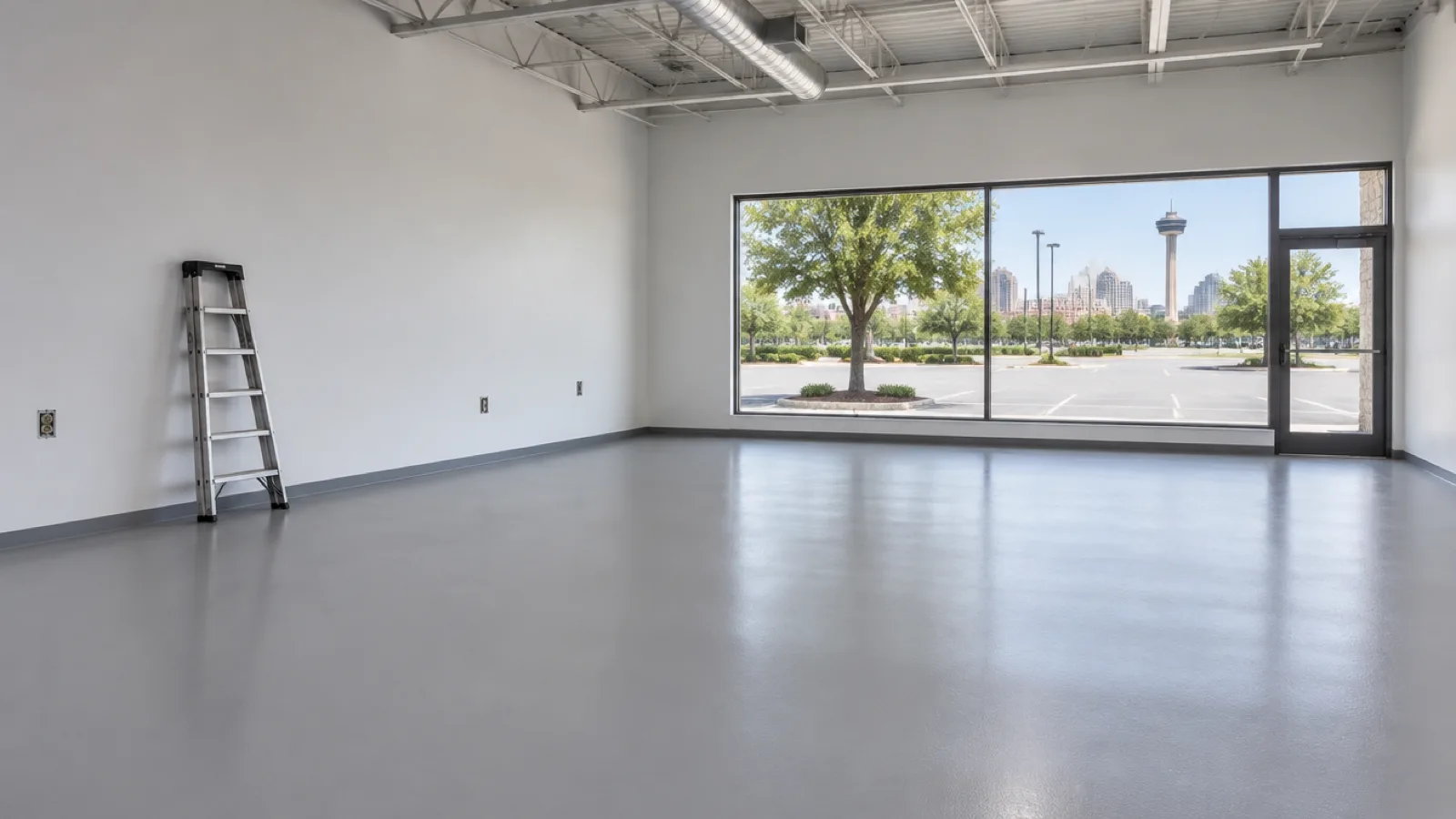
Who pays for a commercial floor coating depends on the lease, and whether the work fits depends on the schedule the lease leaves you. A tenant improvement (TI) allowance may cover some or all of a floor, a landlord may treat it as a tenant upgrade, and a restoration clause may decide what happens to it at exit. If you are comparing commercial epoxy flooring in San Antonio for a suite you are building out or handing back, read the lease first, get the landlord's approval in writing, and choose a system that fits the days you actually have.
A floor in a leased suite has two clocks running on it. The first is the construction or move-out calendar, which is usually short and fixed by a lease date. The second is the lease term itself, which decides whether a bonded coating is an asset you enjoy for years or something you may be asked to deal with on the way out.
We already cover the basics of coatings in our epoxy floor coating guide for San Antonio business owners, and the overnight retail install in our post on polyaspartic floor coating for San Antonio retail stores. This guide covers the part those do not: the lease cycle. That means who funds the floor, what a landlord will approve, what restoration language to look for, how to fit a coating into a turnover window, and how to document the result.
One boundary up front. We install floors; we do not write or interpret leases. Lease terms vary widely, and nothing here states what your lease, Texas law or any building code requires of you or your landlord. Where a point depends on a document, we say so and name who to ask.
Quick answer: who pays for the floor and when the work fits
The party that pays for a leased-suite floor is set by the lease, and the work fits when the product's cure schedule fits inside the days the turnover leaves you. Neither answer can be assumed from how other buildings handle it.
Three questions settle most of it:
- Is the floor base building or tenant work? Landlords commonly define a standard finish for a space. Anything above it is usually described as the tenant's upgrade, but the definition lives in your lease or its attached work description.
- Is there an allowance, and what does it cover? If the lease includes a TI allowance, it states what the money may be spent on, how it is released and by when.
- What does the lease say about the floor at exit? A restoration clause, if present, may ask for the suite to be returned in a stated condition.
On timing, the honest answer is that a coating system is chosen backward from the calendar. Work out how many days the floor can be out of service, then ask the installer which systems and which slab conditions fit inside that. The sections below walk through each piece.
Tenant improvement allowances and what a landlord will approve
A TI allowance is money a landlord may contribute toward building out a space, and whether a floor coating qualifies depends on the lease language and the landlord's approval of the scope. Do not assume a coating is covered because a floor was mentioned in a meeting.
Because every lease is negotiated, the useful move is to ask specific questions before you commit to a system:
- Is flooring an eligible expense? Some allowances list eligible categories. Ask whether a floor coating falls inside them.
- Who approves the contractor and the scope? Many landlords want to see the installer's insurance, the product data sheet and a written scope before work starts. Ask what your building requires.
- How is the allowance paid out? Some are paid against invoices after completion, others in stages. That affects whether you carry the cost for a while.
- Are there deadlines? An allowance may need to be used within a stated period. Ask what the date is and what happens if the floor finishes after it.
- What paperwork closes it out? Expect to be asked for final invoices, and possibly for lien waivers or similar documents. Your landlord or attorney will tell you which.
For the installer's side, we supply product data sheets and a written, itemized scope on a site visit, and we keep repair work separate from coating work in the proposal so the landlord can see what each line is. If the landlord needs a specific format or a certificate, tell us early.
Approval is a separate hurdle from funding. A landlord can agree to pay and still reject a finish, or reject a finish and still pay for part of another. Get the approval of the system, the color and the contractor in writing, so the floor is not in dispute when the work is done.
Base building standard against tenant upgrade
A base building standard floor is whatever the landlord defines as the normal finish for the space, and a tenant upgrade is anything the tenant adds beyond it. The line between them is drawn by the lease, not by the floor.
In a typical suite the starting point is often a bare slab, a sealed slab, or a floor covering the landlord already installed. A coating changes that starting point. That change can matter in two directions:
- It may be welcome. A durable, cleanable floor can make a space easier for a landlord to re-let, and some landlords will contribute toward it for that reason.
- It may be a complication. A coating bonded to the slab is hard to remove without grinding. A landlord who prefers a bare or neutral slab for the next tenant may want it kept off, or want it understood who deals with it later.
Ask the landlord to state, in the approval, whether the coating is being treated as a tenant upgrade, and who is responsible for it at the end of the term. It is a short sentence that avoids a long argument.
The slab itself also deserves a look before anyone prices a coating. Old adhesive, a prior sealer or paint, moisture and cracks all affect the system and the schedule. We cover that in our post on installing epoxy over tile, paint or an old coating, and a measured site visit is how those conditions get found before they become a change order.
Restoration clauses: what you may have to undo at exit
A restoration clause is lease language that may require a tenant to return the space to a stated condition at the end of the term, and it is the single most important thing to read before bonding a coating to a leased slab. Not every lease has one, and the wording differs from lease to lease.
Read for these specifics, and ask your landlord or attorney if the wording is not clear:
- What is the stated condition? Original condition, base building condition, broom clean, or something else.
- Are alterations addressed? Some leases say which tenant alterations may stay and which must be removed, and some leave it to the landlord to decide at the end.
- Is consent required for alterations? Many leases require the landlord's written consent before work, and the consent letter is the place to record what happens to the floor later.
- Who does the work and who pays? If removal is ever required, the lease determines who arranges and funds it.
For the floor, this is a practical question. A bonded coating is a surface layer on the slab. Removing it generally means mechanical grinding, which is the same prep step used before installing a coating, covered in our guide to concrete floor grinding in San Antonio. We do not quote a removal cost without seeing the floor, and we do not publish one.
That means a restoration obligation does not automatically rule a coating out. It means the decision should be made with the clause in front of you, the approval letter on file, and a rough idea of what removal would involve. For some tenants the floor is worth it for the years of use. For others, with a short term and a strict clause, a lower-commitment option makes more sense.
We cannot tell you what your lease requires. Restoration, alterations and allowance terms are written into each lease and differ between buildings. Read your lease, ask the landlord or property manager in writing, and have an attorney review anything that is unclear. Do not rely on a flooring contractor's general article for a contractual question.
Fitting a floor into a turnover window
A turnover window is the period between one occupant leaving and the next taking possession, and a floor fits inside it when prep, application and cure are planned backward from the handover date. The length of the window is set by your lease or construction schedule; for illustration, we use a 10 day window below.
A 10 day window is a hypothetical example, not a promise of what any floor needs. The order of work is what matters:
- Before the window. Measure the suite, test the slab, agree the scope, confirm landlord approval and order material. Everything you can settle before day one is a day you do not spend waiting.
- Early in the window. Clear the space and finish demolition or removal of old flooring, adhesive or coatings. Other trades that create dust or drop material should finish before coating, not after.
- Prep. Diamond grinding, crack and joint repair, and cleaning. This is the step that sets adhesion, and it should not be squeezed.
- Coating. Primer, body coat, any broadcast, and topcoat, each following the data sheet's recoat window.
- Cure and protection. Light traffic, then heavier traffic, as the data sheet allows, with the floor protected from the trades that follow.
- Handover. Walk the floor, photograph it, and record the product and finish.
Two things most often break a turnover schedule. The first is the slab: moisture, contamination or old adhesive discovered during prep. Moisture is measured with methods such as ASTM F1869 (calcium chloride) and ASTM F2170 (in-situ relative humidity), and we explain why it matters in our guide to moisture testing for epoxy floors. The second is trade overlap: a floor that is cured but then scuffed by the next contractor's equipment loses the days it was meant to save.
For a larger suite, or one that cannot be fully out of service, phasing the work zone by zone changes the calendar. Our post on scheduling warehouse floor installs around downtime explains the zone approach, and the same logic applies to any occupied space. We do not repeat it here.
Fast-cure systems and the premium they command
Fast-cure systems such as polyaspartic coatings return a floor to service sooner than a conventional epoxy build, and that speed is what a short turnover is paying for. Our cure-time guide describes full commercial traffic in about a day for polyaspartic against several days to a week for standard epoxy, but the figures that apply to your job come from the product data sheet and your installer.
Read that comparison with care, for three reasons:
- Cure time is not the whole schedule. Prep, repair and moisture issues come before coating and are the same regardless of chemistry.
- Temperature and humidity matter. Data sheets give working ranges, and conditions on the day can move times.
- Size matters. A fast-cure system on a large floor can still take several working days because of the area to prep and coat.
On cost, a fast-cure system generally carries a higher material price than conventional epoxy. We do not publish prices, so we will not put a number on that here. What we can say is that the right comparison is the whole project: the premium against the cost of the days a suite sits unfinished. If a late floor means a late opening or a late handover, a conventional system that needs more days may cost more overall than the faster one, and if the window is generous the reverse can be true.
Our polyaspartic floor coating page describes the system, and our comparison of polyaspartic against epoxy cure time for commercial spaces goes deeper on the chemistry. The quote comparison also deserves a close read: a quote that looks cheaper may use a different system or a lighter prep, which our post on why epoxy floor quotes vary in San Antonio explains.
Decision table: lease length against system and who funds it
The table below is a discussion aid that pairs the remaining lease term with a sensible starting question about system choice and funding. It is not a rule, and each row depends on your lease and the landlord's answers.
| Remaining lease term | Starting question on the system | Who may fund it | Main thing to confirm |
|---|---|---|---|
| Under 2 years | Is a bonded coating worth it, or is a lower-commitment finish enough? | Often the tenant, unless the landlord agrees otherwise | The restoration clause, and what removal would involve |
| 2 to 5 years | Does a durable system pay back inside the term, given the schedule? | Tenant, or shared if an allowance applies | Allowance eligibility and the landlord's written approval |
| 5 to 10 years | Which system suits the traffic and the calendar for the longer term? | Often part of the build-out budget, possibly with an allowance | Whether the floor counts as base building or tenant upgrade |
| New lease, suite being built out | Can the coating be specified before the schedule is fixed? | Depends on the allowance and the work description in the lease | Schedule, data sheet cure times and trade sequence |
| Move-out, handing the suite back | Is the goal a clean slab, a repair, or a finished floor for the next occupant? | Often the departing tenant, per the lease | Required condition at exit and who inspects it |
The columns use plain questions because the answers differ. Treat the first column as a prompt for a conversation with your landlord, not a schedule of obligations. An attorney reviewing the lease can tell you what actually applies.
If the floor will be a surface you keep for years, system choice shifts toward durability and maintenance, which we cover in our guide to what epoxy floor warranties cover. Ask for the warranty in writing and read its exclusions, because a warranty is only as useful as its terms.
Documenting the floor for the condition report
Document a floor with dated photographs, the product and system names, and the data sheets, so that anyone reviewing the suite later can see what was installed and in what condition. A condition report is only as useful as the record behind it.
For a tenant who is entering a suite, the record protects you if the floor's condition is questioned at exit. For a tenant leaving, it shows what you found and what you left. A useful file includes:
- Before photos. The slab or existing floor before any work, including cracks, stains and prior repairs, with the date visible in the file.
- The written scope. What was prepared, repaired and coated, itemized by step.
- Product data sheets and the system name. This tells a later reader what it is and how to maintain it.
- The landlord's approval. The written consent for the alteration and any note on its treatment at exit.
- Handover photos. The finished floor, taken in good light, with a note of the date and any known marks.
- Maintenance instructions. Approved cleaners, and what to avoid, from the product data sheet.
- The warranty paperwork. Keep the signed copy with the lease file.
Store these with the lease, not on one person's phone. When a manager changes or a lease is renewed, a floor with a clean paper trail is a smaller conversation than one nobody can document.
The surface preparation that underlies all of this is worth understanding too. A coating bonds to a profile prepared on the slab, and ICRI 310.2R describes concrete surface profiles (CSP 1 to 9); adhesion is commonly checked with a pull-off test such as ASTM D4541, and slip resistance is expressed with methods such as ANSI A326.3. Which of these apply to a job is for the specifier, the data sheet and the installer to decide. Our post on matching concrete surface profile to a coating explains the profile idea in plain terms.
Putting a lease-cycle floor plan together
A workable plan reads the lease first, gets the landlord's approval in writing, tests the slab, chooses a system backward from the calendar, and keeps a record. Doing those in order is cheaper than finding out at the end that one was skipped.
- Read the lease for allowance, alteration and restoration language, and ask the landlord or an attorney about anything unclear.
- Ask the landlord which finishes, contractors and paperwork they approve.
- Book a site visit so the slab is measured and tested before the schedule is set.
- Choose the system from the number of days available and the data sheet, not from a headline cure time.
- Sequence the trades so the floor is protected after it cures.
- File the photos, scope, data sheets, approval and warranty with the lease.
If you want us to look at a suite, call (830) 355-3303 for a free on-site measure and written quote. Bring the lease dates and the approval requirements, and we will work from the calendar you actually have. Our commercial epoxy flooring service page has more on how we scope and schedule commercial work.
Frequently asked questions
Does the landlord or tenant pay for a new floor?
It depends on the lease. Some leases include a tenant improvement allowance that may cover part of a floor, and anything the landlord treats as an upgrade may fall to the tenant. Read the allowance and alteration language, then ask the landlord or an attorney to confirm in writing before you order work.
Can an epoxy floor be installed during a lease turnover?
Often yes, if the schedule fits the system. Fast-cure systems such as polyaspartic return a floor to service sooner than conventional epoxy, but prep, repairs and moisture results come first. Ask the installer to build the schedule backward from your handover date and to cite the product data sheet's cure times.
Will I have to remove the floor when the lease ends?
That depends on the lease. Some include restoration or alteration language that says what must be returned to a stated condition at exit, and a bonded coating can be a factor. Read the clause, get the landlord's consent to the coating in writing, and ask an attorney if the wording is unclear.
Does a coated floor count as a leasehold improvement?
We cannot say, because that classification comes from the lease, the landlord and your accountant, not from the floor. It can affect who funds the work, how it is treated at the end of the term and how it is recorded. Ask the landlord and your accountant or attorney before work starts.
How fast can a commercial floor be coated?
It depends on the floor area, the slab condition, the system and the weather, so we do not quote a duration without measuring. Prep and repairs come before coating, and moisture results can add time. A site visit and the product data sheet give the realistic schedule for your suite.