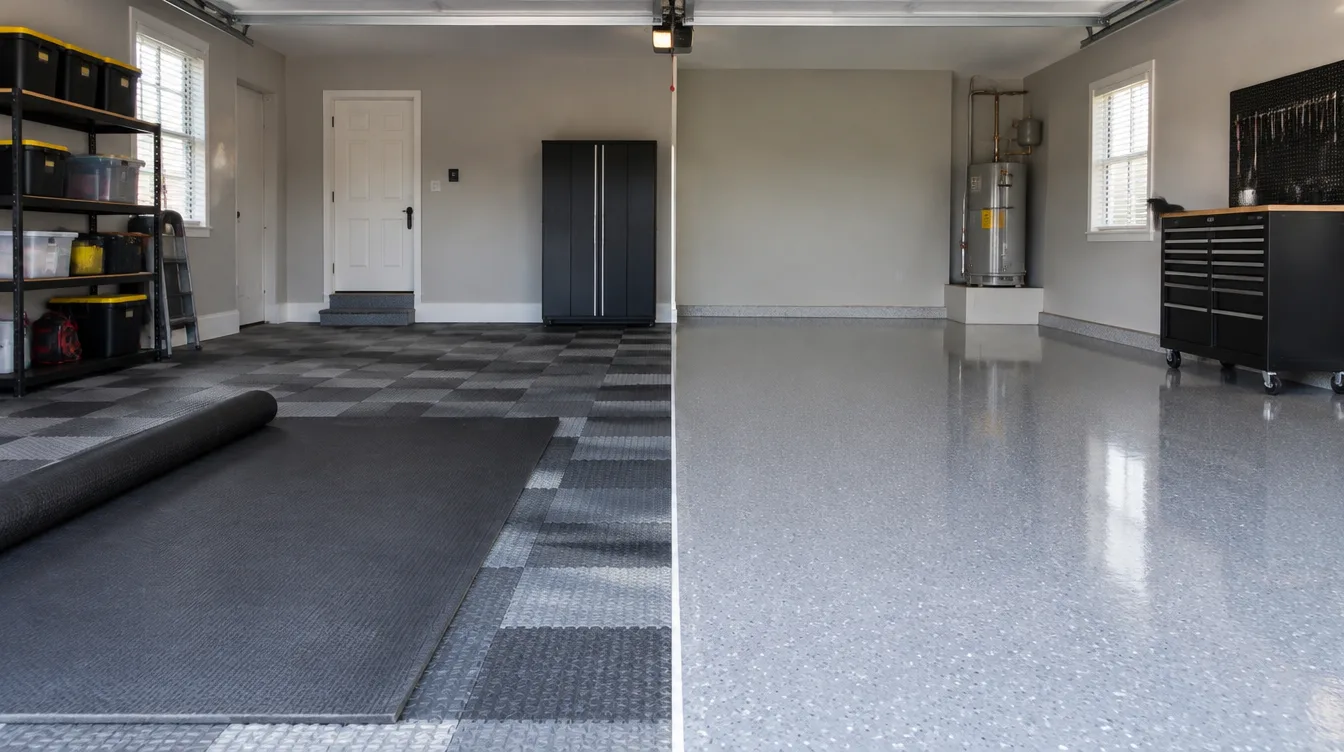
Choose a coating if you want a sealed, permanent floor that is bonded to the slab, and choose tiles or mats if you want something removable, cheap to start and forgiving of a rough slab. Interlocking PVC tiles and roll-out vinyl mats are loose-laid products: they sit on top of the concrete, they can be lifted and moved, and they leave a cavity underneath where moisture, dust and road debris collect. A garage floor coating bonds to the concrete and seals it, which is why it reads as a permanent improvement. Neither choice is wrong. The right one depends on whether you rent or own, how your slab behaves in humid weather, and how long you plan to stay.
Quick answer: coating, tile or mat, by what you actually want from the floor
Start with the outcome you want, then match the product to it. The three options solve different problems, and most disappointment comes from buying one to solve a problem it was never designed for.
- You want it sealed and permanent. A bonded coating is the only one of the three that seals the concrete. Spills stay on the surface where they can be wiped up, and nothing gets underneath.
- You want to install it this weekend with no cure time. Tiles and mats go down the same day and can be driven on at once. A coating needs surface preparation and a cure window.
- You rent, or may move soon. Loose-laid tiles and mats can come up when you leave. A coating cannot be taken with you.
- Your slab is cracked, pitted or uneven. Tiles and mats hide a poor surface without the preparation a bonded system needs, though they will telegraph a significant dip or heave.
- You park hot, heavy vehicles and want one clean surface. Seams, edges and loose pieces are the weak points of tiles and mats. A seamless coating has none.
This guide covers the two alternatives that most homeowners meet while shopping and that our other comparisons do not: interlocking PVC tiles and roll-out vinyl mats. If you are weighing a coating against a painted floor, read our comparison of garage floor epoxy vs paint, and for ceramic and porcelain tile set into a below-grade room, see basement floor epoxy vs tile. We will not repeat either one here.
Interlocking PVC tiles: cost, install and the moisture trap underneath
Interlocking PVC garage tiles are modular squares, usually about a foot across, that snap together at the edges and float over the slab with no adhesive. They are popular because the install is simple. You sweep the floor, lay the first row against a straight edge, and work across the room, trimming the border pieces with a utility knife or saw.
Their real strengths are easy to state:
- Fast install. A two-car garage is a long afternoon for one person who is comfortable measuring and cutting. No cure time, so the garage is usable the same day.
- Forgiving of a bad slab. There is no pull-off adhesion to protect, so oil stains, old paint and hairline cracks do not stop the install the way they stop a coating.
- Damaged pieces can be swapped. If a tile gets cut or stained, you pull one piece and replace it.
- Removable. For renters, that matters more than any other factor.
The limits show up over time. Every tile has four edges, and every edge is a seam. Water, dust and road debris move through those seams and settle on the slab beneath. You cannot see it, and you cannot clean it without lifting the floor. Hot tires can also leave marks on vinyl surfaces, and in a garage that regularly sees summer heat, loose-laid pieces can expand and shift at the joints. Tiles also raise the floor height slightly, which can catch a garage door seal or a low bumper.
On cost, tiles usually have a lower entry price than a professional coating and a higher price than paint, but the numbers depend heavily on the product, the thickness and how much waste your garage layout creates. Treat any single price you see online as a starting point and measure your actual square footage before you compare. For how professional coating pricing is built, see our guide to garage floor epoxy cost in San Antonio.
Roll-out vinyl mats: the easiest option and its limits
Roll-out mats are sheets of PVC or similar vinyl, typically sold in widths that cover a standard bay, that you unroll over the slab and trim to fit. They are the lowest-effort option on the market. There is nothing to snap together, so there are fewer seams than with tiles, and a mat can be rolled up and carried out.
Mats do several things well:
- Almost no installation. Unroll, let the sheet relax, trim and use.
- Few seams. One continuous sheet per bay means far fewer joints than tiles.
- Softer underfoot. Many are textured and a little cushioned, which helps if you stand at a workbench.
- Easy to move. You can lift a mat to clean the slab or to take it with you.
The trade-offs matter in a working garage. A mat does not bond to the concrete, so it can creep, ripple or curl at the edges, especially under repeated turning of tires. Edges can trap water and debris just as tile seams do. A mat only covers where it is placed, so the exposed concrete around it stays bare. And because the mat sits directly on the slab, any moisture the slab releases is held beneath it. On a slab with high moisture vapor emission, that can show up as staining or odor when you finally lift the sheet. Lifting a mat periodically to let the slab dry is sensible housekeeping, and our post on vapor barrier primer options explains what to do when a slab fails a moisture test.
Coatings: what you give up in reversibility and gain in permanence
A coating is a different category of product. It is a liquid that bonds to a prepared slab and cures into a continuous film. The slab is first ground or shot blasted so the coating has a rough profile to grip, cracks and spalls are repaired, and then the primer, color layers and top coat go down in sequence. Our garage floor coating prep guide and the pre-install checklist show what you need to do before the crew arrives.
What you gain is permanence and a sealed surface:
- No cavity underneath. The film is bonded to the concrete, so nothing collects under it.
- Seamless. There are no tile joints and no mat edges to catch water or snag a tire.
- Chemical and stain resistance. Oil, brake fluid, antifreeze and road salt sit on top of the film and wipe off.
- Cleaning. A mop and a mild cleaner are enough. There is nothing to lift.
What you give up is reversibility. A coating stays where it is, and removing it later means grinding. It also demands more of the slab. The concrete should be tested for moisture vapor emission with ASTM F1869 calcium chloride kits or in-situ relative humidity probes under ASTM F2170, and adhesion is commonly verified with an ASTM D4541 pull-off test on commercial work. If you are deciding between a coating chemistry, our post on epoxy vs polyaspartic for garage floors goes into that choice in detail, and it is the right next read once you have decided a coating suits you.
Comparison table: cost, lifespan, moisture risk, reversibility, resale appeal
Use this table as a quick filter. Ratings are general, because product quality and installation vary widely, and your own slab condition changes the outcome more than any label.
| Factor | Interlocking PVC tiles | Roll-out vinyl mats | Professional coating |
|---|---|---|---|
| Install time | Hours for a two-car garage | Under an hour per bay | One to several days with prep and cure |
| Upfront cost | Low to moderate, varies by product | Lowest of the three | Highest of the three |
| Typical lifespan | Years, until tiles shift, stain or crack | Years, until edges curl or wear through | Many years when the prep and slab are sound |
| Moisture risk | Moisture and debris collect through seams | Moisture held under the sheet | Sealed to the slab, but slab moisture must be tested first |
| Reversibility | Fully removable | Fully removable | Permanent |
| Poor or cracked slab | Hides it, may telegraph | Hides it, may ripple | Needs repair and preparation first |
| Cleaning | Hard to clean under; lift to wash | Roll up to wash | Mop the surface |
| Resale appeal | Reads as an accessory | Reads as an accessory | Reads as a permanent upgrade |
No row decides the question on its own. If reversibility is your top priority, the first two columns win. If you want a sealed floor that you can forget about, the third column wins. Most homeowners who stay in their house for years end up weighing upfront cost against how much they dislike living with the problems of a loose-laid floor.
San Antonio humidity and what collects under a loose-laid floor
San Antonio summers are hot and humid, and a garage slab is a large piece of porous concrete in contact with the ground. Moisture moves through concrete as vapor. A sealed film or a loose-laid floor over it changes how that vapor behaves. A coating bonded to the slab holds the moisture at the surface, which is why testing before coating matters. A loose-laid product does not bond, but it also does not let the slab breathe freely, so the vapor can collect beneath it.
What actually builds up under tiles and mats over a few seasons:
- Dust and grit. Fine particles work through seams and settle on the slab. When you lift the floor, you find a layer of fine dust that has been abrading the underside the whole time.
- Moisture and condensation. Warm humid air meets a cooler slab and condenses. Without airflow, the slab stays damp.
- Efflorescence. Dissolved minerals carried by the moisture dry as a white powder on the slab surface.
- Odor and mildew. Trapped moisture plus organic debris is a recipe for a musty smell in a closed garage.
- Insects. Voids under loose floors are shelter for them.
This is the point where a coating tends to win for homeowners who plan to stay. It does not remove moisture from the slab, but it leaves no cavity to fill with debris, and its surface can be wiped clean. If you want the facts on how coatings handle our heat and humidity, our guide to how weather affects epoxy installation explains the install window.
Hot tire pickup, jack stands and point loads
Garage floors take concentrated loads that residential floors never see. A parked vehicle puts several hundred pounds on each tire contact patch, a floor jack puts the load of a corner of the car on a few square inches, and jack stands do the same. How each floor option handles that is where the practical differences show up.
Tiles are rated for static loads by their makers, but they can shift, dent or crack under a concentrated jack stand foot. Many owners put a plywood pad under a jack for that reason. The seams can also open slightly under turning tires over time.
Mats can be dented by a stand foot and pushed out of position by a tire that turns while stopped. A mat that creeps is a trip hazard and a place for a tire to catch.
Coatings spread point loads into the concrete, since the film is only a skin over a slab that carries the load. The failure mode to know about is hot tire pickup, where a hot tire softens a poorly bonded coating and lifts it off the slab. It is almost always a preparation or chemistry problem rather than a flaw in coatings as a category. A professionally prepared and correctly specified system resists it, and our DIY vs professional install comparison explains why prep quality drives that result.
Slip resistance is the other point that matters in a wet garage. Textured tile and mat surfaces provide grip, but they are tested for different uses, and a garage that sees wet tires should be judged on a measured wet coefficient of friction, commonly reported as DCOF under ANSI A326.3. Ask any supplier for the number rather than relying on the word "non-slip."
Which to choose if you rent, and which if you are staying
The simplest way to decide is to answer two questions: do you own, and how long will you be there.
- You rent, or may move within a year or two. Choose loose-laid tiles or a mat. You can take them with you, you are not altering the landlord's slab, and the lower upfront cost makes sense for a short stay. Lift them every so often to let the slab dry and to check what has collected underneath.
- You own and plan to stay several years. A professionally installed coating is usually the better long-term value. You pay once for a sealed, seamless floor that cleans with a mop, and it reads as a permanent improvement if you sell.
- You own but the slab has serious problems. Spalling, deep cracks and active moisture are fixable, but they cost money before any coating goes down. Tiles or a mat can be a reasonable stopgap while you plan the repair, as long as you accept the trade-offs.
- You are selling soon. A clean, finished floor helps a garage look maintained. Buyers tend to treat tiles and mats as removable extras and price them that way.
If you are leaning toward a coating, the next step is a measurement and a written quote that names the system, the prep method and the cure time. Call (830) 355-3303 for a free on-site measure and written quote. We test the slab, tell you in writing what it needs and let you compare it to the cost and effort of a loose-laid floor on your own terms.
Frequently asked questions
Are garage floor tiles better than epoxy?
They are easier to install, removable and forgiving of a poor slab, but they create seams and a cavity underneath. A coating bonds to the concrete and stays sealed, which matters where moisture or spills are a concern.
What collects under interlocking garage tiles?
Moisture, dust and road debris migrate through the seams and sit on the slab. In a humid climate that trapped moisture can lead to efflorescence and odor, and the floor has to be lifted to clean it.
Can you put garage tiles over a cracked slab?
Yes, and that is one of their genuine advantages. Loose-laid tiles hide a poor surface without the preparation a bonded coating demands, though they will telegraph significant unevenness.
Do roll-out garage mats damage concrete?
They do not damage sound concrete, but trapped moisture beneath a mat on a slab with high vapor emission can cause staining. Lifting them periodically to let the slab dry is sensible.
Which option adds more value when selling a house?
A professionally coated floor generally reads as a permanent improvement, while tiles and mats are seen as removable accessories. Buyers tend to price them accordingly.