Finishing a San Antonio basement floor means choosing between two dominant options: epoxy coating systems and ceramic or porcelain tile. Both are durable, both handle basement conditions when installed correctly, and both cost more than leaving concrete bare. The right choice depends on how you use the space, your moisture conditions, your timeline, and your budget.
This guide compares them side by side on every factor that matters for San Antonio basement applications.
Side-by-Side Comparison
| Factor | Epoxy System | Ceramic / Porcelain Tile |
|---|---|---|
| Installed cost (500 sq ft) | $2,000–$3,500 | $3,000–$7,000 |
| Install time | 2–3 days | 3–5 days + grout cure |
| Down time (usable) | 24 hrs light use / 72 hrs full | Walk on in 24 hrs (tile only) |
| Moisture handling | Seamless; with MM primer: 98% RH | Grout joints trap moisture, mold risk |
| Maintenance | Mop and done - no grout | Grout cleaning, periodic resealing |
| Lifespan | 15–25 years | 25+ years (tile); grout 10–15 years |
| Repair ease | Spot patch possible, color match varies | Single tile swap |
| Impact resistance | Flexes with slab movement | Cracks at grout lines under shift |
| Slip resistance | Anti-slip broadcast available | Varies by tile rating |
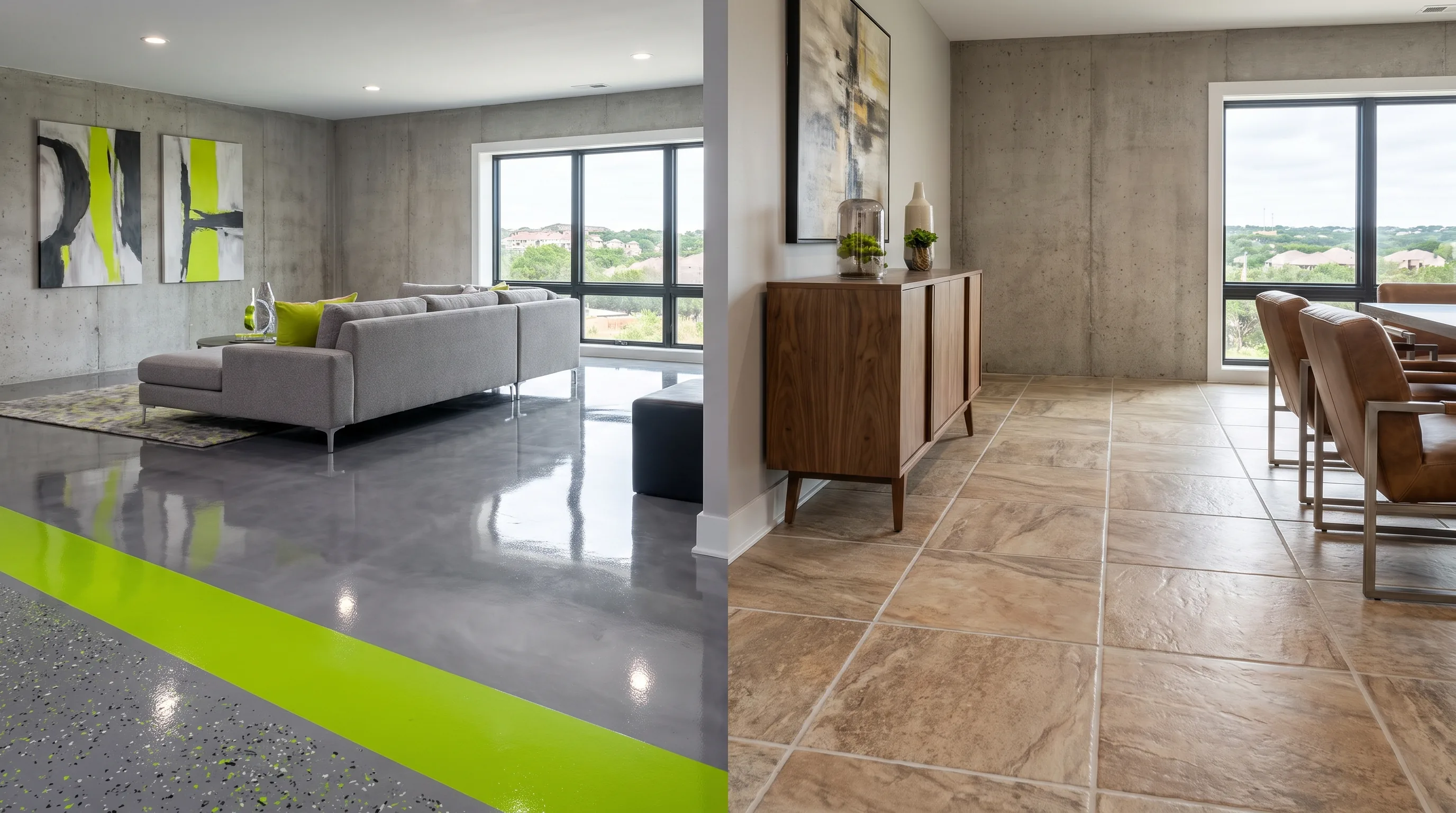
| Custom appearance | Unlimited color, metallic, flake options | Large tile/pattern selection |
Cost Breakdown for San Antonio Basements
| Cost Component | Epoxy System | Tile (Ceramic Mid-Range) |
|---|---|---|
| Surface prep / profiling | $0.75–$1.25/sq ft | $0.50–$1.00/sq ft |
| Materials | $1.50–$3.00/sq ft | $2.00–$6.00/sq ft |
| Labor | $1.50–$2.50/sq ft | $3.00–$5.00/sq ft |
| Moisture mitigation primer | $0.50–$1.00/sq ft | Waterproof membrane: $1.00–$2.00/sq ft |
| Total installed (500 sq ft) | $2,000–$3,500 | $3,250–$7,000 |
Labor accounts for the biggest difference. Tile setting requires skilled labor with precise layout, cutting, and grout work. Epoxy application is also skilled work but covers area faster with fewer materials per square foot at the mid-range price point.
Head-to-Head: Key Decision Factors
- Seamless surface - no grout joints to harbor mold
- Lower installed cost on large open areas
- Flexes with concrete movement (no cracking)
- Faster usable timeline for large spaces
- Anti-slip finish option for safety
- Easier cleaning - single smooth surface
- Requires professional moisture testing
- Full floor must be replaced, not spot-swapped
- Single tile replaceable if damaged
- Walk-on in 24 hours (tile; not grout)
- Massive pattern and material selection
- Feels natural underfoot - cooler in summer
- Grout joints mold in humid basements
- Higher labor cost per square foot
- Cracks at grout if slab shifts
- Grout resealing every 1–2 years
Moisture: The Deciding Factor for San Antonio Basements
San Antonio's geology - expansive clay soils over the Edwards Aquifer - creates persistent vapor pressure beneath basement slabs. This single factor tips many comparisons toward epoxy.
Tile requires grout joints to accommodate installation tolerances. In a humid environment, those grout joints absorb moisture, develop mold, and require periodic chemical cleaning and resealing. Cracked grout allows water migration under tiles, leading to adhesion failure and hollow tiles.
Epoxy with moisture-mitigating primer creates a continuous sealed membrane across the entire slab. No grout joints. No mold harborage. Vapor transmission is blocked at the primer layer.
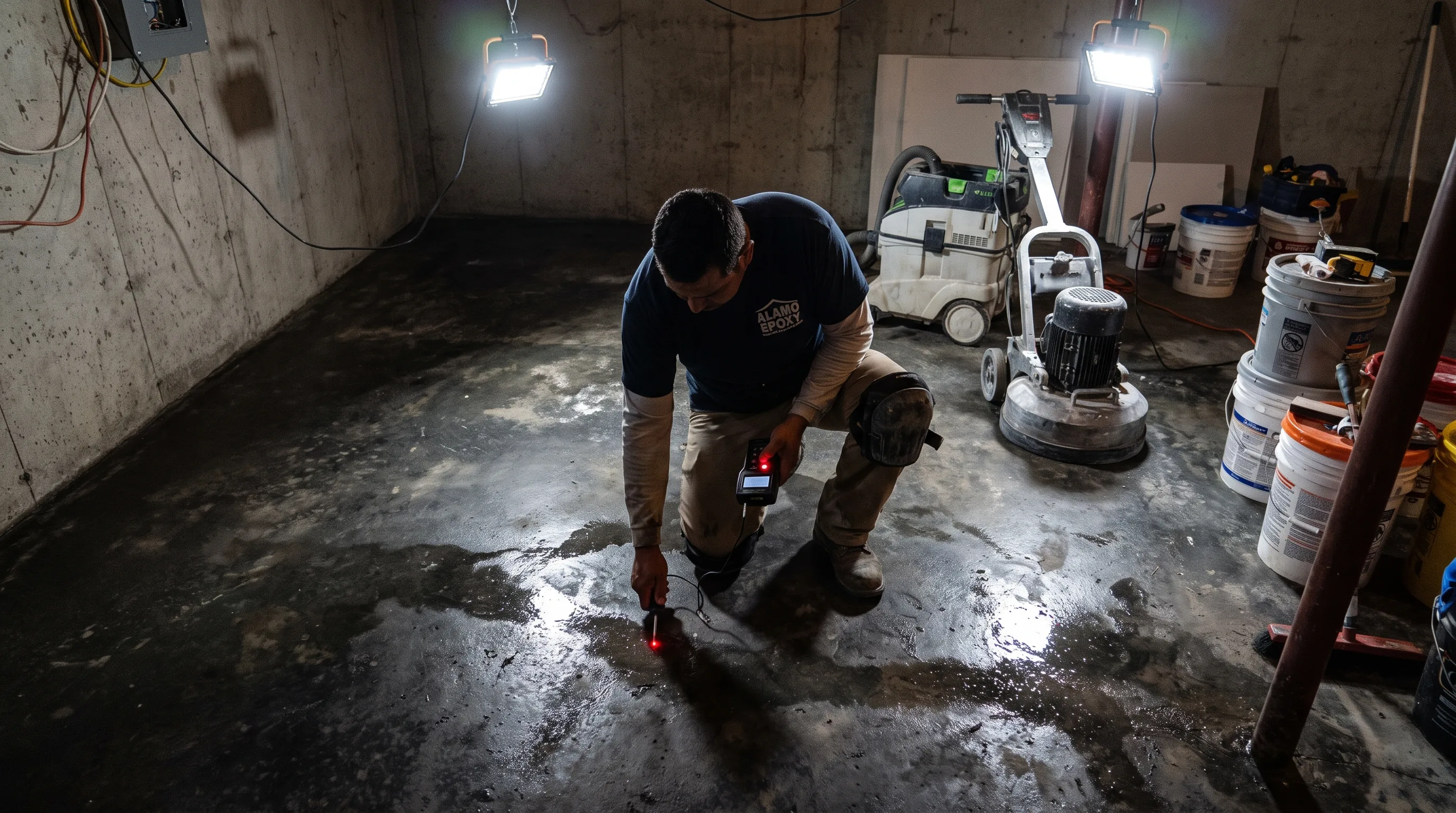
If your F2170 RH reading exceeds 85%, the case for epoxy strengthens significantly - moisture-tolerant tile installs require an additional waterproof uncoupling membrane, adding $1–$2/sq ft to the tile cost and further closing the price gap.
When Tile Wins
- Finished living space requiring a "natural" aesthetic - wood-look porcelain, stone-look ceramic
- High-traffic area where a single damaged section needs easy spot repair
- San Antonio homes with dry basements (RH < 75%, verified by testing)
- Radiant floor heating already installed - epoxy can be applied over radiant but requires protocol
When Epoxy Wins
- Utility basement, workshop, gym, or storage space - functional over decorative
- Elevated moisture readings (RH 75–98%) - moisture-mitigating primer handles it
- Large open areas where labor cost matters - epoxy covers faster
- Seamless sanitation requirement - no grout to harbor bacteria
- Budget constraint - epoxy typically $1,000–$3,000 less on a 500 sq ft basement
- Turnaround time matters - epoxy system complete in 2–3 days vs 7–10 for tile + grout cure
Installation Timeline Comparison
| Phase | Epoxy System | Tile |
|---|---|---|
| Prep / profiling | Day 1 (morning) | Day 1 (morning) |
| Primer / adhesive | Day 1 (afternoon) | Day 1 (afternoon) |
| Base coat / setting | Day 2 | Days 2–3 |
| Topcoat / grout | Day 3 | Days 3–4 |
| First usable | Day 4 (light traffic) | Days 7–10 (after grout cure) |
| Full use | Day 5–7 | Days 10–14 |
Frequently Asked Questions
For most San Antonio basements, a full epoxy system (moisture primer + chip broadcast + polyaspartic topcoat) runs $4–$7 per square foot installed. Tile ranges from $6–$14 installed depending on material and labor. Epoxy is generally less expensive for large open areas.
Quality epoxy systems last 15–25 years in basement applications with normal residential traffic. Ceramic tile can last longer but grout degrades at 10–15 years in high-moisture environments and requires periodic resealing or replacement.
Epoxy with moisture-mitigating primer provides a seamless, grout-free surface that handles vapor transmission better than tile with grout joints. However, neither covers up active water intrusion - that must be resolved first.
A full epoxy system for a 500 sq ft basement takes 2–3 days: day 1 for prep and primer, day 2 for base coat, day 3 for topcoat with short light-use window at 24 hours. Tile installation for the same area typically takes 3–5 days plus 3–7 days of grout curing before normal use.