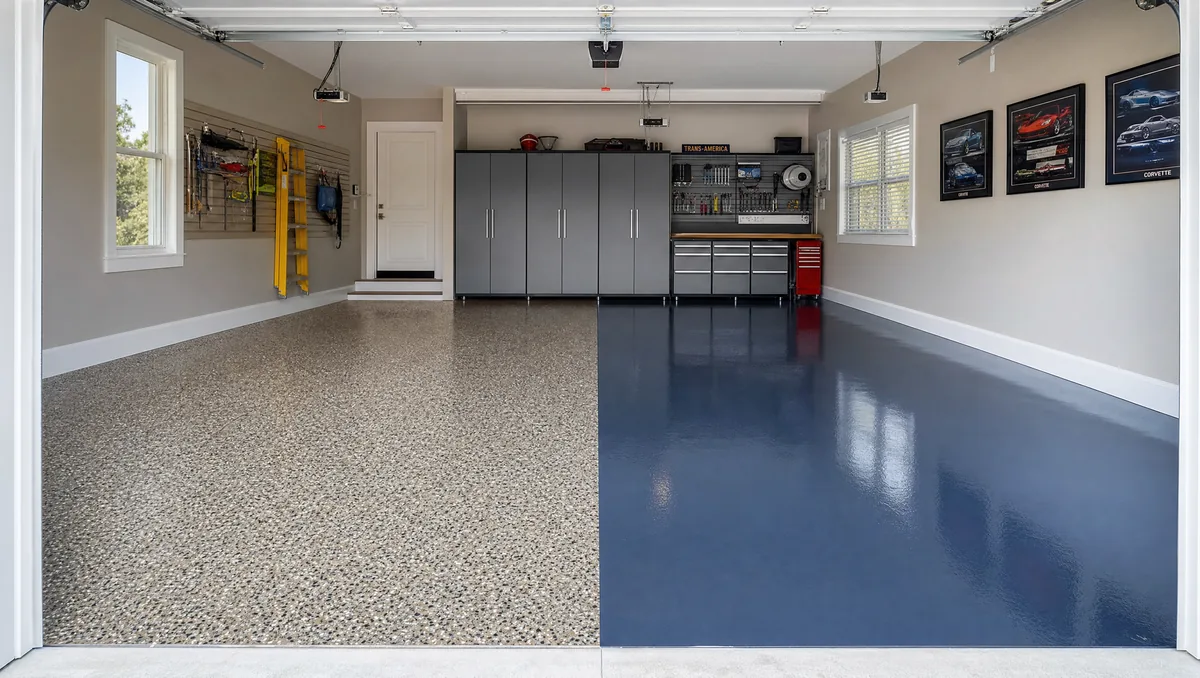
Why San Antonio Makes This Question More Complicated Than It Looks
The epoxy vs. polyaspartic debate runs differently in San Antonio than in, say, Denver or Chicago. Texas heat - specifically the 95–105°F garage floor temperatures that are routine from May through September - affects how both products cure, how they perform under hot-tire contact, and how long they maintain their gloss. A product spec that works perfectly in a Minnesota garage may fail on a San Antonio slab that's been baking in the sun all afternoon. This guide gives you the real-world picture from a contractor that's installed both systems across the metro.
What Is Epoxy Flooring?
Two-part epoxy is a thermosetting polymer created when a resin and a hardener are mixed and applied to concrete. It bonds chemically to the slab surface (assuming proper prep and a dry slab), builds to 8–20 mils of total coating thickness, and creates a hard, durable surface that resists impacts, chemicals, and abrasion. Most "epoxy" garage floors actually use a layered system: an epoxy primer, an epoxy base coat with chip or pigment broadcast, and a polyaspartic or urethane topcoat for UV stability and surface hardness.
What Is Polyaspartic Flooring?
Polyaspartic coatings are a subtype of polyurea. They share polyurea's fast cure speed and excellent UV stability but have been formulated to be more workable - giving installers a longer pot life for broadcast systems. A full polyaspartic system (no epoxy base) applies the product in two to three coats, cures in hours rather than days, and produces a surface that's harder and more UV-resistant than standard epoxy. The tradeoff is cost and the technical demands on the installation crew.
Side-by-Side Comparison: San Antonio Conditions
UV Stability
Epoxy loses this one. Standard epoxy resins are not UV-stable - they yellow and chalk when exposed to direct sunlight. For San Antonio garages with south- or west-facing doors, this happens within one to two seasons. This is why virtually every professional epoxy system includes a polyaspartic or urethane topcoat: the epoxy builds the body of the floor, but it needs UV protection. A full polyaspartic system has UV stability built in throughout - no discoloration, no chalking, even without a separate topcoat.
Heat Tolerance During Curing
Polyaspartic wins here, but it's complicated. Standard epoxy has a minimum application temperature (usually 50°F) and a maximum (usually around 90°F slab temperature). A San Antonio garage slab in July can hit 95°F before noon - above the application window for epoxy. Polyaspartic products are formulated to cure at higher temperatures, making summer scheduling more flexible. That said, experienced epoxy crews work around this by scheduling application for early morning and tempering the slab with water, or by using high-temperature-rated epoxy formulations. At ProEpoxy, we've never missed a summer installation window - it just requires planning.
Hot-Tire Resistance
Polyaspartic wins for topcoat hardness. Hot-tire pickup - where a car parked in the garage pulls the coating up as the tires cool and contract - is one of the most common failure modes for thin-film epoxy systems in San Antonio. The fix is a hard topcoat with sufficient mil thickness. Both epoxy systems with a polyaspartic topcoat and full polyaspartic systems resist hot-tire pickup well; bare epoxy without a topcoat does not. If a contractor quotes you a two-coat epoxy system with no polyaspartic topcoat, ask specifically about their hot-tire warranty.
Cure Time
Polyaspartic wins decisively. A full polyaspartic system can be walkable in 4–6 hours and ready for vehicle traffic in 24 hours. A properly applied epoxy system requires 24 hours between coats and 72 hours minimum before vehicle traffic - making a two- to three-day installation timeline typical for residential garage projects. For commercial spaces that can't afford more than one day of downtime, polyaspartic is often the right call regardless of cost.
Cost
Epoxy-based systems are less expensive. A chip broadcast system (epoxy base + chips + polyaspartic topcoat) runs $4–$6 per square foot installed in San Antonio. A full polyaspartic system starts at $5–$8 per square foot. For a standard two-car garage, that's roughly $400–$900 more for the polyaspartic option - meaningful but not enormous given the longer cure flexibility and higher surface hardness.
Repairability
Epoxy is easier to spot-repair. If a chip broadcast floor gets a gouge or a localized delamination, epoxy materials are broadly compatible with each other for spot repairs. Full polyaspartic systems are harder to repair seamlessly because the fast cure leaves less time for blending, and adhesion between full-cure polyaspartic layers is lower than between epoxy layers.
Which System Should You Choose for Your San Antonio Space?
- Residential garage (standard): Chip broadcast system with epoxy base + polyaspartic topcoat. Best value, most popular, proven 15–20 year performance in San Antonio conditions.
- Garage with UV exposure (south/west-facing door, glass panels): Chip or solid-color system with a premium UV-stable polyaspartic topcoat. The topcoat is doing the UV work - the base system doesn't need to change.
- Commercial space needing same-day return to service: Full polyaspartic system or a fast-cure epoxy hybrid. A standard epoxy system requiring 72 hours is rarely appropriate here.
- Showroom or high-end residential: Metallic epoxy base + polyaspartic topcoat, or full metallic polyaspartic. The aesthetics of metallic epoxy are difficult to replicate in a full polyaspartic system.
- Warehouse or distribution center: High-build industrial epoxy (100% solids). Polyaspartic isn't typically used as a primary warehouse coating due to cost at scale.
The Bottom Line
For most San Antonio homeowners, the answer is: a professionally installed layered system using epoxy for the base and polyaspartic for the topcoat. You get the cost advantage and thickness of epoxy with the UV stability and surface hardness of polyaspartic. If cure speed is a constraint - you need the garage back in one day - then a full polyaspartic system is worth the premium. If you're coating a large commercial floor and budget matters, industrial epoxy is the workhorse of choice.
Ready to talk through which system fits your space? Request a free walkthrough and we'll walk you through the options with a written quote for each so you can compare apples to apples.
Get a Free Quote for Your San Antonio Floor
ProEpoxy installs epoxy, polyaspartic, urethane cement, and polished concrete in the San Antonio metro - using our own crews, not subcontractors. We test every slab before we quote and back our work with a written warranty.
Request Free Estimate →