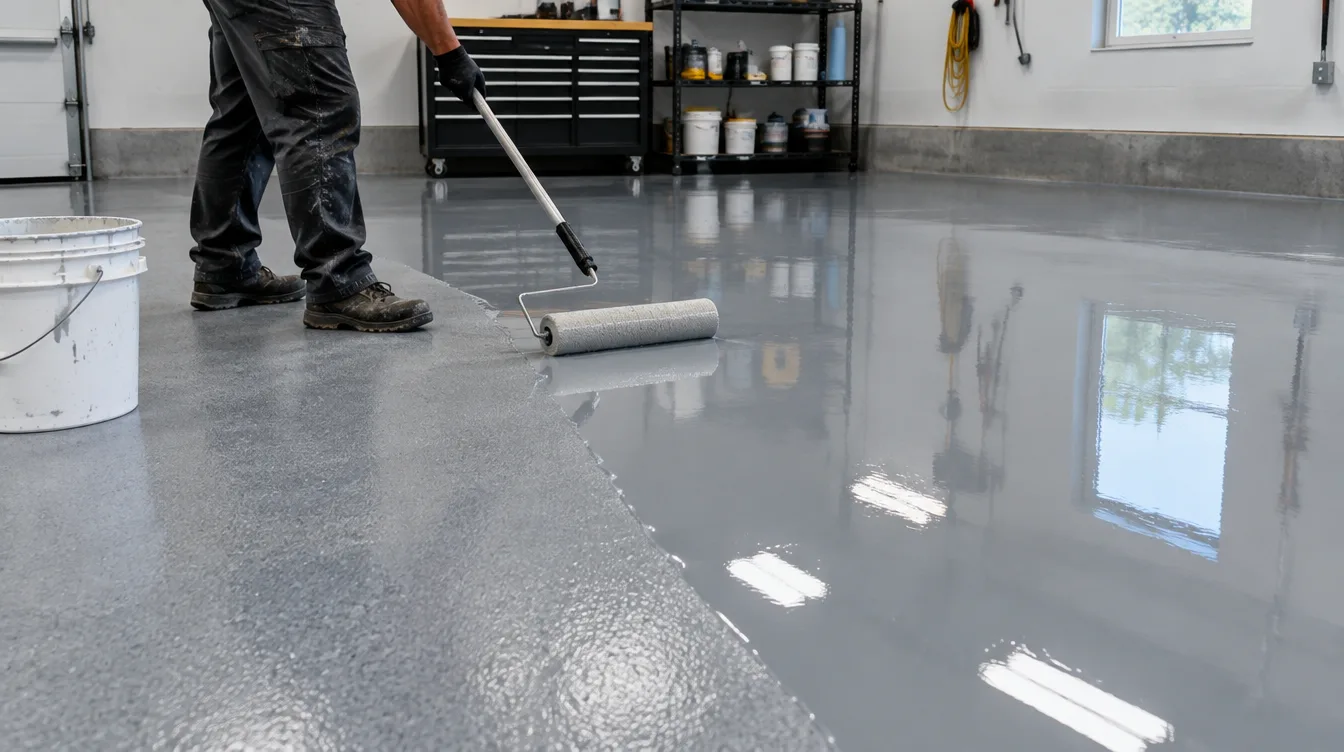
Most epoxy floors should have a top coat, but not every floor needs one: the top coat carries the abrasion, UV and chemical duty and can be renewed later without disturbing the body coat underneath. The question people usually type is epoxy vs polyurethane floors, as if they were rival products. In most installed floors they are layers, with epoxy providing build and adhesion to the slab and a clear coat sitting on top of it. This guide treats the top coat as a layer in the build. If you are comparing whole systems, start with our epoxy floor coating page, and use this post to decide what goes on top of the one you pick.
Quick answer: what a top coat adds and when a floor can go without one
A top coat adds a sacrificial, replaceable wear surface. It takes the scratches, the tire traffic, the chemical splashes and the sun, so the thicker epoxy beneath it stays intact for years.
A body coat of epoxy is hard and builds thickness, but on its own it scuffs, can amber in direct sun and has limited chemical resistance to some solvents and acids. The clear layer on top is chosen to cover exactly those weaknesses. It is thin, usually a fraction of the thickness of the epoxy, and it is cheap to renew compared with redoing the floor.
A floor can go without a top coat in a narrow set of cases:
- Shaded, light-duty interiors. A utility room or storage space with no direct sun, no vehicle traffic and little chemical exposure.
- A system that is itself a single finish coat. Some polyaspartic or polyurethane systems are applied as the color coat and finish at once, so there is no separate clear layer to add.
- A planned short life. A floor the owner expects to recoat soon and accepts a softer, more easily marked surface.
Flake and metallic floors are different. A broadcast flake floor needs a clear layer to seal the chips and give a smooth, cleanable surface, and a metallic floor needs one to protect its depth and shine. This guide does not rehash how polyaspartic compares with epoxy as complete systems, which our posts on polyaspartic versus polyurea and polyurea versus epoxy for garages cover. It stays with the clear layer.
Clear epoxy top coats: cost, build and limits
A clear epoxy top coat is the most economical choice and the thickest of the three, and its limits are UV stability and scratch resistance. It bonds well to the epoxy body coat because it is the same chemistry.
The strengths are real. It builds film, so it fills the texture of a flake broadcast and leaves a smooth, easy-to-clean surface. It adds gloss and depth. And because it is chemically similar to the layer below, the bond between them is strong when the coats are applied within the manufacturer's recoat window.
The limits come from the same chemistry. Standard epoxy resins are aromatic, and aromatic compounds absorb ultraviolet light and shift toward amber over time. Indoors and away from windows that shift can take years to notice. In a garage with the door open for hours each day, or a room with large west-facing glass, it shows sooner. Clear epoxy is also softer than a urethane or polyaspartic film, so it marks more easily under dragged tools and turning tires.
It suits floors where cost matters, sun exposure is low and traffic is moderate. Our detailed look at how yellowing develops, and when a system switch beats a top coat refresh, is in the guide to UV stability for polyaspartic and epoxy, and this post does not repeat it.
Polyurethane top coats: abrasion and chemical resistance
A polyurethane top coat is chosen for abrasion and chemical resistance. It is harder at the surface than epoxy, it resists scuffing and a wider range of chemicals, and aliphatic types hold their color in sunlight.
The word aliphatic matters here. An aliphatic polyurethane does not contain the aromatic groups that make epoxy turn amber, which is why it is the usual answer to yellowing. It is applied thin, commonly in the range of 2 to 4 mils, and it relies on the epoxy underneath for the film build.
Polyurethane also adds a degree of flexibility. Concrete moves slightly with temperature, and a thin flexible layer on top of a rigid epoxy body copes with that better than a second rigid layer. That is one reason it is common in commercial and industrial floors where forklifts, pallet jacks and cleaning chemicals are routine.
The tradeoffs are application and timing. Polyurethane top coats typically have a longer cure than polyaspartic, and they are more sensitive to moisture and humidity at application, because isocyanate chemistry reacts with water and can foam or cloud. In a humid San Antonio summer that means the installer watches the dew point and the slab temperature, and it is one more reason a top coat is installed by trained crews rather than as a weekend job.
Polyaspartic top coats: cure speed and UV stability
A polyaspartic top coat cures fast and resists UV, which makes it the usual choice when a floor needs to return to service quickly or sits in the sun. It is a type of aliphatic polyurea, and it is applied thin, like polyurethane.
Cure speed is the headline. Typical data sheet figures put light foot traffic within a few hours and vehicle traffic within about a day, against a longer window for epoxy and polyurethane. For a garage that has to be back in use or a shop that cannot close for long, that matters.
The cost of that speed is working time. Polyaspartic has a short pot life, often measured in minutes rather than hours, so the crew has to mix in small batches and place the material quickly. A rushed or poorly planned application shows as lap marks and roller streaks, so the installer's skill carries more weight than with a slower material. Polyaspartic is also commonly priced higher than epoxy or polyurethane, and its recoat window is shorter, so the next coat has to follow on schedule or the surface has to be abraded first.
Whether polyaspartic is worth that premium depends on the floor, and our guide to polyaspartic versus epoxy cost covers the money side. As a top coat specifically, it is a strong choice where sun exposure is high, where downtime is expensive or where the floor sees both.
Comparison table: each top coat against abrasion, UV, chemical and cost
| Top coat | Typical thickness | Abrasion | UV color stability | Chemical resistance | Return to light traffic | Relative cost |
| Clear epoxy | About 8 to 12 mils | Fair | Low, can amber in sun | Good, weaker against some solvents | Roughly 12 to 24 hours | Lowest |
| Aliphatic polyurethane | About 2 to 4 mils | Good to very good | High | Very good | Roughly 8 to 16 hours | Moderate |
| Polyaspartic | About 2 to 4 mils | Good to very good | High | Very good | Roughly 2 to 6 hours | Highest |
| No top coat | None | Body coat only | Body coat only | Body coat only | Per body coat | None added |
The thicknesses and cure windows are typical manufacturer data sheet ranges, not guarantees, and they shift with product, temperature and humidity. Treat the table as a way to compare the options, and read the data sheet of the actual product named on your quote.
Gloss, texture and anti-slip additives carried in the top coat
The top coat is where gloss and traction are set, because it is the surface your shoes and tires touch. Choosing a sheen and a slip rating is part of choosing the top coat, not a separate step.
Gloss. Gloss is measured with a gloss meter at 60 degrees in gloss units. Roughly speaking, a high gloss reads above about 70, satin sits between about 30 and 60, and matte falls below about 30. High gloss looks wet and shows dirt, scratches and tire marks readily. Satin and matte hide wear and read as more subdued, and they are usually the more forgiving choice in a working garage.
Texture. A smooth gloss coat can lose traction when wet. A fine aggregate, usually aluminum oxide or polymer grit, can be broadcast into or mixed into the top coat to restore it, and this is the right layer for it because the texture sits at the wear surface. Coarser grit grips better and is harder to clean.
Traction standards. Wet traction is commonly evaluated with the dynamic coefficient of friction under ANSI A326.3, and 0.42 wet is the benchmark many specifiers cite for level interior floors. The right texture depends on whether the floor is a dry garage or a wet wash bay. Our guide to epoxy floor slip resistance goes through the options in depth.
A short caution on additives. Texture can only be added to a top coat in the right quantity, and too much makes a floor that is hard to clean and that holds dirt. Ask for a small test patch of the exact texture on your quote, so you can judge it before the whole floor is coated.
Recoat intervals: the maintenance case for a sacrificial layer
The strongest argument for a top coat is that it can be renewed without touching the floor beneath. A worn top coat is abraded and recoated, which restores the surface at a fraction of the cost of a replacement.
Think of it as a sacrificial layer. In use it takes the scuffs, the tire pickup and the cleaning, and as it wears it loses gloss and starts to show dull tracks along the paths people and vehicles use. That is the signal to recoat, while the body coat is still intact. Waiting until the clear layer wears through to the color or the flake means the next repair is larger.
The renewal interval is set by traffic and exposure rather than the calendar. A light-use residential garage and a warehouse aisle with forklifts are on very different schedules, and the data sheet and the installer's maintenance guidance should name the expectation for your space. A practical approach is to inspect the floor each year and recoat when the sheen has gone patchy.
The technical points are consistent across systems:
- Abrade first. A worn top coat is scuffed with a screen or pad to give the new coat a mechanical bond, and the floor is cleaned of residue.
- Respect the recoat window. Within the manufacturer's window the coats bond chemically. After it, abrasion is required, so the schedule matters on a new install.
- Match the chemistry. Recoating with a different product needs confirmation that the two are compatible, since not every clear coat bonds to every other.
Our guide on two-part versus three-part epoxy floor coating systems covers how the layers combine in a full build, and it shows where the top coat sits in each.
Specifying the top coat correctly on a quote
A quote should name the top coat product, its type, its thickness and its sheen, because a line that just says clear coat hides the choices that decide how the floor performs. The details cost nothing to ask for and prevent surprises.
Check that your written quote states:
- The chemistry. Clear epoxy, aliphatic polyurethane or polyaspartic, named plainly.
- The product and its data sheet. So you can read the cure times, recoat window and rated properties yourself.
- The film thickness. In mils, for the top coat and for the whole system.
- The sheen. Gloss, satin or matte, ideally with a sample.
- The traction plan. The additive and the texture, or a note that none is included.
- The return-to-service times. For foot traffic and for vehicles, in hours.
- The recoat plan. What the renewal looks like and what the warranty says about it.
Substrate prep sits under all of this. A top coat cannot fix a weak bond below it, and the slab still needs the moisture check and surface profile described in our guides to moisture testing and to the surface profile for coating. Once those are right, the top coat decision is where the quote earns its detail. For a written recommendation on your own floor, review our epoxy floor coating page and call us.
Frequently asked questions
Do epoxy floors need a top coat?
Not always, but most systems benefit from one. The top coat carries the abrasion, UV and chemical duty and can be renewed later without disturbing the body coat underneath.
What is the difference between epoxy and polyurethane flooring?
In most floors they are not alternatives but layers. Epoxy provides build and adhesion to the slab, while a polyurethane top coat adds abrasion and chemical resistance over it.
Which top coat resists yellowing in sunlight?
Aliphatic polyurethane and polyaspartic top coats hold color under UV far better than clear epoxy, which is why they are specified for spaces with direct sun exposure.
Can a top coat be recoated without redoing the floor?
That is one of its main advantages. A worn sacrificial top coat can be abraded and recoated, which extends service life at a fraction of a full replacement cost.
Does a top coat make a floor more slippery?
A smooth high gloss top coat can reduce traction when wet. Anti-slip aggregate is usually broadcast into or added to the top coat precisely because that is the layer where texture belongs.
If you want the top coat named on a written quote, call (830) 355-3303 for a free on-site measure. We state the chemistry, thickness, sheen and traction plan in writing so you can compare bids on equal terms.