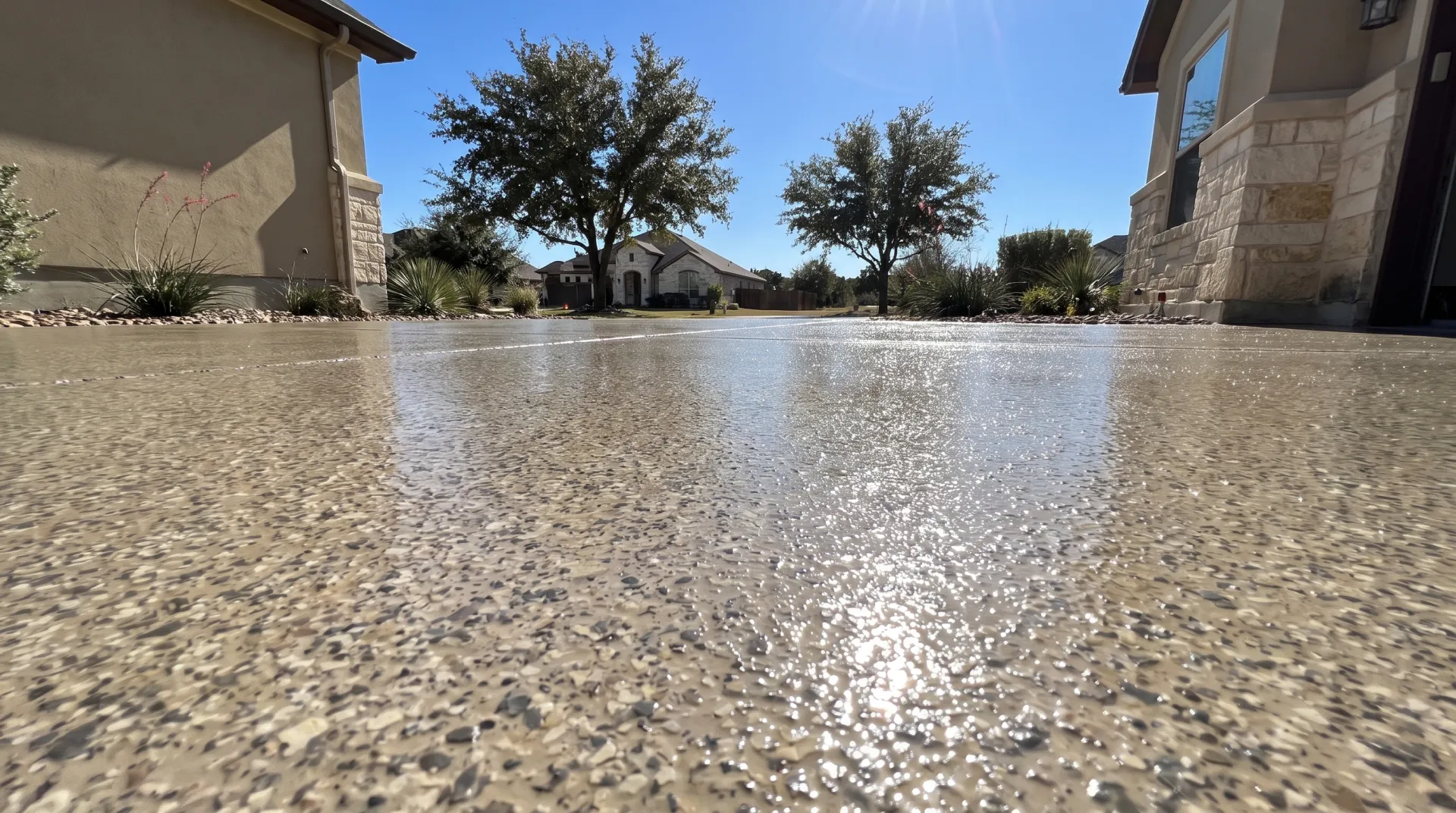
Standard epoxy resin chemically breaks down under UV exposure, producing a visible yellow tint that can appear within 1-3 years in direct San Antonio sunlight - polyaspartic's different resin structure resists that same UV-driven breakdown, holding its original color far longer under identical sun exposure. For garages with west-facing doors, patios, and any floor that sees sustained direct sunlight, that difference is often the deciding factor between the two systems.
The Chemistry Behind UV Yellowing
Epoxy resin contains chemical bonds that are vulnerable to breakdown when struck by ultraviolet radiation - a process called photodegradation. As those bonds break down, the resin's molecular structure shifts in a way that produces a yellow discoloration, most visible on lighter-colored or clear-coated epoxy floors. Polyaspartic resin uses a different chemical backbone that's inherently more resistant to this UV-driven degradation, which is why it holds its color under the same sun exposure that yellows standard epoxy.
Real-World Timeline Comparison
| Exposure Condition | Standard Epoxy | Polyaspartic |
|---|---|---|
| Indirect/shaded garage | Minimal yellowing for 5+ years | No noticeable change |
| Partial direct sun (window/door) | Visible yellowing in 1-3 years | No noticeable change |
| Full direct sun (patio/driveway) | Yellowing within 1 year possible | Holds color for years |
Why this matters in San Antonio specifically: the region's high annual sun exposure and long, intense summer daylight hours accelerate UV-driven yellowing compared to less sunny climates - which is exactly why polyaspartic has become the default recommendation for garages, patios, and driveways here rather than a nice-to-have upgrade.
Does a UV Topcoat Fix Epoxy's Yellowing Problem?
Adding a UV-stable polyurethane topcoat over standard epoxy does meaningfully slow yellowing and is a common and worthwhile upgrade for sun-exposed epoxy floors. However, even a good UV topcoat typically doesn't fully match polyaspartic's inherent resistance for floors with heavy, sustained, direct sun exposure - it narrows the gap rather than closing it completely.
Is Yellowing Just Cosmetic?
In its early stages, yes - UV yellowing is primarily an appearance issue rather than a structural one. But the same photodegradation process that causes discoloration can, over many years, make the coating's surface more brittle and prone to micro-cracking if never addressed. Catching yellowing early and planning a topcoat refresh (or switching to polyaspartic on the next recoat) prevents that cosmetic issue from becoming a durability one.
Have a Sun-Exposed Floor That's Starting to Yellow?
We install UV-stable polyaspartic systems built specifically for San Antonio's sun exposure.
Request a Free QuoteChoosing the Right System for Sun Exposure
If your garage, patio, or driveway sees regular direct sunlight, polyaspartic's UV stability is one of several reasons it's become the preferred choice over standard epoxy in San Antonio - alongside its faster cure time, covered in our comparison of polyaspartic floor coating pros and cons for garage floors. Our polyaspartic floor coating service page has more detail on the systems we install for sun-exposed San Antonio properties.
How UV Resistance Is Actually Tested
Manufacturers don't just guess at how a coating will hold up in the sun - they run accelerated weathering tests, most commonly using QUV or xenon-arc chambers that expose sample panels to concentrated UV radiation and cyclical moisture over a period of days or weeks. These accelerated tests compress years of real-world sun exposure into a lab timeline, allowing a direct side-by-side comparison of how much a coating discolors, chalks, or loses gloss under a standardized UV dose. Polyaspartic formulations consistently score better on these tests than standard epoxy resins, which is where the real-world durability claims come from rather than just marketing language.
It's worth noting that not all polyaspartic products are formulated identically - some manufacturers use more UV-stable aliphatic isocyanates in their resin system, while cheaper formulations may cut corners that reduce UV performance closer to standard epoxy levels. Asking a contractor which specific product line they're installing, and whether it has published QUV test data, is a reasonable question for any San Antonio homeowner comparing quotes for a sun-exposed floor.
Beyond Yellowing: Other UV-Related Effects
Chalking
Chalking is a powdery surface residue that forms as UV radiation breaks down a coating's binder at the microscopic surface level, leaving pigment particles poorly bound and easily rubbed off. It's most visible when you run a hand across the floor and see a dusty residue transfer - a telltale sign of UV degradation distinct from ordinary dirt.
Gloss Loss
Beyond color shift, prolonged UV exposure gradually dulls a coating's sheen even before yellowing becomes obvious. A floor that was originally high-gloss can lose 20-30% of its reflectivity over a few years of direct sun exposure if the topcoat isn't UV-stable, which is a subtler but equally noticeable form of sun damage.
Surface Micro-Cracking
In advanced stages, sustained UV breakdown can create a fine network of hairline surface cracks - sometimes called "checking" - that doesn't compromise structural integrity right away but does create a rougher surface that collects dirt more readily and eventually requires a topcoat refresh or full recoat.
Protecting an Existing Epoxy Floor from Further UV Damage
Homeowners who already have a standard epoxy floor showing early UV wear have a few practical options short of a full tear-out and recoat:
- Apply a UV-stable topcoat refresh: a fresh coat of UV-resistant polyurethane over the existing epoxy can restore gloss and slow further yellowing, provided the underlying coating hasn't degraded too far
- Reduce direct exposure where practical: window film on nearby glass, an awning over a patio, or simply parking a second vehicle to block a garage door's sun path can meaningfully cut cumulative UV dose over time
- Plan a system switch at the next recoat: when the floor eventually needs a full recoat, switching to polyaspartic at that point avoids repeating the same yellowing cycle with another round of standard epoxy
Choosing Between a Topcoat Refresh and a Full System Switch
Whether to patch the UV problem with a fresh topcoat or commit to switching systems entirely depends on how far the existing coating has degraded and how much direct sun the space realistically gets. A garage with only mild yellowing after several years and moderate, indirect sun exposure is often a good candidate for a topcoat refresh - it's less expensive and extends the life of the existing installation. A patio or driveway with heavy, sustained direct exposure that's already showing visible chalking or surface roughness usually gets better long-term value from a full switch to polyaspartic, since a topcoat refresh on a heavily UV-damaged base coat tends to underperform and need repeating sooner than expected.
San Antonio's Sun Exposure in Context
San Antonio averages well over 2,600 hours of sunshine annually, with long summer days that push direct UV exposure on south- and west-facing surfaces considerably higher than in less sunny regions of the country. A west-facing garage door catches the most intense, lowest-angle afternoon sun for several hours a day during peak summer months, which is exactly the exposure pattern that accelerates epoxy yellowing fastest. Homeowners evaluating coating options for a garage or patio should factor in not just whether the space gets sun, but which direction it faces and for how many hours - a north-facing garage with minimal direct exposure has a very different UV risk profile than a west-facing one that bakes in afternoon sun most of the year.
This regional intensity is also why local experience matters when choosing an installer. A contractor who primarily works in a milder climate may not fully appreciate how much faster UV degradation progresses under San Antonio conditions compared to their typical service area, and might under-recommend UV protection relative to what the local sun exposure actually demands.
Color and Finish Choices That Help Resist Visible Yellowing
Beyond the resin system itself, color choice plays a secondary role in how noticeable UV degradation appears over time. Lighter colors - white, light gray, pale beige - show yellowing far more visibly than darker colors, since the yellow tint contrasts sharply against a light base. Darker gray or charcoal floors mask early-stage yellowing more effectively, simply because the color shift is less visually obvious against a darker background, even though the underlying chemical degradation is happening at a similar rate. Homeowners set on a lighter color palette for a sun-exposed space have an even stronger case for choosing polyaspartic over epoxy, since the visual consequence of any UV degradation would otherwise be more pronounced.