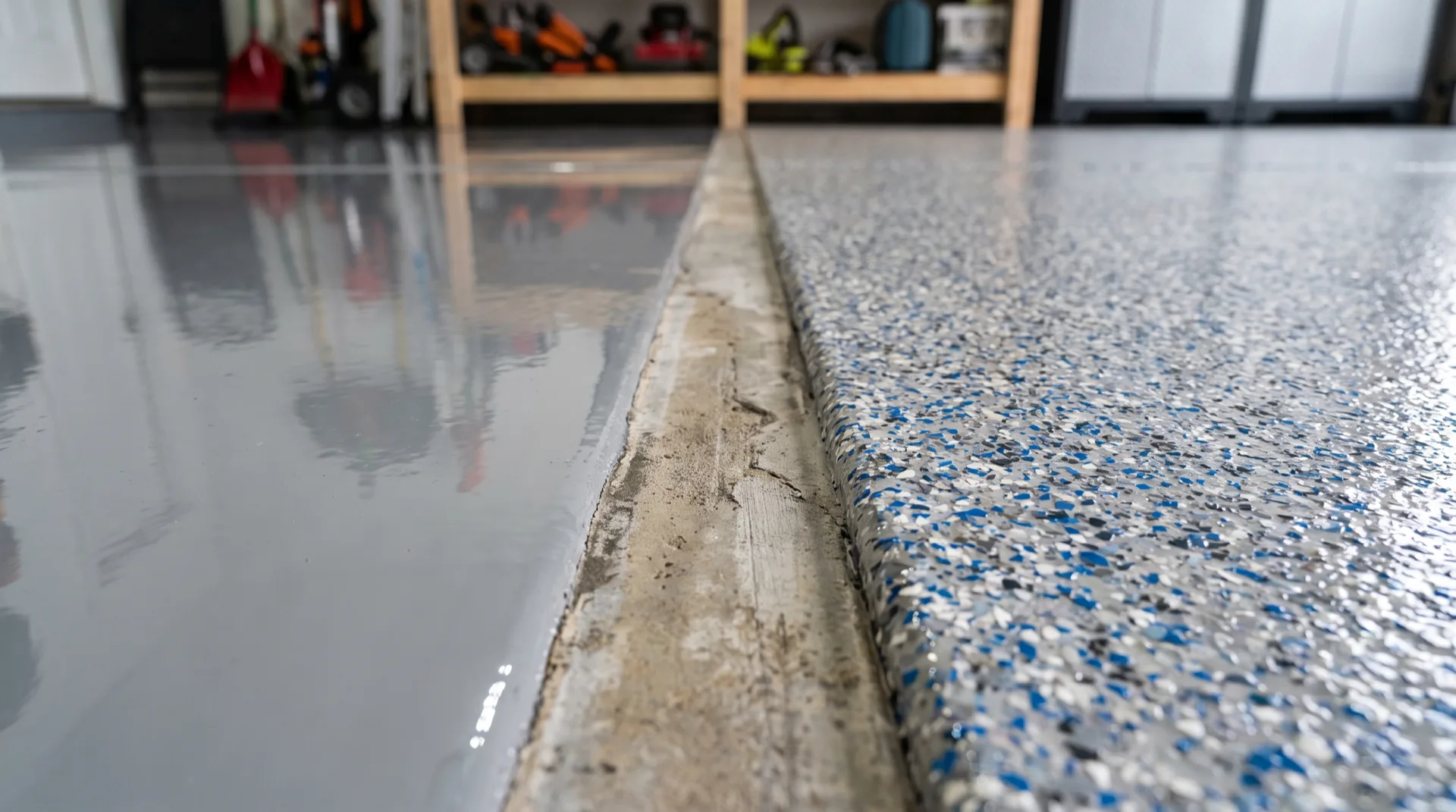
A two-part epoxy floor coating system uses resin and hardener applied directly as a liquid coating, while a three-part system adds a broadcast layer of quartz or sand aggregate between coats to build a thicker, mortar-style floor - the right choice for a San Antonio garage or business depends mainly on traffic level and the substrate's condition, not on one system being universally "better" than the other.
What "Two-Part" and "Three-Part" Actually Mean
The terminology describes how many distinct components go into the finished floor system, not the number of coats applied. A two-part system consists of resin and hardener, mixed together and rolled or squeegeed onto prepared concrete as a self-leveling liquid coating, typically finished with a urethane or polyaspartic topcoat for added durability and UV stability. A three-part system starts the same way but adds a third component - a graded aggregate, usually quartz sand or colored sand broadcast to excess into the wet base coat - which is then back-rolled with additional resin and finished with a topcoat. That aggregate layer is what gives three-part systems their characteristic thicker, more heavily built-up profile.
Build Thickness and Impact Resistance
The added aggregate in a three-part system typically results in a floor build of 1/8 inch or more, compared to roughly 10-20 mils (thousandths of an inch) for a standard two-part coating. This extra thickness translates directly into better impact and point-load resistance, which is why three-part mortar systems are the standard specification for environments like commercial kitchens, manufacturing floors, and heavy equipment bays where dropped tools or rolling loads are a regular occurrence. A typical residential garage or light-commercial space rarely generates this level of mechanical stress, which is part of why a well-specified two-part epoxy floor coating system is usually more than adequate outside of genuinely heavy-use environments.
Comparing Two-Part and Three-Part Systems
| Factor | Two-Part System | Three-Part System |
|---|---|---|
| Typical build thickness | 10-20 mils | 1/8 inch or more |
| Impact/point-load resistance | Good for typical use | Excellent, industrial-grade |
| Installation time | 1-2 days typical | 2-4 days typical |
| Relative cost | Baseline | 30-60% more |
| Best-fit use case | Garages, retail, light commercial | Kitchens, manufacturing, heavy bays |
The deciding factor is traffic, not preference: a three-part system's extra cost and installation time only pays off when the floor will actually see the heavy impact and point loads it's designed for - otherwise a two-part system delivers comparable everyday durability at a lower price.
Cure Time and Installation Disruption
Two-part systems generally cure faster and involve less installation disruption, since there's no aggregate broadcast and back-roll step to add time to the process. A typical residential garage floor can often go from bare concrete to a finished, walkable two-part coating within one to two days, weather and cure conditions permitting. Three-part systems require additional time for the aggregate broadcast step, the back-roll coat, and typically a longer overall cure window before the space can return to full use, which matters more for businesses that need to minimize downtime than for a homeowner who can simply park outside for an extra day.
Not Sure Which System Fits Your Floor?
We'll assess your traffic level and substrate to recommend the right build - two-part or three-part.
Request a Free QuoteCost Differences and What Drives Them
Three-part systems typically cost 30-60% more than a comparable two-part installation, and the premium comes from three main sources: the aggregate material itself, the additional labor required to broadcast and back-roll it evenly, and the longer overall installation timeline. For a typical two-car garage, this can mean a difference of several hundred to over a thousand dollars between the two approaches, depending on the specific topcoat and aggregate selected. Homeowners evaluating quotes should confirm exactly which system a contractor is proposing, since "epoxy flooring" as a category can refer to either build, and comparing a two-part quote against a three-part quote without understanding the difference makes an apples-to-oranges cost comparison that obscures what's actually being purchased.
Aesthetic and Design Differences
Beyond performance, the two systems also look and feel somewhat different underfoot. Two-part systems with a decorative flake or metallic topcoat offer a smooth, glossy, relatively thin-profile finish that reads as a coated floor. Three-part systems, because of their aggregate build, often have a slightly more textured, quartz-flecked appearance even before any color or flake is added, and some homeowners specifically prefer this more substantial, mortar-like look and feel for a workshop or heavy-use garage. Neither look is objectively better - it comes down to the specific aesthetic a homeowner or business wants alongside the performance requirements of the space.
When a Two-Part System Is the Right Call
For the large majority of San Antonio homeowners, a two-part epoxy system is the right specification. Typical residential garage traffic - vehicles, foot traffic, occasional dropped tools - falls well within what a quality two-part system with a durable topcoat handles for well over a decade. Retail showrooms, light offices, and similar low-impact commercial spaces are generally in the same category. Choosing two-part here isn't a compromise; it's matching the coating specification to the actual demands of the space, which is exactly how a knowledgeable contractor should approach any flooring project. For a broader overview of how coating specifications get matched to a business's needs, our epoxy floor coating 101 guide for San Antonio businesses walks through the full decision process from substrate condition through topcoat selection.
When a Three-Part System Is Worth the Investment
Three-part systems earn their higher cost in specific, genuinely demanding environments: commercial kitchens dealing with dropped equipment and constant wet traffic, manufacturing floors with rolling carts or heavy machinery, auto shops with vehicle lifts and dropped tools, and any space where forklift or pallet jack traffic is routine. In these settings, the extra build thickness directly reduces the likelihood of chipping, cracking, or point-load damage that would otherwise require frequent repair. A facility manager evaluating flooring options for this kind of environment should treat the three-part premium as a durability investment rather than an unnecessary upcharge, since the alternative is more frequent coating failure and repair costs down the line.
Getting an Accurate Recommendation for Your Space
The best way to determine which system fits a specific floor is a proper on-site assessment covering current traffic patterns, planned future use, substrate condition, and budget, rather than defaulting to whichever system a contractor happens to prefer installing. A contractor who explains the tradeoffs clearly - rather than upselling a three-part system to every customer regardless of actual need, or conversely cutting corners with two-part in a genuinely heavy-use commercial space - is the one worth hiring. Homeowners and facility managers researching epoxy flooring cost in San Antonio should keep this system distinction in mind when comparing quotes, since it's often the single biggest driver of price variation between contractors bidding on the same space.
Substrate Prep Requirements for Each System
Surface preparation matters for both systems, but the tolerance for imperfection differs somewhat between them. A two-part system, being thinner, telegraphs minor surface irregularities more readily, which makes proper diamond grinding or shot blasting to open the concrete pore structure and level minor high spots especially important before application. A three-part system's thicker aggregate build is somewhat more forgiving of minor surface unevenness simply because there's more material mass to work with, though it still requires the same fundamental prep - removing laitance, addressing any moisture issues, and profiling the concrete to the correct texture for proper adhesion. Neither system should ever be applied over inadequately prepped concrete, since poor adhesion is the single most common cause of coating failure regardless of which system is chosen, and no amount of aggregate thickness compensates for a surface that wasn't properly profiled beforehand.
Repair and Recoat Considerations Over Time
How each system ages and what repair looks like down the road is also worth factoring into the decision. A two-part system that develops localized wear or damage is generally straightforward to spot-repair or fully recoat, since the thinner profile means less material to remove and reapply, and color-matching a recoat to an existing two-part floor is usually manageable. A three-part system's thicker, textured build can be somewhat more involved to spot-repair invisibly, since matching the aggregate broadcast pattern and depth in a small repair area takes more skill than simply reapplying a liquid coating. This isn't a reason to avoid three-part systems where they're genuinely needed, but it's a practical consideration worth discussing with a contractor upfront, particularly for a commercial space that can't tolerate a mismatched-looking repair in a highly visible area.