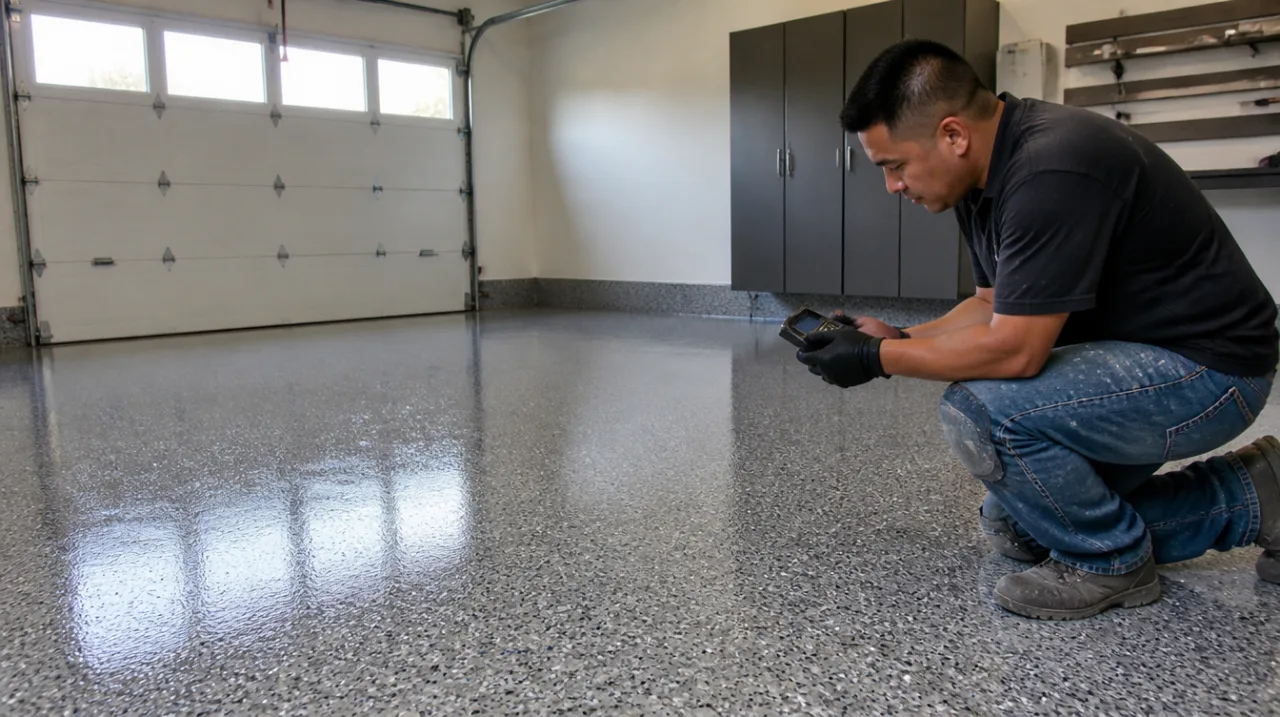
A standard epoxy garage floor in San Antonio is typically a three-day job on site, and the floor is usable in stages: light foot traffic after about a day, furniture and bins after one to two days, and vehicles after roughly three to seven days. Those numbers come from the product data sheet and the weather on the day, so the written estimate should state them for your system. If you are planning around a garage floor coating, think of the schedule as two clocks: the days the crew works, and the days the floor needs afterward before it carries the weight and heat of a parked car.
Quick answer: days on site, and days before you can use it
Plan for three consecutive working days on site and a full week before the floor is treated like any other floor. The crew is there for preparation, primer, the body coat, the decorative broadcast and the top coat. Each of those steps needs its own window, which is why an epoxy job runs longer than a single-visit system.
This guide is written from the owner's side of the schedule. It answers the planning questions: which days the crew is working, what you can and cannot do each day, and when each activity comes back. If you want the hour-by-hour detail of what the crew does inside one install day, our guide to what to expect during a garage floor epoxy installation covers it, and we will not repeat it here. For the speed difference between coating chemistries, see our polyaspartic cure time guide.
| Stage | Typical timing | What it means for you |
|---|---|---|
| Crew on site | 3 consecutive days | Garage fully cleared, access needed each morning |
| Light foot traffic | About 24 hours after the top coat | Shoes only, no dragging or turning |
| Furniture and bins | 1 to 2 days after the top coat | Lift, do not slide |
| Vehicle tires | 3 to 7 days after the top coat | Longer in cool weather, shorter in summer heat |
| Wet cleaning and chemicals | About 7 days after the top coat | Dry sweep only until then |
Treat every figure in that table as a typical range, not a promise. The manufacturer's published cure schedule for the exact product governs, and a reputable installer writes that schedule into the quote.
Day one: masking, grinding and repairs
Day one is preparation, and it is the day that decides whether the rest of the floor lasts. The crew masks the walls, door seals and any fixtures that stay, then grinds or shot blasts the slab to open the surface so the coating can grip it. The target is a concrete surface profile measured against the ICRI 310.2R scale, and for a thin-film garage system that is usually in the low CSP range.
Once the surface is open, the crew finds out what the slab is really like. Cracks are routed and filled, spalled edges are patched, and oil staining is treated or ground out. Repair materials need time to set before anything goes over them, so this is also the day a crack filler or patching compound is allowed to harden overnight.
On day one you will hear the grinder and see a vacuum system running most of the morning. Plan to be reachable by phone, because this is when a hidden problem is most likely to surface. Our garage floor coating prep guide explains why this step takes as long as it does.
Day two: primer and body coat
Day two is the chemistry day. The primer goes down first, soaks into the open surface and gives the body coat something to bond to. Then the pigmented epoxy body coat is rolled or squeegeed over it, in sections sized so the crew can finish each one before the material starts to set.
The body coat is also the layer that determines the color of the finished floor, so this is the day to be sure the sample you approved is the sample on the floor. Epoxy is a two-part resin, and the reaction starts the moment the parts are mixed. That is why crews mix in measured batches and place them quickly rather than mixing the whole job at once.
Some systems apply the primer and the body coat on the same day, and some leave the primer to cure overnight. Either way, the floor is off limits for the rest of the day. Keep pets, children and tools out of the garage, and keep the door closed so dust and insects stay out of the wet film.
Day three: broadcast, scrape and top coat
Day three is the decorative and protective day. While the body coat is still tacky, the crew broadcasts vinyl flake across it, either as a light scatter or as a full broadcast that completely covers the base. Once the film has hardened enough to walk on in spiked shoes, the crew scrapes and vacuums off the loose flake, then applies the clear top coat that seals everything.
The top coat is where the finished feel is set: gloss level, texture, UV stability and resistance to chemicals and hot tires. A urethane or polyaspartic top coat over an epoxy body coat is common, and our guide to epoxy vs polyaspartic garage floor cure time compares how those choices change the timeline.
The top coat also starts the clock for everything in the return-to-service table. Foot traffic, furniture and vehicles are all counted from the moment the final coat goes on, not from the day the crew arrived. If your quote lists a top coat, ask on which day it will be applied so you can mark the dates.
| Day | Crew work | Your job |
|---|---|---|
| Day 1 | Masking, grinding, crack and spall repair | Garage fully cleared, vehicles parked elsewhere |
| Day 2 | Primer and pigmented body coat | Keep the door closed, keep pets and children out |
| Day 3 | Flake broadcast, scrape, top coat | Confirm the top coat time, note the cure dates |
| Days 4 to 7 | No crew, floor cures | Follow the return-to-service table below |
Return to service table: foot traffic, furniture, vehicle tires, wet cleaning
Return to service happens in order of how much load and heat each activity puts on the floor. Foot traffic comes back first, furniture and bins next, vehicle tires later, and wet cleaning and chemicals last. Counted from the end of the top coat, a typical epoxy system with a urethane or polyaspartic top coat follows the schedule below.
| Activity | Typical wait | Why it waits |
|---|---|---|
| Walking, shoes only | About 24 hours | A soft film marks permanently under a heel |
| Bins, toolboxes, light furniture | 1 to 2 days | Point loads leave rings in a film that is still hardening |
| Parking a car | 3 to 7 days | Tires add weight, heat and a twisting load |
| Hot tire parking after a long drive | About 7 days | A warm tire can soften a coating that is still curing |
| Wet mopping, soaps, chemicals | About 7 days | Full chemical resistance needs the cure to finish |
| Heavy shelving and workbenches | About 7 days | High static loads need a fully developed film |
Vehicles are the last thing to return, and the reason is easy to see. A tire is heavy, it holds heat from the road, and it turns while it is parked. All three put more stress on a young coating than anything a person can do on foot. When you do move a car back in, pull straight in and out and avoid turning the wheel while stopped for the first week.
Two practical tips make the wait easier. First, park in the driveway or on the street for the whole week instead of testing the date. Second, put cardboard under anything you place on the floor early, so a corner or a foot cannot leave a permanent mark. Our pre-install checklist includes the items to move out before day one and the ones to keep out until the floor is ready.
How San Antonio summer heat shortens pot life and changes the schedule
Heat speeds the chemical reaction in epoxy, which shortens both pot life and working time, and in San Antonio summers that changes the shape of the day more than it shortens the job. Pot life is the time a mixed batch stays workable in the bucket. When slab and air temperatures climb, that window narrows, and the crew has to place material faster or mix smaller batches.
In practice, that means three things for the schedule:
- Earlier starts. Crews begin at first light so the heaviest coating work finishes before the afternoon peak.
- Smaller batches. Mixing less at a time keeps material from setting in the bucket or on the floor.
- Cure and traffic dates move earlier, but not by much. Warm slabs harden sooner, but the manufacturer's minimum still applies, and a quick surface set does not mean the film is ready for a tire.
Humidity matters as well. A damp morning can slow the surface cure and, in the worst cases, leave a cloudy film on some amine-cured epoxies. A reputable crew will watch the slab temperature against the dew point and reschedule rather than apply material in unsuitable conditions. For the full weather picture, see our guide to how weather affects epoxy floor coating installation in San Antonio, and for choosing a season see the best time of year to epoxy a garage floor.
What delays a job: moisture results, humidity, repairs found during grinding
Three things delay an epoxy install more often than anything else: a failed moisture test, high humidity at the time of application, and repairs discovered once grinding starts. None of them is a sign of a bad installer. They are the reasons a contingency day is worth planning for.
Moisture test results. Concrete releases water vapor, and epoxy is a film that traps it. Two common tests measure that: calcium chloride testing under ASTM F1869 and in-situ relative humidity testing under ASTM F2170. If the readings are above the limit the product allows, the slab needs a moisture-mitigating primer or a different plan, and that adds material and a day. Our post on vapor barrier primer options explains what the next step looks like.
Humidity and dew point. If the slab surface sits close to the dew point, condensation can form on the concrete and ruin adhesion. The crew checks slab temperature and relative humidity before the primer goes down. A damp, cool morning in a closed garage is the usual culprit, and the fix is often just a later start.
Repairs found during grinding. Grinding shows the concrete as it really is. Hairline cracks that were invisible under dirt, hollow areas and old patching all show up on day one. Repairs need time to set, and a large repair can push the primer to day two. The moisture and repair issues are why a quote should state which items are included and which are priced if found.
Planning around the cure: what to arrange before the crew arrives
The easiest way to a stress-free install is to arrange the week before the crew arrives, not after it starts. Three days on site plus a week of limited use means about ten days where the garage behaves differently. A short checklist covers most of it.
- Clear the garage completely. Everything on the floor comes out before day one, including shelving that sits on the slab and anything stored along the walls.
- Park elsewhere for the full week. The driveway or the street is fine. Count the days from the top coat, not from the first day of work.
- Choose where the items will wait. A spare room, a covered patio or a rented unit works, as long as it is dry and secure.
- Confirm door and power access. Crews need power for grinders and mixers and a way to ventilate the space.
- Tell the crew about pets and children. Wet film and tools are not safe around either, and a baby gate does not stop paws or a ball.
- Ask for the written cure schedule. The quote should list the foot, furniture and vehicle dates for your system, so you are not guessing.
If you are comparing contractors, ask each one the same three questions: how many days on site, which day is the top coat, and when can a car go back in. The answers tell you how much the schedule has been thought through, and a written answer is more useful than a verbal one. If you are also weighing doing the work yourself, our comparison of DIY vs professional garage floor epoxy installation shows how the timeline changes without a crew.
When you are ready to book, call (830) 355-3303 for a free on-site measure and written quote. The quote names the system, the preparation method, the days on site and the cure schedule for your garage, so you can plan the week before it starts.
Frequently asked questions
How long does an epoxy garage floor take to install?
A standard residential garage is typically a multi-day job, with preparation, primer, body coat and top coat each needing their own window. The crew is usually on site across several consecutive days.
How long before you can park on a new epoxy floor?
Vehicle traffic is the last thing a floor is cleared for, well after foot traffic, because tires apply heat and point loading. The manufacturer's full cure time governs it and should be stated on the estimate.
Can you walk on an epoxy floor the next day?
Light foot traffic is usually permitted well before vehicles, but the exact timing depends on the product and the ambient temperature during cure. Walking on it too early marks the surface permanently.
Does heat speed up or slow down epoxy cure?
Heat accelerates the chemical reaction, which shortens both pot life and working time. In San Antonio summers that often means earlier start times and smaller mixed batches rather than a faster overall schedule.
What can delay an epoxy floor installation?
A failed moisture test, high humidity during application, and substrate repairs discovered once grinding begins are the three most common causes, which is why a contingency day is worth planning for.