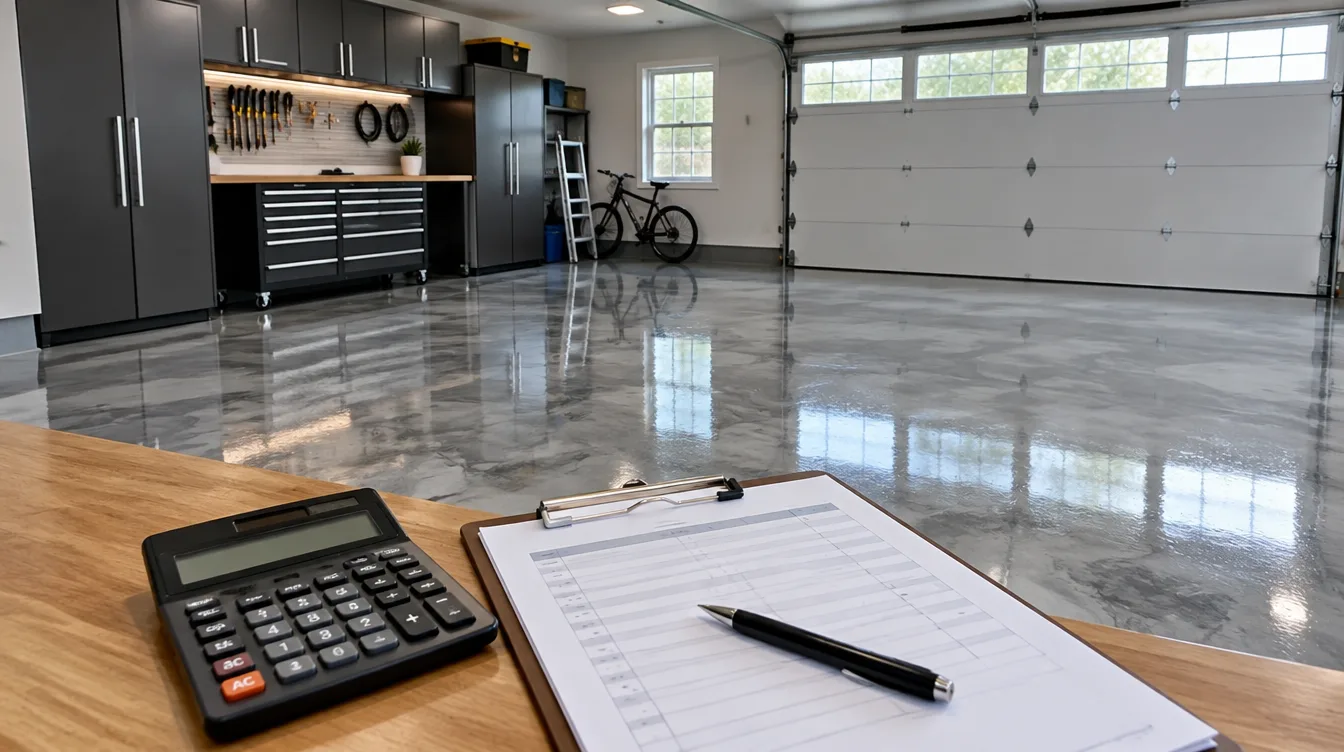
You can safely save money on an epoxy floor by choosing a simpler color and finish, by scheduling and staging the work sensibly, and by keeping the existing slab, and you cannot safely save by cutting surface preparation, thinning the product or dropping a coat, or skipping the moisture test. The first group lowers the price without touching how long the floor lasts. The second group lowers the price and shortens the life of the floor, usually to the point of a full redo. If you want the system options behind a budget, start with our epoxy floor coating page, then use this guide to decide where to trim.
Quick answer: the three savings that are free and the three that cost you the floor
Three savings cost nothing in service life: color and finish choices, scheduling and staging, and keeping the existing slab. Three savings guarantee trouble: cutting preparation, thinning the product or dropping a coat, and skipping the moisture test.
| Decision | Safe or false saving | What it does to the floor |
| Plain color instead of decorative flake or metallic | Safe | No change in durability |
| Standard lead time, work staged in phases | Safe | No change in durability |
| Keep the existing slab, repair rather than replace | Safe | No change if the slab is sound |
| Skip or shorten surface preparation | False | Bond fails, coating peels |
| Thin the product or drop a coat | False | Wears through early |
| Skip the moisture test | False | Moisture lifts the coating |
This guide does not explain why contractors price the same floor differently, which our post on why epoxy floor quotes vary covers. It also does not break down total cost by size, which our guide to epoxy floor cost by square footage handles. It answers the narrower question a price-sensitive buyer actually has: which savings are real and which are traps.
Safe saving: color, finish and decorative choices
Choosing a plain solid color over decorative flake or metallic is the easiest saving because it removes cost without touching the coating that protects the slab. The system underneath, meaning the prepared slab, primer and body coat, can be identical. What you drop is material and labor spent on appearance.
Our two car garage cost guide shows how the price steps up with decoration. Multi-color flake runs $6 to $8 per square foot and metallic runs $7 to $10, and a plain solid color typically costs less than either. A solid color still gets a clear topcoat for wear and chemical resistance, so the durability is intact. If you like the look of flake but want the lower price, a single-color flake broadcast sits in the middle. Our comparison of epoxy flake vs solid color garage floors shows what each finish looks like in use, including how flake hides dirt and wear.
Gloss level is another free choice. A satin or semi-gloss finish typically adds little or nothing to the price and hides tire marks and dust better than a high gloss. The practical rule is to spend decorative money where people see the floor and keep it simple where they do not. A workshop wall, a storage room or a back-of-house area does not need a metallic finish.
Safe saving: scheduling, staging and coating in phases
You can reduce cost by taking the standard lead time, by clearing the space yourself, and by combining areas into one visit. None of these change the floor, because they reduce the contractor's cost of doing the work, not the work itself.
Rush scheduling is a premium. A contractor who has to move other jobs, add a crew or work evenings charges for it. Accepting a normal lead time removes that charge, and on a garage there is rarely a reason to hurry beyond convenience.
Clearing the space yourself is the one piece of preparation worth doing. Moving vehicles, shelves, bikes and stored boxes out of the work area saves crew time on the day. What you should not do is attempt the technical preparation, which the false-saving sections below explain.
Combining areas into one visit is the staging saving. A crew's setup, equipment transport and containment cost roughly the same for a small floor as for a large one, as we explain in the post on cost by square footage. Coating a garage, a laundry room and a mudroom in the same visit spreads that fixed cost over more area, so the rate per square foot drops. Phasing works in the other direction for large floors: coating a warehouse or shop in sections lets the business keep operating, which avoids the downtime premium that overnight and weekend work carries.
Safe saving: keeping the existing slab rather than replacing it
If the concrete is sound, the cheapest correct decision is to coat it, not replace it. Cracks, minor spalls and surface staining are repairable, and a properly prepared slab has already finished curing and shrinking.
Homeowners sometimes assume that a stained, cracked or pitted garage floor needs replacement before coating. It usually does not. Crack repair is a standard step, and the garage cost guide lists it as an added line item rather than a reason to tear out the slab. Surface damage from oil, tires and years of moisture cycling is ground away during preparation.
The exception is a slab with structural problems: heaving, severe settlement or active water intrusion. Those need to be fixed first, and a coating on top does not solve them. The practical test is a visit from a contractor who can read the slab. If the concrete is sound, keeping it is a real saving, and it avoids the cost of demolition, hauling and a new pour.
Keeping the slab also keeps the floor level and the drainage you already have, which matters in garages that slope to a door and in commercial spaces with floor drains.
False saving: cutting surface preparation
Cutting surface preparation is the most expensive way to save money on an epoxy floor, because preparation is what the coating bonds to. A coating on a poorly prepared slab does not fail on day one. It fails in a year or two, in sheets, at the hot tire lane or the door threshold.
Proper preparation means mechanical profiling with a diamond grinder or shot blaster, plus dust containment and vacuuming, to give the slab a defined roughness. The scale is ICRI 310.2R, where CSP 1 to 9 describes how rough a prepared surface is, and the coating thickness determines the profile needed. Acid etching, which some budget quotes use, does not give that profile on most garage slabs. Our guide to concrete surface preparation for epoxy flooring and our comparison of shot blasting vs diamond grinding explain the methods.
The saving is small. In our garage cost guide, diamond grinding adds roughly $0.50 to $1.50 per square foot to the total, so skipping it on a 450 square foot garage saves roughly $225 to $675. A floor that peels turns that into a full strip and reinstall, which costs several times the grinding line.
The same logic answers the do-it-yourself preparation question. Mechanical profiling needs a diamond grinder or shot blaster and dust control, and a slab prepared incorrectly is the most common cause of coating failure. Our comparison of DIY versus professional epoxy installation covers where owner work makes sense and where it does not, and on a garage floor the preparation is firmly in the second group.
False saving: thinning product or dropping a coat
Thinning product or dropping a coat lowers material cost and service life together, because mil build is what resists abrasion and impact. A thin system in a working garage or shop wears through at the traffic lanes years earlier than a full-build system, and the recoat then costs more than the original saving.
The ways to cut a system down are easy to miss in a quote. A contractor can use a lower-solids product, which leaves less cured film per gallon, apply fewer coats, or skip the topcoat. A 100% solids epoxy leaves a film that matches what was applied, while a lower-solids product shrinks as the carrier evaporates, so the same wet thickness gives less cured thickness. Our guide to industrial epoxy floor thickness explains the wet versus dry mil difference, and why a quote that says only a mil number without saying which can mislead.
The topcoat is the piece most often dropped, and it matters in San Antonio. The topcoat carries UV stability, abrasion resistance and chemical resistance, and a system without one yellows and wears faster in heat and sun. Our garage cost guide notes that a three-coat system costs 40 to 60 percent more than a one-coat system, and it also performs dramatically better in Texas heat. That is a real price difference, but it buys the service life, so the comparison is cost per year rather than cost today.
Ask for the product, the solids content, the number of coats and the dry mil thickness of each in writing. That one request makes the thin quotes visible.
False saving: skipping the moisture test
Skipping the moisture test is a false economy because the test costs very little compared with the install, and a moisture failure usually means removing and redoing the whole floor. Moisture moving up through a slab pushes against the coating from underneath, and the coating lifts, blisters or delaminates.
The two common tests are ASTM F1869, which uses calcium chloride to measure moisture vapor emission from the surface, and ASTM F2170, which uses in-situ probes to measure relative humidity inside the slab. In our garage cost guide, moisture vapor emission testing costs $75 to $150, and a moisture-tolerant primer or vapor barrier coat, when the slab needs one, adds $0.75 to $1.50 per square foot. San Antonio's expansive clay soils make moisture common, so the test is not optional.
The test is a short visit and a small fee. A failed floor is a strip, a regrind, a new system and a second round of downtime. A quote that leaves the test out is cheaper only because the risk has been moved to you. Our guide to moisture testing for epoxy flooring explains what the results mean and what to do when a slab fails.
Cost against service life: what each decision actually buys
The way to judge any saving is to ask what it costs in years of service, not only in dollars today. A saving that costs nothing in life is a good decision, and a saving that cuts life is usually a loss once the replacement is counted.
| Decision | Saves up front | Effect on service life | Verdict |
| Plain solid color | Decorative material and labor | None | Take it |
| Standard lead time | Rush premium | None | Take it |
| Combine areas in one visit | Repeated setup cost | None | Take it |
| Keep a sound slab | Demolition and new pour | None | Take it |
| Cut surface preparation | Grinding line | Peels in one to two years | Refuse it |
| Thin system or fewer coats | Some material | Wears through early | Refuse it |
| Skip the moisture test | A small test fee | Risk of full failure | Refuse it |
Use the table to read a low quote. If the low quote is low because of the first four rows, it is a good deal. If it is low because of the last three, it is pricing a different, shorter-lived floor, and the comparison is not like for like. Our garage cost guide gives the per-system ranges to check a quote against, and our garage floor epoxy cost breakdown shows which lines carry the price.
The simplest filter is to ask every bidder for the same four things in writing: the preparation method, the product and its solids content, the number of coats with the dry mils of each, and whether a moisture test is included. Quotes that answer all four can be compared. Quotes that do not are leaving something out, and it is usually one of the three false savings.
Frequently asked questions
What is the cheapest way to coat a garage floor properly?
Choose a plain solid color over a decorative flake or metallic finish, accept a standard lead time rather than a rush, and keep the existing slab. None of those three shorten the life of the floor.
Can I save money by preparing the floor myself?
Usually not. Mechanical profiling needs a diamond grinder or shot blaster and dust containment, and a substrate prepared incorrectly is the most common cause of coating failure, which turns a small saving into a full redo.
Is a thinner epoxy coating a reasonable way to cut cost?
It reduces material cost and service life at the same time. Mil build is what resists abrasion and impact, so a thinner system in a working garage or shop tends to need recoating years earlier.
Why is skipping the moisture test a false economy?
Moisture moving up through a slab lifts a coating off it. The test costs very little relative to the install, and a failure found afterward usually means removing and reinstalling the entire floor.
Is the cheapest quote ever the right one?
It can be, but only once the quotes are comparable. If one excludes prep, specifies fewer mils or omits a moisture test, it is pricing a different floor rather than the same floor for less.
If you are weighing a budget, call (830) 355-3303 for a free on-site measure and written quote, or review our epoxy floor coating page to compare systems before you ask for bids.