A professionally installed epoxy floor in San Antonio costs roughly $4.50 to $9.00 per square foot at 400 square feet and $3.25 to $7.00 per square foot at 2,400 square feet, and the rate falls as the floor gets bigger because the fixed costs of the job do not. That puts a 400 square foot floor at about $1,800 to $3,600, a 600 square foot floor at $2,400 to $4,800, a 1,000 square foot floor at $3,500 to $7,500 and a 2,400 square foot floor at $7,800 to $16,800. For the system options behind those numbers, see our epoxy floor coating overview.
Quick answer: the installed range per square foot and why area moves it
The installed rate for a standard professional epoxy system in San Antonio sits at $3 to $6 per square foot for residential work and $4 to $8 per square foot for commercial and industrial specifications, which are the same ranges published on our main epoxy page. Those are the headline rates. What this post adds is how the rate moves with the size of the floor, because a quote for 400 square feet and a quote for 2,400 square feet are not the same rate multiplied by a different number.
Four costs on every job do not scale with area. The crew has to load in, set up the grinder and dust extraction, contain the work area, and spend at least one working day on site whether the floor is small or large. On a 400 square foot floor those costs are spread over very few square feet, so the effective rate climbs. On a 2,400 square foot floor the same costs are spread six times wider and the rate drops. Materials and grinding labor, by contrast, do scale with area, which is why the rate falls quickly at first and then flattens.
If you want the broader picture of what drives epoxy pricing in general, our guide on how much epoxy flooring costs in San Antonio covers it. This post stays on one question: what does your specific number of square feet do to the price.
Cost at 400 square feet: a single bay or utility room
A 400 square foot floor typically costs $1,800 to $3,600 installed, which works out to $4.50 to $9.00 per square foot, and it sits above the $3 to $6 headline rate because the fixed costs dominate. A one car garage with extra depth, a large utility room, a small workshop or a retail back room all land near this size. If the space is a garage, our garage floor epoxy cost guide gives the budget view by garage size and system.
At this footprint the system choice swings the total more than anything else. A single color 100% solids epoxy with a clear topcoat sits at the low end. A full broadcast flake system with a polyaspartic or urethane topcoat sits at the high end, and a metallic system can run past it. The slab condition matters too, because crack repair and a moisture vapor barrier primer are priced per job or per square foot on top of the base system and take a larger share of a small total.
Below roughly 400 square feet, many contractors apply a minimum charge rather than pricing strictly by area. A 250 square foot floor still needs the same grinder, vacuum, containment and crew day, so it can quote close to a 400 square foot floor. If you are pricing a floor this small, ask whether the quote is a per square foot rate or a minimum, since the two can differ by hundreds of dollars.
Cost at 600 square feet: a large single or small double garage
A 600 square foot floor typically costs $2,400 to $4,800 installed, or $4.00 to $8.00 per square foot. This is the footprint of a large two car garage, a garage with a workshop bay, or a small commercial unit, and it is one of the most common sizes quoted in the San Antonio area.
The rate here is already lower than at 400 square feet at both ends of the range, because the crew day is now being used more fully. A flake system with a clear topcoat is the common middle choice and usually prices in the middle of this band. If you only need a rough budget, multiply the area by $5 to $6 for a standard flake system and then confirm against a measured quote.
For a detailed look at a typical two car footprint, including per system pricing and what a homeowner usually pays, our two car garage epoxy floor cost guide breaks the garage case down line by line. The numbers in this post and in that guide are meant to be read together, with the garage guide giving system detail and this post showing how the rate changes once the floor grows past a standard garage.
Cost at 1000 square feet: a three car garage or small commercial suite
A 1,000 square foot floor typically costs $3,500 to $7,500 installed, or $3.50 to $7.50 per square foot. That is the size of an oversized or tandem garage, a three car garage with a side bay, a small shop, or a single tenant commercial suite.
At this size the effective rate begins to approach the published $3 to $6 residential headline for standard systems. The fixed costs are now a smaller share of the total, and a crew can often complete grinding, primer and body coat in a rhythm that wastes less time between steps. Decorative systems still run above the headline rate here, because a full broadcast flake or metallic finish adds material volume and extra labor steps that scale with area.
Commercial specifications at this size are priced at the commercial band of $4 to $8 per square foot, which means a 1,000 square foot suite built to an industrial specification lands between $4,000 and $8,000. The difference from a residential floor of the same size is usually the system: thicker film build, a chemical or abrasion resistant topcoat, and a documented surface preparation to a specified profile. For how commercial pricing is built and what it covers, see our commercial epoxy flooring cost guide.
Cost at 2400 square feet: light commercial and where rates flatten
A 2,400 square foot floor typically costs $7,800 to $16,800 installed, or $3.25 to $7.00 per square foot, and this is where the rate stops falling quickly. A light commercial unit, a small warehouse bay, a showroom or a large detached shop all sit around this size.
The rate flattens because the fixed costs are now almost fully absorbed. Going from 400 to 1,000 square feet cuts the effective rate noticeably. Going from 1,000 to 2,400 square feet cuts it by much less, because by that point the cost is mostly material and grinding labor, which scale in direct proportion to area. Beyond roughly this size the rate keeps easing, but slowly, and the larger savings come from choosing the right system rather than from adding area.
At commercial specifications of $4 to $8 per square foot, a 2,400 square foot floor ranges from $9,600 to $19,200. A job this size also introduces scheduling effects that do not show up in a rate table. Phasing the work around business hours, cutting joints and managing foot or forklift traffic during cure can add labor that an empty residential floor never needs, and that is why the quote for a working facility can sit near the top of the band.
Comparison table: area against total, rate per square foot and typical system
| Floor area | Typical space | Installed total | Rate per sq ft | Typical system |
| 400 sq ft | Single bay, utility room, small shop | $1,800 to $3,600 | $4.50 to $9.00 | Solid color or partial flake |
| 600 sq ft | Large single or small double garage | $2,400 to $4,800 | $4.00 to $8.00 | Full flake with clear topcoat |
| 1,000 sq ft | Three car garage, small commercial suite | $3,500 to $7,500 | $3.50 to $7.50 | Flake or solid, commercial topcoat |
| 2,400 sq ft | Light commercial, large shop | $7,800 to $16,800 | $3.25 to $7.00 | Solid, flake or industrial specification |
Read the table by row, not by column. Within a single row, the low end is a thinner solid color or standard flake system on a sound slab and the high end is a decorative or heavy duty system on a slab that needs repair. Between rows, the pattern to notice is that both ends of the rate range fall as the floor grows, while the total rises. The totals are planning ranges, not quotes, and a measured on-site estimate always governs.
The fixed costs that do not shrink with the job: mobilization, grinding setup and minimum charges
Fixed costs are the reason a small floor costs more per square foot, and they come in four forms: mobilization, grinding setup, containment and the crew minimum. Understanding each one makes it easier to read a quote and to see why two floors of different sizes should not be priced at the same rate.
Mobilization is the cost of getting a crew, a vehicle and equipment to your site and back. It is the same for 400 square feet as for 2,400, and it is usually built into the rate rather than shown as a separate line.
Grinding setup covers the diamond grinder, dust extraction and vacuum that prepare the slab. Proper preparation is what makes the coating bond, and the equipment setup takes the same time regardless of area. Where preparation needs to meet a specified surface profile, the governing reference is ICRI 310.2R, which defines concrete surface profile from CSP 1 to CSP 9, and the grind is matched to the coating thickness the system requires.
Containment and protection means masking walls, covering cabinets and sealing doorways so grinding dust and coating material stay where they belong. On a small floor with a lot of perimeter, this takes a surprising share of the day.
The crew minimum is the smallest day a crew will work. A contractor cannot send three people to a site for two hours, so a very small floor is priced as a full day. This is the single biggest reason the rate climbs steeply below 400 square feet.
Slab moisture is another cost that does not scale with area in the way most owners expect. Moisture testing to ASTM F1869 (calcium chloride) or ASTM F2170 (in-situ relative humidity) is a per job step, and if a slab fails, a vapor barrier primer adds material and labor. On a small floor this can raise the effective rate noticeably, while on a large floor it spreads more thinly. If you want to compare quotes on this basis, our post on why epoxy floor quotes vary so much in San Antonio walks through the line items that separate a low bid from a complete one.
How to use these ranges when you have your own square footage
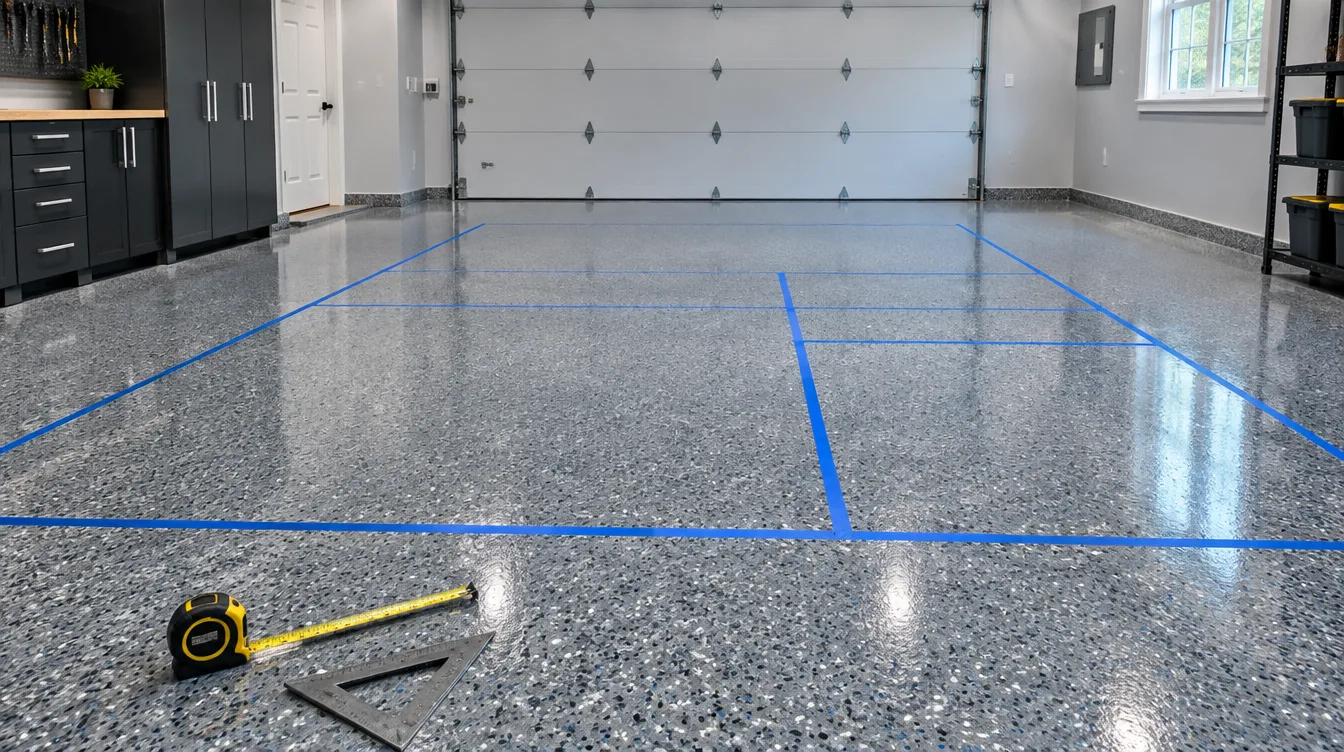
Start with a measured area, not an estimate. Measure the length and width of each section of the floor, multiply them, and add the sections together, leaving out any area that will be covered by a permanent fixture. Round to the nearest ten square feet and use that number to read the table above.
If your floor falls between two rows, interpolate. An 800 square foot floor, for example, sits between the 600 and 1,000 square foot rows, so a planning range of roughly $3,000 to $6,000 is reasonable. Then adjust for the three things that move a quote more than area does: the system you choose, the condition of the slab and whether the space is a home or a working facility. A thin solid color on a clean slab will price near the bottom of any row, and a full flake or metallic system on a cracked, moisture affected slab will price near the top.
Finally, ask for the measured square footage to appear as its own line on the estimate. When the area is written down, you can divide the total by it and check the rate against this post, and you can see immediately whether a quote is priced by area or by minimum charge.
Frequently asked questions
How much does it cost to epoxy a 600 square foot floor?
A 600 square foot floor usually lands in the mid four figures for a professionally installed flake or solid system, and the rate per square foot is higher than a larger job because grinding setup and mobilization are fixed regardless of area.
Why is the per square foot price lower on bigger floors?
Mobilization, equipment setup, containment and the crew's minimum day do not change with area. Spreading those fixed costs over more square feet lowers the effective rate, which is why a 2400 square foot job quotes well below a 400 square foot one.
Is there a minimum charge for a small epoxy floor?
Most contractors apply a minimum because a small floor still needs the same grinder, vacuum, containment and crew day as a larger one. Below roughly 400 square feet the minimum often sets the price rather than the area does.
Does the system type change the cost more than the size?
Often yes. Moving from a thin solid color to a full broadcast flake or a troweled mortar system can change the rate more than doubling the floor area does, because material volume and labor steps both increase.
Should I get a floor measured before accepting a quote?
Yes. Quotes built on a stated size rather than a measured one are a common source of disputes, and the measured square footage should appear as a line item on the estimate so the numbers can be checked.
If you have a floor to price, call (830) 355-3303 for a free on-site measure and written quote, or read our epoxy floor coating page to compare systems before you book.