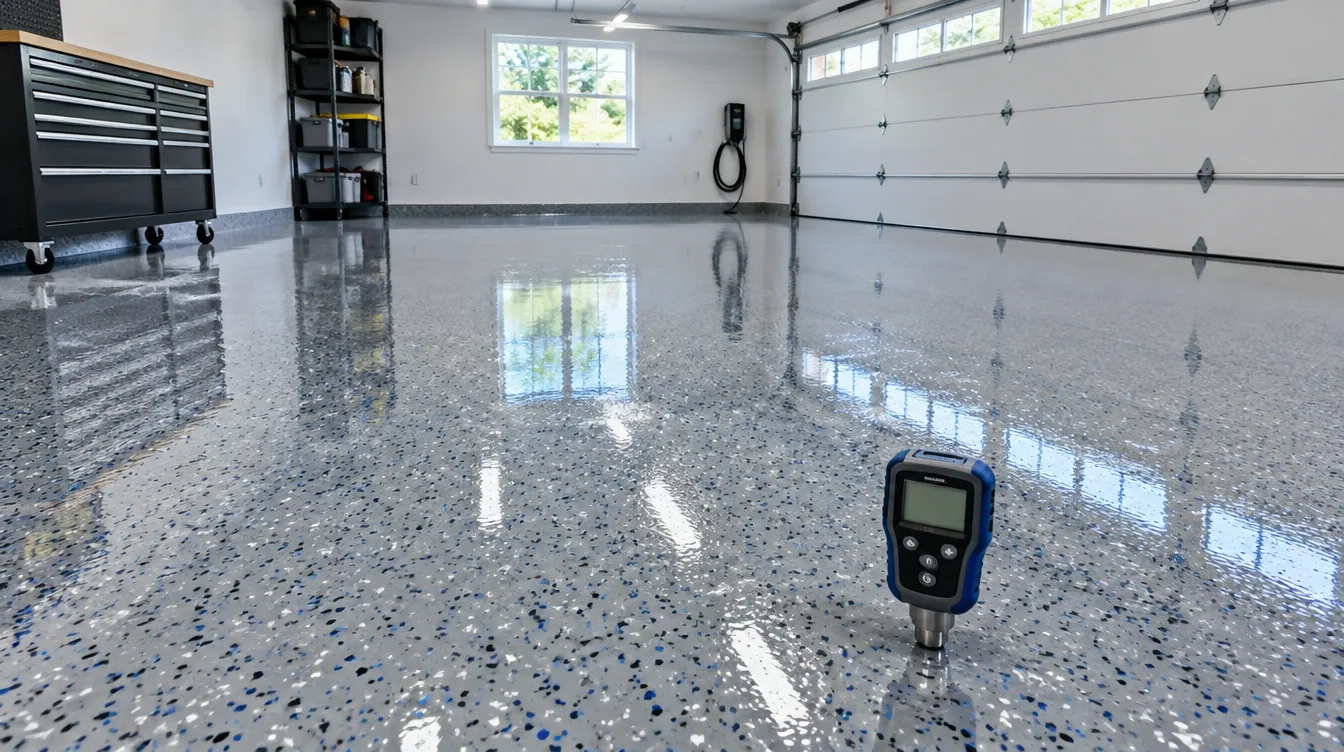
A professionally installed garage or home epoxy floor is typically built to roughly 10 to 20 mils of dry film, or more with a full flake broadcast, while a big-box kit delivers about 2 to 6 mils, so the two are not the same product. A mil is one thousandth of an inch, and the thickness you get is set by how much material is applied per square foot, not by how many coats are claimed. For the system we install in garages, see our epoxy garage floor page. This guide covers residential thickness only, and shows how to check the number from the material quantity on your estimate.
Quick answer: the mil range a home garage floor should be
A home garage floor should be built to roughly 10 to 20 mils of dry film for a standard professional system, with decorative flake systems sitting in the upper half of that range or above it. That is substantially thicker than the 2 to 6 mils a consumer kit leaves on the slab, and it is built up through a primer, a body coat and a topcoat rather than applied in a single pass.
The exact figure for your floor comes from the manufacturer's data sheet for the system chosen, which states a coverage rate for each coat. The ranges in this post are typical planning numbers, consistent with what we publish elsewhere on this site, and the data sheet controls.
Residential thickness is a smaller question than industrial thickness. A garage sees passenger vehicles, hot tires, dropped tools and the occasional spill, which is a modest load next to forklift traffic. Our guide to industrial epoxy floor thickness covers load ratings and builds for warehouse and heavy equipment floors, and this post deliberately stays out of that territory. The sections below explain what a mil is, why a kit is a different product, what standard residential builds look like, and how to verify thickness from an invoice.
What a mil is and why coverage rate determines it
A mil is one thousandth of an inch of dry film thickness, and coverage rate is the same number seen from the other side. If you spread a gallon of coating over a large area, the film is thin. Spread it over a small area and the film is thick.
The relationship is fixed by arithmetic. One gallon of a 100% solids coating covers about 1,604 square feet at a thickness of one mil. Divide that by the number of mils you want and you get the coverage rate. At 10 mils, a gallon covers about 160 square feet. At 20 mils, it covers about 80 square feet. A coating that is not 100% solids loses part of its volume as water or solvent evaporates, so the dry film is thinner than the wet film. The formula for dry film is:
Dry mils = 1,604 x solids fraction / square feet covered per gallon
This is why thickness is specified in mils and not in coats. Two coats can be 4 mils each or 16 mils each, and the floors will behave very differently. Our guide to two-part versus three-part epoxy systems explains how build relates to impact resistance, and the industrial guide above explains wet versus dry film in more detail.
Thickness is what resists abrasion and impact. A thin film wears through at the tire path and the door threshold, and a thicker film takes longer to do the same. It also hides more of the slab's surface variation, which is why thicker systems look more even.
Why a big-box kit at a few mils is a different product
A big-box kit delivers a few mils because it is a different product, a thinner, lower-solids coating sold to cover a large area from a small container. The label claim and the resulting film are the same number viewed two ways: a bigger coverage claim means a thinner film.
Many consumer kits marketed as epoxy are a water-based blend, not a two-part 100% solids epoxy, as our comparison of DIY versus professional epoxy installation explains. A water-based product at roughly half solids loses about half its wet thickness as it dries. Here is an illustration, using round numbers rather than any specific product: a kit claiming 500 square feet from 2.5 gallons covers 200 square feet per gallon. At 50 percent solids, that is 1,604 x 0.5 / 200, about 4 dry mils. That is a thin film for a floor that takes tires.
Kits also tend to skip mechanical preparation and rely on an acid etch, and they are applied without the equipment and the experience needed to hit even coverage. A film that is thin on paper is usually thinner in places, because rolling by hand varies. The result is the pattern most homeowners describe: the floor looks good for a season, then lifts at the tire contact zones.
The right comparison is therefore not two thicknesses of the same thing. A kit at a few mils and a professional flake system at 15 to 20 mils differ in solids content, in chemistry, in preparation and in how much material is on the floor. The thickness is the easiest of those differences to measure.
Standard residential builds: thin solid, flake broadcast, full chip
Three builds cover most residential garages: a thin solid color, a flake broadcast and a full chip. Each adds material, and each sits higher in the range.
Thin solid color. A primer, a single pigmented body coat and a clear topcoat. This is the lightest professional build, commonly in the range of 8 to 12 mils, which is the figure our garage cost guide gives for a professional 100% solids system. It looks clean and uniform, and it is the baseline.
Flake broadcast. A body coat is rolled on, and decorative flake is broadcast into it, usually to a partial or heavy cover, and then topcoated. The flake adds both texture and thickness, and the topcoat locks it in. These builds commonly fall in the 10 to 20 mil range that we cite for a standard two-part system, with a heavy broadcast and an extra topcoat at the upper end.
Full chip. The flake is thrown until the wet coating can take no more, then excess is removed and the floor is sealed with one or two topcoats. This creates a uniform, tile-like surface, and it is the thickest of the three, roughly 20 mils or more. Our comparison of epoxy flake versus solid color garage floors shows how each finish looks and wears.
The topcoat matters as much as the body coat. A UV-stable topcoat, such as the polyaspartic we use over the epoxy base, is what keeps a garage floor from yellowing in Texas sun, and it adds wear resistance without adding much thickness. A thick floor under a weak topcoat still scuffs and discolors.
Thickness table: system against mils, expected life and typical use
| System | Typical dry mils | Expected life under garage use | Typical use |
| Consumer kit, water-based | About 2 to 6 | Often 1 to 3 years in Texas conditions | Storage corner, light use |
| Professional thin solid color | About 8 to 12 | Many years with proper prep | Clean, uniform garage floor |
| Professional flake broadcast | About 10 to 20 | A decade or more with proper prep | Daily parking, decorative finish |
| Full chip broadcast | About 20 or more | A decade or more with proper prep | Daily parking, hot tires, workshop |
The expected-life column follows what we publish on our garage pages: kits last one to three years on average under Texas conditions, and a professionally installed 100% solids system routinely lasts a decade or more. The mil ranges are typical planning figures and overlap between rows, because products differ. The data sheet for the specific system sets the real build.
Verifying delivered thickness from the material quantity on the invoice
You can estimate how thick your floor will be by working back from the material, because the quantity of product applied over a known area fixes the average film. This is why the gallons or kits used should appear on the estimate, along with the measured square footage.
The method has three steps. First, take the gallons of each coat and the area. Second, divide the area by the gallons to get square feet per gallon. Third, divide 1,604, multiplied by the solids fraction, by that number to get dry mils.
Here is a worked example for a 450 square foot garage, which is a typical two-car footprint. Suppose the body coat is a 100% solids epoxy and the estimate lists 3 gallons. That is 150 square feet per gallon, which gives 1,604 / 150, about 10.7 mils. If the estimate lists only 1.5 gallons for the same garage, that is 300 square feet per gallon and 1,604 / 300, or roughly 5 mils, which is a kit-level film priced as a professional install. The calculation does not require any trust in the contractor's claim.
Three practical points make this work. Allow for waste, since some material stays in the pail, on the roller and in the pores of the slab, so the real film is a little thinner than the theoretical one. Compare like with like: the arithmetic assumes 100% solids, and a lower-solids product needs a larger quantity for the same dry film. And ask for the data sheet, which states the coverage rate the manufacturer intends for each coat.
During application, installers check wet film thickness with a notched gauge, and the quantity check on the invoice is the homeowner's version of the same control. Preparation matters here as well, because an open, porous slab absorbs the first coat. Our guide to concrete surface profile and matching the grind to the coating explains the profile, and thickness that disappears into the slab never reaches the surface.
Where more mils stop helping in a residential setting
More mils stop helping once the film is thick enough for the use, and in a home garage there is a sensible ceiling. Beyond what the use case requires, extra thickness adds cost and cure time without adding useful performance.
Three reasons explain this. First, a garage does not carry industrial loads, so there is no point specifying a build designed for forklifts or heavy point loads. Second, thickness does not repair a weak foundation. A thick coating over a slab that was poorly prepared or is passing moisture still fails, because adhesion and moisture control, not thickness, decide those failures. Moisture is tested under ASTM F1869 and ASTM F2170, and adhesion is verified with a pull-off test under ASTM D4541 where a specification calls for it. Our guide to moisture testing for epoxy flooring explains the tests. Third, thicker films cure more slowly and shrink more as they set, and an excessive build can add stress to the floor rather than relief.
The better investment above a certain thickness is in the other layers: a proper grind, a moisture test, a UV-stable topcoat and a quality flake. Those raise the life of the floor more than another few mils of body coat does, and they appear on our garage cost guide as the line items that matter. Our guide to garage floor epoxy cost shows where each of them sits in the price.
When you compare quotes, ask for the thickness of each coat and the total, with the gallons per coat. A quote that cannot state them is leaving out the number that matters most.
Frequently asked questions
How thick should a garage epoxy floor be?
A professionally installed residential garage system is substantially thicker than a consumer kit, built up through a primer, body coat and topcoat. The right number comes from the manufacturer's specified coverage rate for the chosen system.
What is a mil in flooring?
One mil is one thousandth of an inch of dry film thickness. Coatings are specified in mils because it is the film thickness, not the number of coats, that determines abrasion and impact resistance.
How can I tell how thick my epoxy floor will be?
Work back from the material. The quantity of product applied over a known area gives the theoretical film thickness, which is why the gallons or kits used should appear on the estimate.
Is a thicker epoxy floor always better?
Up to a point. Beyond what the use case requires, extra thickness adds cost and cure time without adding useful performance, and in a home garage there is a sensible ceiling.
Why do store-bought kits claim to cover so much area?
Because spreading a fixed amount of product over a larger area produces a thinner film. The coverage claim and the resulting mil thickness are the same number viewed two ways.
If you want the thickness of your garage floor stated in writing, call (830) 355-3303 for a free on-site measure and written quote, or read our epoxy garage floor page to see the system we install.