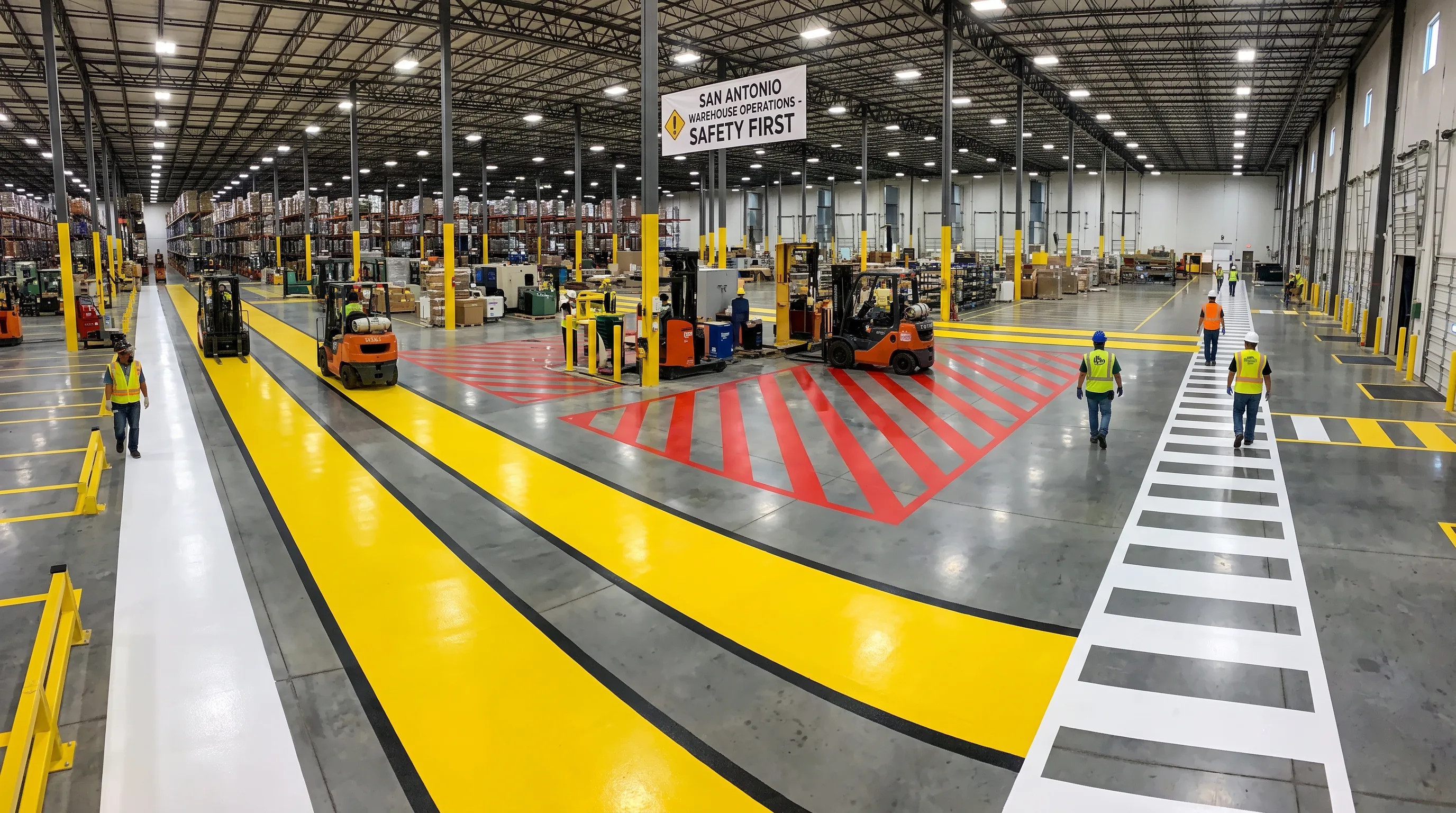
A San Antonio warehouse without proper floor line marking is both an OSHA liability and an operational inefficiency. Forklifts, pallet jacks, and foot traffic need clearly defined lanes - not just for compliance, but for throughput. A 400,000 sq ft distribution center that wastes 8% of floor space through ambiguous routing loses real money every day.
This guide covers every decision you'll face: OSHA color standards, marking material options, line widths, durability expectations under Texas industrial conditions, and how to spec a marking system that lasts.
OSHA and ANSI Color Standards for Warehouse Floor Marking
OSHA 29 CFR 1910.22 requires that aisles and passageways be clearly marked where mechanical handling equipment is in use. The specific color system comes from ANSI/ASSP Z535.1 and industry practice. These are the universally recognized codes:
Most San Antonio warehouses use yellow as their primary aisle color, white for workstation boundaries, and red for fire extinguisher and emergency stop zones. Consistency matters: OSHA inspectors expect the same color to mean the same thing throughout your facility.
Line Width and Spacing Standards
There is no OSHA-mandated line width, but visibility requirements drive the standard in typical warehouse and distribution environments:
- Primary aisles: 3–4 inch lines minimum, 4–6 inch preferred for high-traffic facilities
- Secondary aisles and pedestrian walkways: 2–3 inch lines
- Storage cell boundaries: 2 inch lines sufficient
- Crosshatch hazard zones: 2–3 inch lines at 45-degree angle, 6–12 inch spacing
- Aisle width per OSHA 1910.22(b): Minimum 3 feet wider than the largest equipment, or 4 feet minimum
Epoxy vs Traffic Paint: Durability Comparison
Material choice is where most facilities get this wrong. Warehouse floors in San Antonio face forklift tire abrasion, pallet jack loads, chemical spills, and temperature swings year-round. Here's how the primary options compare:
| Factor | 2-Part Epoxy | Water-Based Traffic Paint | Floor Marking Tape |
|---|---|---|---|
| Service life (warehouse) | 7–12 years | 1–2 years | 2–4 years |
| Forklift abrasion resistance | Excellent | Poor | Moderate |
| Chemical resistance | High | Low | Moderate |
| Application downtime | 8–24 hours cure | 1–2 hours dry | Immediate |
| Cost per linear foot | $0.75–$1.50 | $0.15–$0.40 | $0.30–$0.80 |
| 5-year total cost | Lowest | Highest (3+ repaints) | Moderate |
For permanent aisle marking in any facility with regular forklift traffic, 2-part epoxy line marking is the correct long-term choice. Professional epoxy line marking costs more upfront but eliminates annual repainting cycles that disrupt operations.
Installation Process: How Epoxy Floor Marking Is Applied
- Layout and MeasurementAll aisle dimensions, storage zones, and equipment clearances are measured and marked with chalk lines. AutoCAD drawings are used for precision in larger facilities.
- Surface PreparationConcrete must be clean, dry, and profiled. Shot blasting or diamond grinding creates the CSP 2–3 profile needed for epoxy adhesion. Oil-contaminated concrete requires degreasing before mechanical prep.
- MaskingIndustrial masking tape is applied along all chalk lines. Quality masking is what separates professional-looking lines from amateur results - clean edges define the outcome.
- Epoxy ApplicationTwo-part epoxy line marking material is mixed and applied with a short-nap roller at 20–30 mils DFT. Anti-slip aggregate is broadcast while wet in pedestrian areas.
- Tape Removal and CureMasking tape is removed within 30–60 minutes while epoxy is still tacky for clean edges. Foot traffic restricted 8–16 hours; forklift traffic restricted 24–48 hours depending on temperature.
Cost and Timeline for San Antonio Warehouse Marking
| Facility Size | Linear Feet (Typical) | Epoxy Cost Range | Completion Time |
|---|---|---|---|
| Small warehouse (10,000 sq ft) | 800–1,200 LF | $900–$1,800 | 1 day |
| Mid-size (50,000 sq ft) | 3,000–5,000 LF | $3,500–$7,500 | 2–3 days |
| Large distribution (200,000+ sq ft) | 10,000–20,000 LF | $12,000–$30,000 | 5–10 days |
Most San Antonio warehouse marking projects can be phased by zone, allowing continued partial operations during installation. Working overnight or on weekends eliminates daytime disruption entirely.
Warehouse Line Marking Quote
We handle layout verification, OSHA color compliance, surface prep, and full epoxy line marking for San Antonio warehouses and distribution centers of any size.
Get a Free Quote