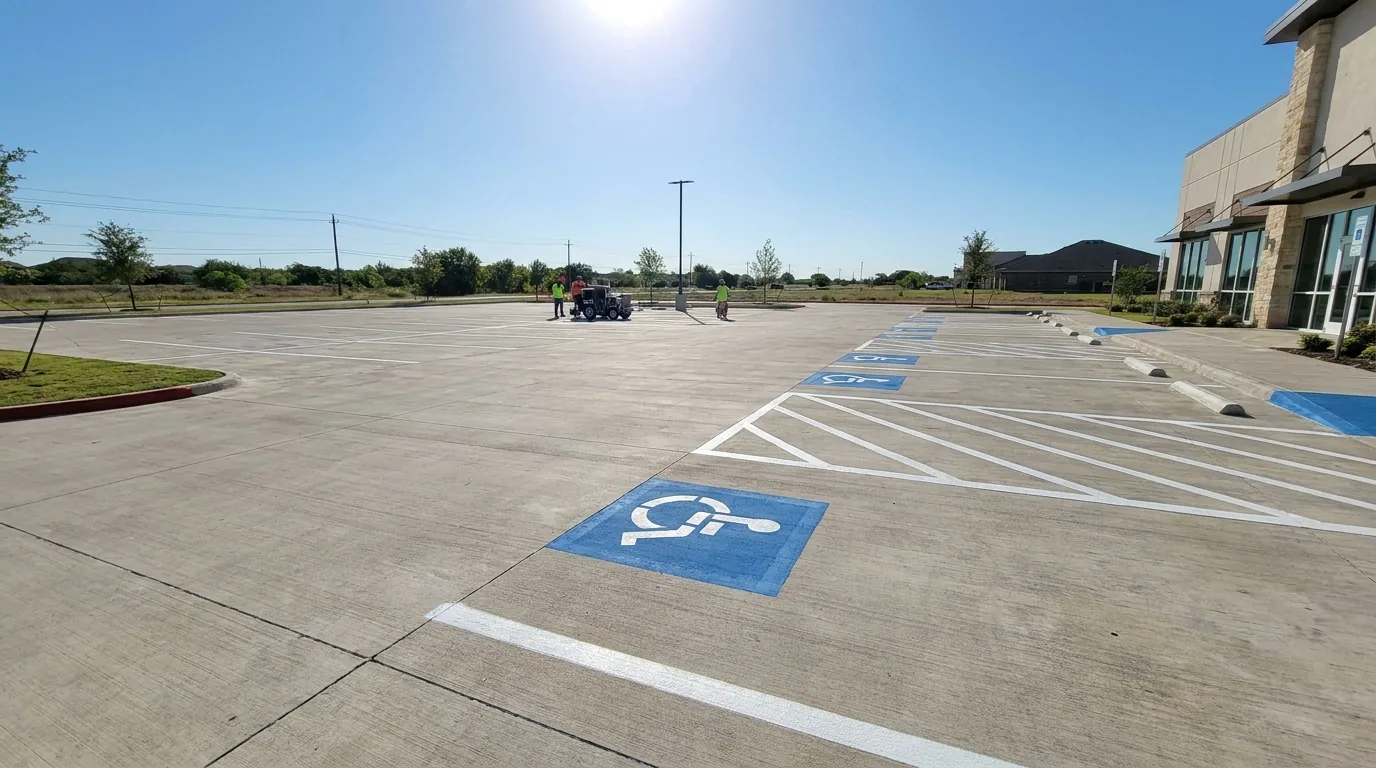
Parking lot striping in San Antonio is not a cosmetic task - it is a legal compliance requirement, a liability issue, and a significant factor in how efficiently a parking facility operates. Property owners who treat striping as a low-priority maintenance item typically encounter two problems: ADA complaints and premature paint failure from San Antonio's UV intensity and heat.
This guide covers what ADA and Texas Accessibility Standards actually require for parking layout, the practical difference between traffic paint and epoxy striping, and what a professional restripe involves for typical San Antonio commercial lots.
ADA and Texas Accessibility Standards: What's Required
Accessible parking compliance in San Antonio falls under two overlapping frameworks: the federal Americans with Disabilities Act (ADA) and the Texas Accessibility Standards (TAS), enforced by the Texas Department of Licensing and Regulation (TDLR). TAS applies to new construction and alterations; ADA applies to existing facilities regardless of construction date.
Non-compliance carries meaningful risk: ADA complaints are filed with the Department of Justice and can result in court orders to remediate plus civil penalties up to $75,000 for a first violation. TDLR enforcement for TAS violations in Texas can require corrections within 60 days with re-inspection fees. Many ADA complaints originate from observable striping issues visible from the parking lot entrance - undersized spaces, missing hash-line aisles, absent pavement symbols.
Traffic Paint vs. Epoxy Striping: Which to Use
San Antonio property managers typically choose between two striping materials. The right choice depends on surface type, budget cycle, and restripe frequency expectations.
| Property | Waterborne traffic paint | Epoxy striping |
|---|---|---|
| Surface compatibility | Asphalt and concrete | Concrete primarily (adhesion issues on asphalt) |
| Service life (SA climate) | 1–3 years | 5–10 years |
| UV resistance | Moderate - fades in 12–18 months | High - minimal UV fade |
| Chemical resistance | Low - fuel and oil cause rapid fade | High - excellent chemical resistance |
| Cost per sq ft | Lower ($0.10–$0.25/ln ft) | Higher ($0.40–$0.90/ln ft) |
| Dry time before traffic | 30–60 minutes | 4–8 hours |
| Best for | Asphalt lots, budget-conscious, frequent restripe cycles | Coated concrete garages, high-traffic facilities, long-term cost reduction |
For most San Antonio asphalt parking lots, waterborne traffic paint is the practical choice - it bonds to asphalt reliably and is designed for full restripe cycles every 2–3 years. Epoxy striping is best suited to coated concrete surfaces (such as inside parking garages that already have an epoxy or polyaspartic floor coating) and high-visibility areas where marking longevity matters, such as fire lanes, ADA spaces, and crosswalks.
What a Professional Restripe Includes
A complete parking lot restripe from a professional contractor in San Antonio includes more than paint application:
- Layout verification: Confirm existing stall count and dimensions against ADA requirements for the lot's total capacity. Identify any non-compliant accessible spaces before painting over existing lines.
- Surface preparation: Power wash or blow out dust and debris. On concrete, light acid wash or mechanical prep for epoxy striping adhesion.
- Blackout of obsolete lines: When stall layout changes, existing conflicting lines must be obscured with compatible black paint before new lines are applied - not simply overpainted.
- Stall striping: Machine-applied lines using a parking lot striper for consistent width and edge quality. Hand-rolled striping produces visible width variation and is a sign of low-quality work.
- ADA symbol stenciling: International Symbol of Accessibility applied in the designated accessible spaces - blue background with white symbol on concrete or the reverse on asphalt depending on local enforcement preference. TAS requires the symbol to be painted on the surface itself.
- Curb painting and fire lane marking: Red curbing and "No Parking - Fire Lane" stencils where applicable.
- Stop bars and directional arrows: At drive-lane intersections and lot entries where required by the layout.
For parking garage epoxy surfaces specifically, striping must be applied with traffic-grade paint compatible with the topcoat chemistry. Waterborne epoxy-compatible traffic paint is the correct specification - standard oil-based alkyd traffic paint adhesion on polyaspartic topcoats is poor and will peel within months.
How Often San Antonio Lots Need Restriping
San Antonio's UV intensity accelerates paint fade faster than northern markets. A general restripe timeline for common lot types:
- High-traffic asphalt lots (retail, restaurants, medical offices): every 18–24 months.
- Medium-traffic asphalt lots (office parks, light commercial): every 2–3 years.
- Concrete lots with sealer: every 3–5 years for traffic paint; 5–8 years for epoxy striping.
- Coated concrete garage slabs: 5–10 years for epoxy striping if topcoat is maintained.
ADA-designated spaces should be inspected annually regardless of overall lot condition - faded or illegible accessible markings are an enforcement liability even when the rest of the lot still looks acceptable.
Parking Lot Striping Quote
We handle layout verification, ADA compliance review, blackout of obsolete lines, and full restripe for San Antonio commercial lots of any size.
Get a Free Quote