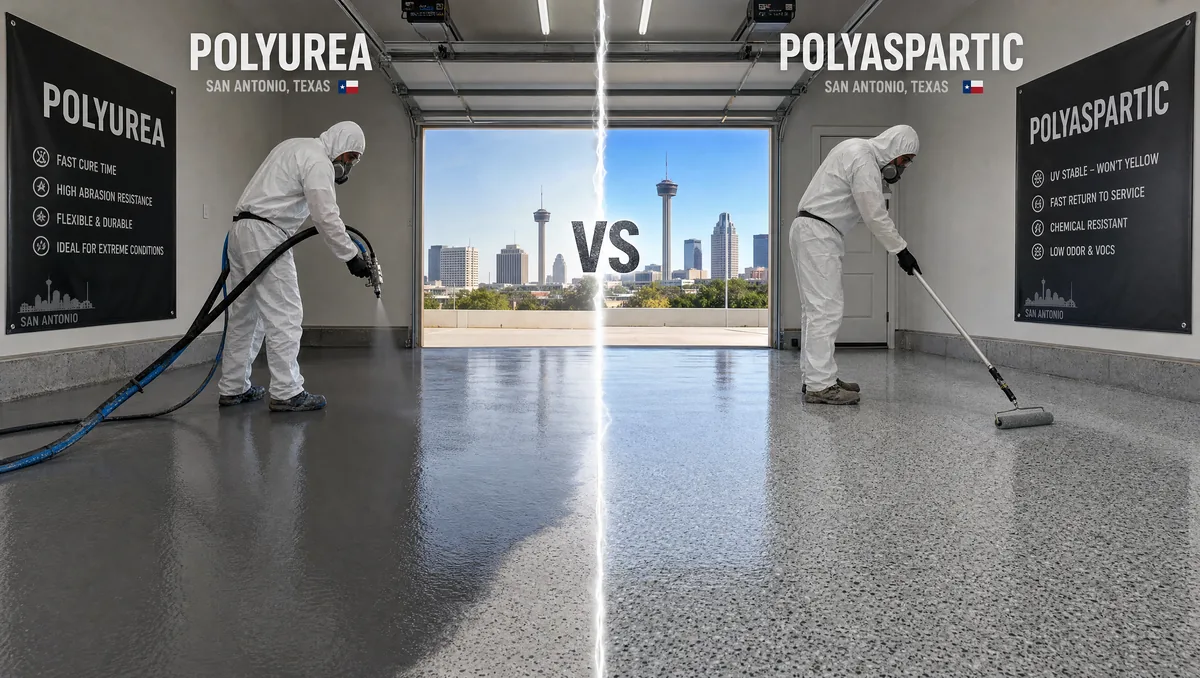
Spend any time reading about floor coatings and you will see polyurea and polyaspartic treated as synonyms - listed side by side on product pages, used interchangeably in contractor quotes, and conflated in almost every comparison guide online. They are not the same material. They behave differently during application, perform differently over time, and suit different situations in a San Antonio climate where summer heat, UV exposure, and moisture vapor from clay-heavy soils create conditions that expose the difference between them quickly.
This guide explains what each coating actually is, where they genuinely overlap, and how to choose between them for a garage floor, commercial slab, or any other concrete surface in the San Antonio metro.
What Is Polyurea?
Polyurea is a fast-reacting elastomeric coating formed by the chemical reaction between an isocyanate component and an amine-terminated resin. The defining characteristic is speed: polyurea cures in 15–30 seconds at room temperature, which means it reaches full structural integrity within minutes rather than hours. That extreme cure rate requires specialized plural-component spray equipment and highly trained applicators - you cannot roll or brush a true polyurea coating with standard tools.
The material is highly flexible. Polyurea can stretch 300–400% before tearing, which makes it exceptional for surfaces that experience thermal movement or vibration - bridge decks, parking structure decks, industrial floors with heavy equipment traffic. It is also highly resistant to most chemicals, abrasion, and impact.
The tradeoff is in application precision. The 15-second window leaves essentially no margin for error. Contaminated concrete, incorrect mixing ratios, or a drop in substrate temperature can all cause adhesion failure, pinholing, or delamination - problems that won't show up until weeks or months later. This is why polyurea floor coating is most often specified for heavy industrial environments and infrastructure applications rather than residential garage floors, where the precision required doesn't match the budget available.
What Is Polyaspartic?
Polyaspartic is a subset of polyurea - technically, it is an aliphatic polyurea. The critical difference is the resin component: polyaspartic uses an aliphatic amine instead of the aromatic amine used in standard polyurea, which dramatically slows the reaction time and, crucially, makes it UV-stable.
Where standard polyurea can cure in under 30 seconds, a polyaspartic floor coating cures in 30–90 minutes depending on the formulation and ambient temperature. That extended working time allows application by roller or squeegee, makes it practical for standard crews without specialized spray equipment, and gives installers enough time to broadcast decorative chips or create patterns before the surface locks in. Polyaspartic is also self-leveling in many formulations, which simplifies application on large flat surfaces.
The UV stability is particularly relevant for San Antonio. Standard epoxy and aromatic polyurea yellow and chalk when exposed to direct sunlight - sometimes within a single Texas summer. Polyaspartic, being aliphatic, does not. It retains color and gloss under direct sun for 15–20 years, which is why it is the standard topcoat choice for garage floors and exterior concrete applications in high-UV markets like South Texas.
Where They Overlap - And Why They Get Confused
The confusion is partly chemical and partly marketing. Since polyaspartic is technically a polyurea, manufacturers accurately describe polyaspartic products as "polyurea coatings." When a flooring company advertises a "polyurea floor system," they are often selling a polyaspartic product - and that is not inaccurate, just imprecise in a way that makes comparison shopping difficult.
Both materials share genuine performance similarities: both cure faster than standard epoxy, both are more flexible, both have better chemical resistance than water-based epoxy systems, and both can achieve very high film builds in a single coat. For most residential and light-commercial applications, the distinction matters less than the quality of the overall system - surface preparation, product selection, and application method matter more than whether the topcoat is technically "polyurea" or "polyaspartic."
Key Differences: What Actually Matters in Practice
| Property | Polyurea (Standard / Aromatic) | Polyaspartic (Aliphatic Polyurea) |
|---|---|---|
| Cure time | 15–60 seconds | 30–90 minutes |
| Application method | Plural-component spray only | Roller, squeegee, or spray |
| UV stability | Poor - yellows in sunlight | Excellent - color-stable outdoors |
| Application temp range | Wide - works in extreme cold and heat | Moderate - slows significantly below 35°F |
| Flexibility / elongation | Very high (300–400%) | Moderate (80–200%) |
| Cost (installed) | Higher - specialized equipment required | Lower - standard tools, faster labor |
| Best use | Heavy industrial, infrastructure | Residential garages, commercial floors, exterior |
Cure Speed
In practice, polyurea's extreme cure speed is both its biggest strength and its biggest liability for floor coating applications. For industrial spray-applied waterproofing or bridge deck membranes where speed is critical and specialized crews are on hand, it is ideal. For a garage floor in San Antonio where you need a crew to broadcast color chips, squeegee the topcoat flat, and allow for corrections if something goes wrong - the slower cure of polyaspartic is an operational advantage, not a compromise.
UV Stability
This is the most practically important difference for outdoor and sun-exposed applications in San Antonio. Aromatic polyurea will yellow within months under direct sun - a problem for any garage with a south- or west-facing door that stays open during the day. Polyaspartic is rated for exterior use and UV exposure without color shift. For any floor that sees direct sunlight, polyaspartic is the right topcoat choice.
Application Temperature
San Antonio summers regularly push ambient temperatures past 100°F, and slab temperatures can reach 120–130°F in a west-facing garage in July. Standard polyurea handles this range well because its chemistry is less temperature-sensitive. Polyaspartic formulations vary - some standard products cure too quickly in extreme heat, creating application windows of only a few minutes before the product gels. At ProEpoxy, we source heat-rated polyaspartic formulations specifically designed for Texas summer conditions, which extends the working time back to a manageable range even on hot slabs.
Flexibility
Standard polyurea's 300–400% elongation makes it the right choice for membranes that need to bridge cracks or flex with structural movement. For a garage floor slab on grade in San Antonio - where the main movement is slow seasonal shrinkage and the occasional crack from tree roots or clay soil shift - the moderate flexibility of polyaspartic is more than adequate. You are not waterproofing a bridge deck; you are protecting a concrete floor.
Which Should You Use in San Antonio?
For the vast majority of residential and commercial floor coating projects in San Antonio, polyaspartic is the right choice - either as a standalone coating system or as the UV-stable topcoat layer over an epoxy base. Here is how to think through it:
- Residential garage floor: Polyaspartic topcoat over epoxy base coat with chip broadcast. The polyaspartic locks in the color, protects the chip layer, and handles UV exposure from the garage door opening. This is the system ProEpoxy installs on essentially every residential garage in the metro.
- Commercial floor with heavy forklift or vehicle traffic: High-build epoxy base with a polyaspartic or aromatic polyurea topcoat. The choice between polyaspartic and aromatic polyurea here depends on whether the floor sees direct sun. Indoor warehouse with no sun exposure - either works. Covered parking with open walls or skylights - polyaspartic for UV stability.
- Infrastructure or heavy industrial membrane: Standard aromatic polyurea applied by plural-component spray. This is the correct product for bridge decks, secondary containment, and applications where extreme flexibility and ultra-fast cure matter more than color stability.
- Exterior patio or pool deck: Polyaspartic only. Full sun, UV exposure, and temperature cycling make aromatic polyurea unsuitable for any exterior decorative application.
If a contractor quotes you a "polyurea system" for a residential garage without specifying that it is an aliphatic (UV-stable) formulation, ask directly. A non-UV-stable topcoat on a San Antonio garage will yellow noticeably within 12–18 months - not a failure mode you want to discover after the invoice is paid.
The Bottom Line
Polyurea and polyaspartic are related but meaningfully different materials. Polyurea's extreme reactivity and flexibility make it the right tool for heavy industrial and infrastructure applications. Polyaspartic's UV stability, manageable application window, and versatility across temperature ranges make it the correct choice for garage floors, commercial slabs, and exterior concrete in San Antonio - which is why it is the topcoat system we specify on every project we install.
When you are comparing quotes, look past the label and ask about UV stability, application method, and the installer's experience with heat-rated formulations in Texas conditions. A polyaspartic system installed correctly in a San Antonio garage will look sharp and perform reliably for 15–20 years. A non-UV-stable coating installed incorrectly - regardless of what it is called on the product sheet - will not.
Questions about which system is right for your floor? Get a free estimate and we will walk you through the options based on your slab, your use case, and your timeline.
Get a Free Quote for Your San Antonio Floor Coating
ProEpoxy installs UV-stable polyaspartic systems on garages, commercial floors, and exterior concrete across the San Antonio metro. Every estimate includes a product recommendation, system spec, and written warranty - no upselling, no guesswork.
Request Free Estimate →