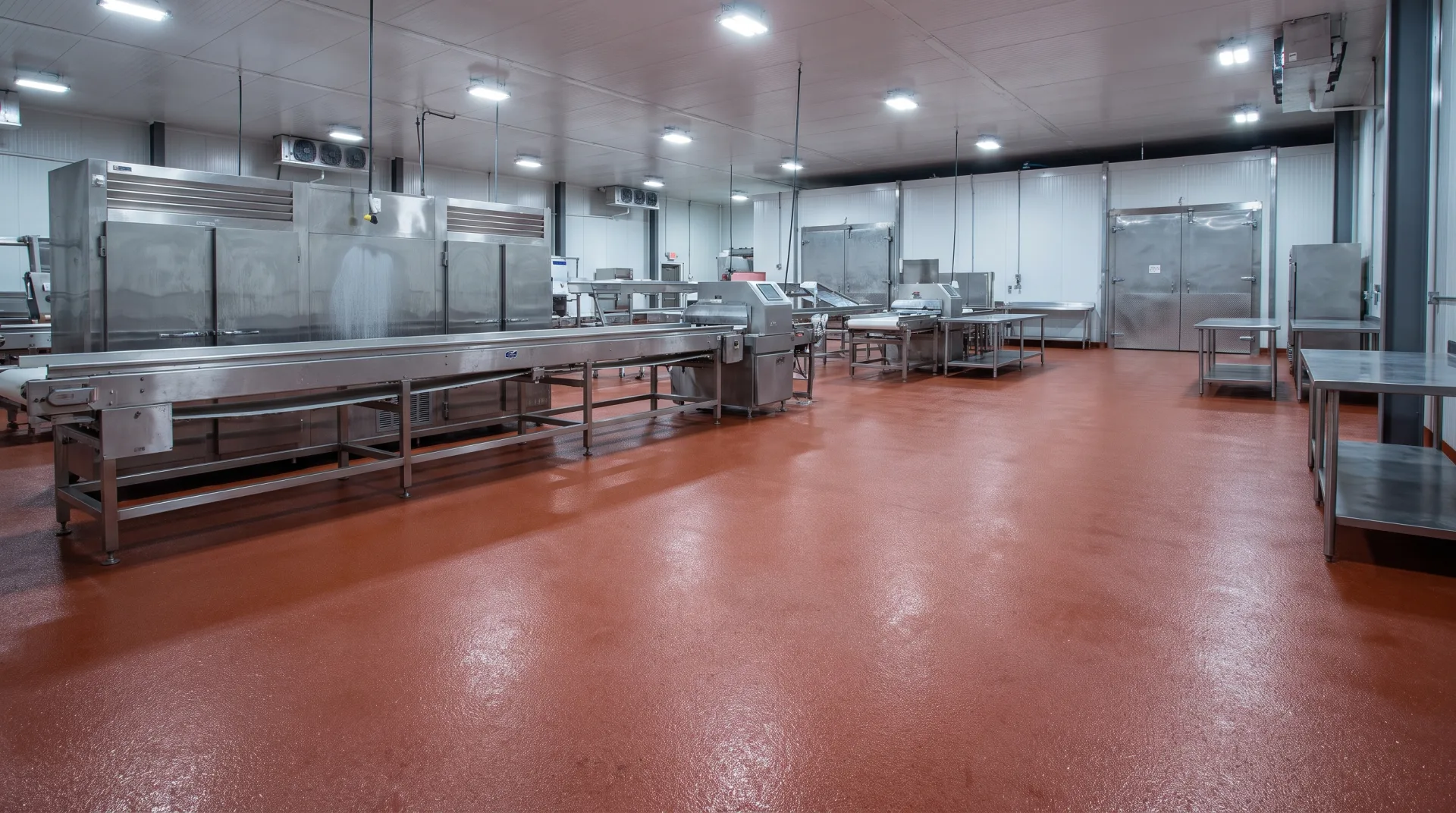
Urethane cement is the standard flooring choice for San Antonio meat processing and cold storage facilities because it's the rare system that handles thermal shock, food-safety requirements, and slip resistance simultaneously - conditions that push standard epoxy and even many specialty coatings past their limits when combined in one demanding environment.
Why Meat Processing Floors Face Uniquely Combined Stress
Few flooring environments combine as many simultaneous stressors as a meat processing facility. The floor experiences constant water and moisture exposure from washdown and processing runoff, hot water and steam cleaning cycles alongside cold storage transitions creating repeated thermal shock, animal fats and blood that can be chemically aggressive to lesser coatings, and heavy foot and cart traffic throughout the day. A coating system that handles any one of these stresses well but not the others tends to fail relatively quickly in this combined environment, which is exactly why urethane cement's broad resistance profile has become the industry-standard choice.
Thermal Shock Resistance Between Processing and Cold Storage
Meat processing facilities typically move product - and staff - between ambient-temperature processing areas and cold storage or freezer zones dozens of times per shift, and the floor at these transition points experiences the same repeated thermal cycling. Standard epoxy can become brittle and crack under this kind of repeated temperature swing, particularly at door thresholds and transition zones where the change happens most abruptly. Urethane cement's more flexible, thermally stable composition resists this cracking far better, maintaining its bond and surface integrity across the full temperature range a facility experiences from hot washdown water through to sub-freezing cold storage.
Food Safety and Regulatory Compliance
Urethane cement systems used in food processing environments are formulated to meet USDA and FDA guidelines applicable to food-contact area flooring, and their dense, non-porous surface resists the bacterial growth that can develop in cracks, pits, or porous areas of an inadequately sealed floor. This matters directly for a facility's health inspection outcomes and overall food safety program, since flooring condition is a routinely inspected item in meat and food processing facility audits. A urethane cement floor installed and maintained properly gives inspectors and facility quality managers confidence that the flooring itself isn't a contamination risk point.
Comparing Systems for Meat Processing Environments
| Factor | Standard Epoxy | Urethane Cement |
|---|---|---|
| Thermal shock resistance | Poor to moderate | Excellent |
| Food safety compliance | Possible with right formulation | Purpose-built for food-contact areas |
| Chemical/fat resistance | Moderate | Excellent |
| Slip resistance (wet) | Depends on broadcast | Excellent with textured finish |
| Typical lifespan (heavy use) | 3-7 years | 15-20+ years |
The combined-stress environment is the deciding factor: in a facility with only one or two of these stressors, standard epoxy might suffice - but meat processing and cold storage combine nearly all of them at once, which is exactly the scenario urethane cement was developed to handle.
Slip Resistance in a Constantly Wet Environment
Meat processing floors are wet essentially all the time - from processing runoff, washdown, and condensation near cold storage entries - making slip resistance a critical safety consideration, not a secondary aesthetic one. Urethane cement can be finished with a textured, slip-resistant surface using broadcast aggregate specifically suited to constantly wet conditions, providing meaningfully better traction than a smooth or worn coating under the same conditions. Our urethane cement floor service page covers the slip-resistant finish options we specify for San Antonio food processing facilities.
Upgrading Your Meat Processing or Cold Storage Floor?
We install urethane cement systems built for the combined demands of food processing environments.
Request a Free QuoteCove Base and Sanitation Detail Work
Meat processing facilities almost universally require integral cove base - a curved, seamless transition where the floor meets the wall - to eliminate the sharp corners and seams where bacteria and debris can otherwise accumulate and resist cleaning. Urethane cement systems readily incorporate this detail as part of the overall installation, creating a fully seamless, washable surface from floor to several inches up the wall. This detail work adds some time and cost to the installation but is generally considered non-negotiable for facilities under USDA or similar regulatory oversight, since it directly addresses a common citation point in sanitation inspections.
Coordinating Installation With Cold Storage Operations
Installing or replacing flooring in a facility with active cold storage requires careful coordination with refrigeration operations, since product storage, temperature maintenance, and the flooring project's own temperature and cure requirements all need to align. Our guide on cold storage warehouse flooring requirements in San Antonio covers the broader considerations for working around active refrigeration during a flooring project, relevant context for meat processing facilities that include cold storage zones as part of a larger installation. Phased, zone-by-zone scheduling - similar to how warehouse floor projects manage live operations - often allows a meat processing facility to complete a flooring upgrade without a full production shutdown, provided the plan is coordinated well in advance with both the flooring contractor and the facility's own operations team.
Maintenance for Long-Term Performance
Urethane cement's long service life still depends on appropriate ongoing maintenance specific to a meat processing environment. Regular washdown with cleaning agents compatible with the specific urethane cement formulation, prompt attention to any developing cracks or wear at high-traffic transition points, and periodic professional inspection of cove base seals all help the floor perform at its designed lifespan. Our related guide on urethane cement flooring for San Antonio food processing facilities covers general maintenance practices applicable across food processing settings, including meat processing specifically.
Understanding Fat and Blood Exposure Effects on Flooring
Animal fats and blood present a specific chemical challenge that's easy to underestimate compared to more obviously aggressive industrial chemicals. Fats can penetrate and soften certain coating chemistries over sustained exposure, and blood proteins combined with regular hot-water washdown create a repeated chemical and thermal cycle that wears down less-resistant systems faster than either factor would alone. Urethane cement's dense matrix resists this fat penetration significantly better than standard epoxy, maintaining its surface integrity and bond strength even under years of continuous exposure in an active processing line. Facilities that have previously dealt with premature epoxy failure in processing areas specifically often find the root cause traced back to exactly this kind of fat and protein exposure combined with thermal cycling - the precise combination urethane cement was engineered to handle.
Planning a New Facility or Major Renovation
Facilities planning a new meat processing build or major renovation have the advantage of specifying urethane cement flooring alongside other design decisions from the start, rather than retrofitting it into an existing layout. This includes planning drain placement and floor slope specifically around the coating system's requirements, coordinating cove base height and detailing with wall material choices, and sequencing the flooring installation appropriately within the broader construction timeline so the floor isn't damaged by other trades working in the space after it's installed. Facility owners working with a design-build team should loop in their flooring contractor early in the design phase specifically to align these details, since retrofitting proper drainage or cove base into an already-finished space is considerably more disruptive and expensive than planning for it upfront.
Working With an Experienced Food-Facility Installer
Installing urethane cement correctly in a meat processing environment requires more specialized knowledge than a general commercial flooring install, given the regulatory, sanitation, and operational coordination involved. When vetting a contractor, ask specifically about their experience with USDA or FDA-regulated facilities, their approach to integral cove base detailing, and how they've handled scheduling around active cold storage operations on previous projects. A contractor who can speak specifically and confidently to these food-facility-specific concerns - rather than describing only general commercial flooring experience - is a much stronger indicator of a smooth project than price alone, particularly given how costly a flooring failure or compliance gap can be to remediate in an operating food processing facility.
Long-Term Value for Facility Owners
While urethane cement carries a higher upfront cost than standard epoxy, its 15-20+ year service life in a demanding meat processing environment - compared to just 3-7 years for epoxy under the same conditions - typically results in a lower total cost of ownership once repeated recoat and repair cycles are factored in. Facility owners evaluating flooring bids should request lifecycle cost projections rather than comparing only installed price per square foot, since the system that costs more today often costs meaningfully less across a 15-20 year ownership horizon in a facility with this level of combined chemical, thermal, and moisture exposure.