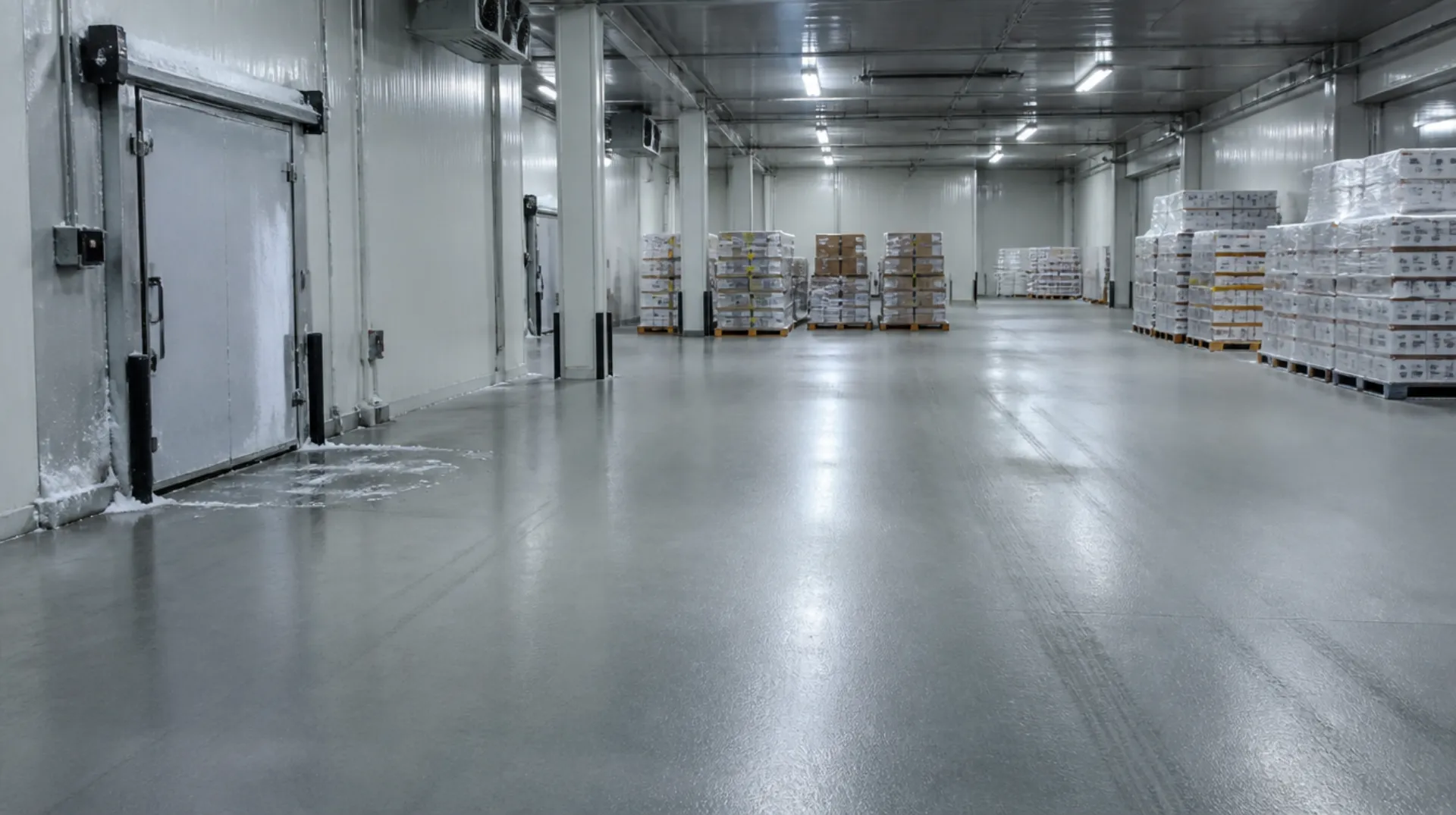
Cold storage warehouse flooring in San Antonio needs to handle three things standard concrete and epoxy struggle with: thermal shock from repeated freeze-thaw cycling at dock doors, moisture vapor drive from below the slab, and reliable slip resistance on surfaces that regularly ice over or stay damp. Getting all three right calls for a purpose-built system, not a general-purpose warehouse coating extended into the freezer zone.
Why Standard Epoxy and Bare Concrete Fail in Cold Storage
A typical epoxy coating is formulated and tested around ambient warehouse conditions, not sustained sub-freezing temperatures with constant cycling. Every time a forklift moves through a dock door between a warm receiving area and a freezer held at -10°F to 0°F, the floor at that transition point expands and contracts. Standard epoxy's resin chemistry doesn't flex enough to absorb that repeated thermal cycling, and over months it develops fine cracking that widens into full failures at the door thresholds first, since that's where the temperature swing is most extreme.
Bare or minimally sealed concrete has a separate problem: moisture vapor drive. Cold surfaces attract condensation, and in a freezer that condensation can migrate into the concrete itself and freeze, expanding and causing spalling - small chips and flaking at the surface - over repeated cycles. A coating system needs to fully seal the slab as a continuous membrane to block that moisture pathway, which is exactly what a thin, patchy, or improperly cured coating fails to do.
Key Requirements Checklist for Cold Storage Flooring
- Temperature range tolerance: the system must remain flexible and crack-resistant across the full operating range, from warehouse ambient down to typical freezer temperatures and back
- Seamless, moisture-proof membrane: full coverage with no gaps or thin spots that would let vapor drive reach the slab underneath
- Slip resistance on wet or icy surfaces: textured or aggregate-broadcast finishes that maintain traction even when condensation or frost forms on the surface
- Chemical resistance to cleaning agents: food and beverage cold storage facilities in particular use frequent washdown with sanitizing chemicals that a standard coating may not tolerate long-term
- Fast, low-temperature cure capability: a system that can be installed and cured without needing to bring the whole room to standard room temperature for days
Recommended Flooring Systems for Cold Storage
| System | Temp Range Tolerance | Cure Time | Slip Rating |
|---|---|---|---|
| Standard Epoxy | Poor below freezing | 24-72 hrs | Moderate |
| Urethane Cement | Excellent, -40°F+ | 4-24 hrs | High (textured) |
| MMA (Methyl Methacrylate) | Excellent, installs in cold | 1-2 hrs | High (textured) |
| Polyurethane Topcoat | Good, flexible | 12-24 hrs | Moderate-High |
Why MMA stands out for active facilities: methyl methacrylate systems can often be installed and returned to service within hours rather than days, and can cure even at low ambient temperatures - a major advantage when a cold storage room can't stay offline for an extended install window.
San Antonio-Specific Considerations
San Antonio's humid subtropical climate outside the freezer creates its own installation wrinkle: the temperature and humidity differential between the ambient dock area and the cold room is often more extreme here than in drier climates, which increases condensation risk at the threshold zone during and after installation. Facilities here also tend to run cold storage as part of a broader distribution or food-service supply chain given the city's logistics and food-processing base, which means uptime expectations are typically strict and installation scheduling has to work around active shipping and receiving cycles rather than a full facility shutdown. Our warehouse flooring service page covers the broader systems we install across San Antonio's distribution and industrial facilities, cold storage included.
Installation Process and Downtime Expectations
Installing cold storage flooring in an active facility typically happens in phases to minimize disruption. The process starts with a moisture and temperature assessment of the specific zone, followed by surface prep - grinding or shot-blasting to remove any existing coating and create a bondable profile - then application of the primer and base membrane, and finally the textured topcoat for slip resistance. For urethane systems, the room usually needs to be brought closer to ambient temperature during the prep and initial cure window, meaning that specific zone is typically offline for 1-3 days depending on square footage. MMA systems compress this significantly, since their fast cure chemistry allows the room to return to operating temperature much sooner after installation.
Facilities with multiple cold rooms or zones often schedule the work room by room, keeping the rest of the facility fully operational while one section is being recoated - a phased approach that avoids a full-facility shutdown even for a large multi-room cold storage operation.
Planning a Cold Storage Flooring Project?
We'll assess your temperature range, traffic pattern, and washdown requirements and recommend the right system for your facility.
Request a Free QuoteDoor Threshold and Transition Zone Detailing
The dock door threshold between a cold room and the rest of the warehouse deserves special attention beyond the general flooring system, since it's the single highest-stress zone in the entire installation. Some facilities install a dedicated expansion joint or transition detail at this exact point, allowing the two flooring zones on either side of the door to move independently during thermal cycling rather than fighting against each other at a single continuous seam. Skipping this detail is one of the most common reasons a otherwise well-installed cold storage floor develops cracking specifically at door openings within the first year or two, even when the rest of the room performs well.
Comparing Cold Storage Needs to General Warehouse Flooring
Facilities that operate both ambient and cold storage space under one roof sometimes assume a single flooring system can serve both zones for simplicity. In practice, the specialized thermal and moisture demands of a freezer room justify a different system than the ambient warehouse floor, even though both need to hold up to similar forklift and pallet traffic. Our guide on warehouse flooring options in San Antonio covers the broader system choices for ambient zones, which pairs well with this guide when planning a facility with mixed temperature zones. Chemical exposure is another area of overlap worth planning for together, and our post on urethane cement flooring for breweries and wineries covers similar washdown and moisture-resistance considerations relevant to food and beverage cold storage as well.
Maintenance in a Cold Storage Environment
Once installed, cold storage flooring generally needs less day-to-day maintenance than an ambient warehouse floor, since the cold temperature itself limits bacterial growth and slows general wear. Routine inspection should focus on the door threshold and transition zones specifically, checking for early signs of cracking or lifting before they progress. Washdown frequency and the specific sanitizing chemicals used should be confirmed against the coating manufacturer's chemical resistance data, since not all systems tolerate every cleaning agent equally, and using an incompatible cleaner can degrade the topcoat's slip resistance over time even if the coating itself doesn't visibly fail.
Selecting the Right Slip Resistance Profile
Slip resistance in a cold storage environment needs a different specification than a dry ambient warehouse floor, since condensation, frost, and occasional ice formation change the surface's friction characteristics in ways a smooth or lightly textured floor can't handle safely. Most cold storage systems use a broadcast aggregate - fine silica sand or aluminum oxide media scattered into the wet coating before it cures - to create a consistently textured surface with traction that holds up even when damp or lightly frosted. The aggregate size and broadcast rate matter: too fine and the texture washes out under heavy washdown; too coarse and the surface becomes difficult to clean thoroughly, which matters in food-grade cold storage where sanitation standards are strict. A contractor experienced in cold storage specifically will typically test or recommend a texture profile matched to the facility's actual foot and cart traffic patterns rather than defaulting to a generic industrial broadcast rate.
Working With Refrigeration Contractors During Installation
Cold storage flooring projects often require coordinating with the facility's refrigeration contractor, since bringing a room to installation-friendly temperatures (or keeping it at operating temperature for an MMA install) needs to be planned around the refrigeration system's capabilities and the facility's product storage requirements. Product already in the room may need to be relocated to another cold zone temporarily, and the timeline for bringing the room back to full operating temperature after installation should be built into the project schedule from the start. Facilities that loop in their refrigeration contractor and flooring installer together during planning, rather than treating the two as separate uncoordinated projects, generally see fewer scheduling surprises and less risk of product loss from temperature excursions during the changeover.