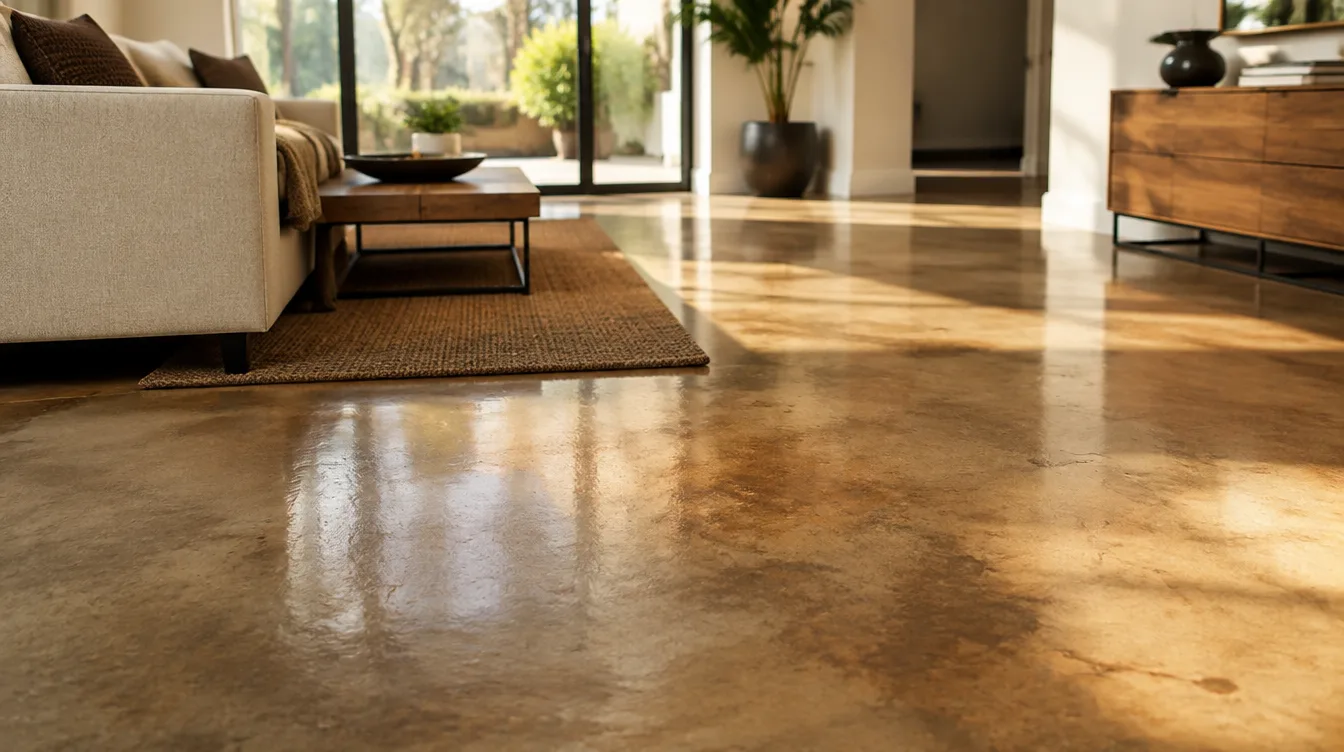
Stained concrete in San Antonio typically runs $3 to $8 per square foot installed, and where a project lands in that range depends on the stain type, the condition of the slab and the sealer, not on floor area alone. That figure covers surface preparation, the stain itself and the sealer, and it is the same range we publish on our stained concrete page. At $3 to $8, a 500 square foot floor runs $1,500 to $4,000 and a 1,000 square foot floor runs $3,000 to $8,000. If you are weighing stain against a coating, our stained concrete vs epoxy comparison covers that question in full, and this guide stays on stained concrete alone.
Quick answer: what stained concrete costs per square foot
A sealed, stained concrete floor in San Antonio typically costs $3 to $8 per square foot installed. The bottom of the range is a single-color stain on a sound, clean slab with a standard sealer. The top of the range is a multi-color or decorative floor, or a slab that needs repair before it can be stained.
Two features of stain pricing are worth knowing before you ask for quotes. First, area is a weak driver. Stain is applied by hand or sprayer in thin coats, so a larger floor does not get as much cheaper per square foot as a machine-applied system does. Second, the slab matters more than the stain. Stain is translucent, so every patch, crack and burnish mark left underneath shows through, and fixing those defects can add more to a quote than the color itself.
This guide does not explain how acid staining works as a chemical process or how to choose colors. Our post on acid stained concrete covers the process and indoor versus outdoor use, and our overview of stained concrete floors covers styles and palettes. The sections below stay on cost: what sits inside the number, what moves it and how to get a quote you can compare.
What sits inside that number: prep, stain, sealer
Three things sit inside a stained concrete rate: surface preparation, the stain application and the sealer. A quote that shows only a stain price is missing the two items that decide how long the floor looks good.
Surface preparation. The slab has to be clean and open enough to accept color. That usually means removing dirt, sealers, adhesive residue and old coatings, grinding or cleaning mechanically to a light, open profile, and repairing cracks and spalls. The ICRI 310.2R scale describes profile from CSP 1 to 9, and stain needs the light end of it, since the aim is open pores rather than a deep anchor pattern. Our guide to concrete surface profile and matching the grind to the coating explains the scale.
The stain. Acid-based or water-based stain is applied in one or more coats, often with a neutralizing and rinsing step for acid stains. Materials are a modest share of the total. Labor and the number of passes are the larger part.
The sealer. Stain is color only. It does not protect the surface, so a sealer goes on top, usually in two coats. The sealer you choose sets both the look, from matte to gloss, and the reseal schedule you will live with.
When you read a quote, ask for these three as separate lines. A rate that bundles them makes it impossible to tell whether a low price comes from a thinner prep, a single sealer coat or a genuinely efficient crew.
Acid stain against water-based stain on cost
Acid stain and water-based stain cost broadly the same in materials, and the difference in price usually comes from labor. Neither is automatically the cheaper option, so choose on the finish you want and let the quote follow.
Acid stain reacts chemically with the minerals in the concrete to produce variegated, earthy tones, and the reaction leaves residue that has to be neutralized and rinsed. Those extra steps add labor. Our indoor acid stained rate published in the acid stain guide is $4 to $7 per square foot installed, including preparation, stain, neutralization and two sealer coats, which sits in the middle of the overall range.
Water-based stain is a pigmented, penetrating product that offers more color control, including uniform and bright colors that acid cannot produce. It does not need neutralizing, and it can reach the target color in fewer passes on some floors. Where a design calls for several colors or tight color matching, though, the added control can take extra application time, which raises the price in the other direction.
The practical advice is to ask each contractor to quote the same finish with both stain types if you are undecided, with the same preparation and the same sealer. If the two come back within a dollar or so of each other, which is common, choose on appearance.
What pushes a quote up: slab condition and remediation
Slab condition is the biggest reason stained concrete quotes vary, because stain is translucent and shows everything that is on or in the surface. Remediation of defects can add more to the quote than the staining itself.
The usual causes of a higher price are these:
- Patches and repairs. Cracks, spalls and old patches take stain differently from the surrounding concrete, so they show as lighter or darker areas even after repair.
- Adhesive and coating residue. Mastic from old tile, paint, curing compounds and previous sealers block stain and have to be removed completely.
- Trowel burnish. A hard-troweled, glassy surface resists penetration and may need extra mechanical preparation to open it.
- Stains and contamination. Oil, grease and spills can repel stain and show as blotches.
- Moisture. A slab that is passing moisture can cloud or lift a sealer. Moisture vapor emission is tested under ASTM F1869 and in-slab relative humidity under ASTM F2170, and a failing result can require a moisture-tolerant sealer or a change of plan. Our guide to moisture testing for floor coatings explains the tests.
Older San Antonio homes in neighborhoods such as Alamo Heights and Southtown often have slabs with decades of repairs and residue, and they price toward the upper end for that reason. A new, clean, power-troweled slab with no previous finish is the cheapest to stain.
The way to control this cost is to have the slab assessed before you commit. A site visit that identifies patches, residue and moisture risk lets the contractor price remediation as its own line, so you can see what the defects cost and decide whether to embrace them as character or fix them.
Decorative work: borders, scoring, multi-color and dyes
Decorative work moves a stained floor to the upper part of the range, because each design element adds layout, labor and often a second material. Plain, single-color stain is the baseline, and everything beyond it is an upgrade.
Common decorative additions include:
- Saw-cut scoring. Cut lines create tile, grid or geometric patterns. Layout, cutting and dust control add labor, and each line has to be sealed.
- Borders and inlays. A border in a second color needs masking and separate application, which is slow, careful work.
- Multi-color and layered stain. Applying more than one color, or layering for depth, means more coats and more drying time between them.
- Dyes. Concrete dyes add vivid color that stain cannot reach, and they are applied in addition to or instead of stain.
- Stencils and graphics. Logos or patterns require masking and precise application, and they are most common in commercial spaces.
Each of these is priced by area or by linear foot, so ask for decorative items as separate lines. That lets you add or drop them to hit a budget without changing the base floor. A simple approach is to stain the whole floor in one color and put the decorative detail only where it will be seen, such as an entry border or a feature area.
Sealer choice and what each one adds to the rate
The sealer is the one component that shapes both the price and the long-term cost, so it deserves more attention than it usually gets. The choice is mostly between acrylic and urethane families, and between standard and high-performance versions.
Acrylic sealers are the standard choice for interior residential floors. They are affordable, easy to apply and easy to renew, and they are the usual basis for the lower end of the range. Their weakness is wear and sun: they scuff in traffic and can yellow or break down outdoors.
Urethane sealers, water-based or solvent-based, are tougher and more abrasion-resistant. They cost more in materials and sometimes in application, and they suit higher-traffic and commercial floors. A harder sealer pushes the rate up but stretches the time between reseals.
UV-stable topcoats are the answer for outdoor and sun-exposed floors. Our maintenance guide notes that upgrading from a standard acrylic to a UV-stable topcoat at a reseal adds roughly $0.50 to $1 per square foot and can double the interval between reseals. That is a good example of paying a little more now to spend less over time.
Finish also matters for safety. A glossy sealer can be slippery when wet, so entries, bathrooms and exterior floors usually get a satin finish or a fine grit additive. Slip resistance is measured by dynamic coefficient of friction under ANSI A326.3, and it is worth asking for on wet or exterior areas.
Cost table: finish level against rate and what you get
| Finish level | Where it sits in $3 to $8 | What you get | What to confirm |
| Single-color stain, sound slab, standard sealer | Bottom of the range | Even color, simple finish, standard sealer | Prep method, number of sealer coats |
| Interior acid stain, prep and two sealer coats | $4 to $7 published for indoor work | Variegated, earthy color with neutralization and sealing | Neutralizing step, sealer type |
| Water-based stain, multi-color or dye | Middle to upper range | Controlled, brighter or layered color | Number of colors, sample board |
| Decorative, with borders and scoring | Upper range | Pattern, borders and design detail | Linear feet of cuts, border width |
| Slab needing repair or residue removal | Upper range, remediation priced separately | A workable surface before any stain goes on | Itemized repair and removal lines |
The point of the table is to give you a way to place a quote. If a quote is at the bottom of the range for a floor that clearly needs repair, something has been left out. If it is at the top for a clean, simple floor, ask what the extra covers.
The ongoing cost most quotes omit: the reseal cycle
A stained floor has a recurring cost that most quotes leave out: the sealer wears and has to be renewed. The color in the concrete is permanent, but the sealer on top is a wear layer, and resealing keeps the floor protected and looking the way it did on install day.
Resealing costs a fraction of the original installation, because no stain or heavy preparation is needed, but it recurs. The interval depends on traffic and exposure. In traffic areas, entries and any space exposed to sun or moisture, it is commonly every one to three years. A low-traffic interior room can go several years between coats, and outdoor floors sit at the short end. Our guide to maintaining stained concrete floors sets out the schedule and the process in detail.
Over a decade, that recurring cost matters more to the total than the install price does, so it belongs in the budget from day one. Three things reduce it. Choose a tougher sealer for traffic areas, protect the finish with a maintenance routine of neutral cleaners and no abrasive pads, and reseal on schedule rather than waiting until the surface is worn through, since renewing a sound sealer is cheaper than stripping a failed one.
For commercial floors, where traffic is heavier and downtime has a cost, the reseal cycle drives the real expense, and our post on commercial stained concrete covers the commercial specification.
How to get a quote you can actually compare
A comparable quote names the same preparation, the same stain, the same sealer and the same square footage, so the totals can be set side by side. Ask each contractor for five things in writing.
First, the preparation method, including how existing coatings, residue and patches will be handled. Second, the stain type and number of coats. Third, the sealer type, the number of coats and the finish level. Fourth, any decorative items as separate lines. And fifth, the measured square footage, so the total divided by area reproduces the rate and you can check it against the $3 to $8 range.
Ask also for a sample on your own slab if the color matters. Stain reacts with each slab differently, and a test patch in a corner is the only way to see the real result before the whole floor is done. A contractor who will do that is one who expects to stand behind the result.
With the three components priced separately and the reseal schedule stated, a quote tells you what the floor costs to install and what it will cost to keep.
Frequently asked questions
How much do stained concrete floors cost?
Stained concrete in San Antonio typically runs $3 to $8 per square foot installed. Where a project lands in that range depends on the stain type, the condition of the existing slab and the sealer specified rather than on floor area alone.
What is the cheapest way to stain a concrete floor?
A single-color stain on a sound, clean slab with a standard acrylic sealer sits at the bottom of the range. Skipping surface preparation is not a saving, because stain is translucent and will show every defect left underneath it.
Does acid stain cost more than water-based stain?
The materials are broadly comparable, and the cost difference usually comes from labor. Acid staining needs neutralizing and rinsing after the reaction, which adds steps, while water-based stains offer more color control in fewer passes.
Why do stained concrete quotes vary so much?
Mostly because of the slab. Patches, old adhesive residue, trowel burnish marks and cracks all show through a translucent finish, so remediation can add more to a quote than the staining itself does.
How much does it cost to reseal a stained concrete floor?
Resealing costs a fraction of the original installation, but it recurs every one to three years in traffic areas. Over a decade that recurring cost matters more to the total than the install price does.
If you want a number for your own floor, call (830) 355-3303 for a free on-site measure and written quote, or read our stained concrete page to see how we prepare, stain and seal a slab.