San Antonio sits on a massive aquifer and experiences high summer humidity - two factors that create relentless moisture pressure beneath basement concrete slabs. When epoxy fails in a basement, bubbles up, peels, or turns cloudy, moisture is the culprit in the vast majority of cases.
The good news: moisture problems are diagnosable and solvable. You need the right test, the right threshold data, and the right epoxy system for your reading. This guide walks through every step.
Why Moisture Destroys Standard Epoxy Bonds
Epoxy is a two-part polymer that bonds to concrete through mechanical adhesion - it grips the open pores of a profiled slab surface. Water vapor migrating upward through the slab interrupts this bond at the molecular level. As vapor pressure builds beneath the film, it pushes the coating off the surface, creating blisters, delamination, and eventual peeling.
San Antonio's clay-heavy Blackland Prairie soils hold water and transmit it slowly but persistently into slab undersides. A basement floor can test bone dry on the surface while hosting significant subsurface vapor emission - which is exactly why surface-only moisture tests miss the real problem.
The Three Moisture Tests - What Each One Measures
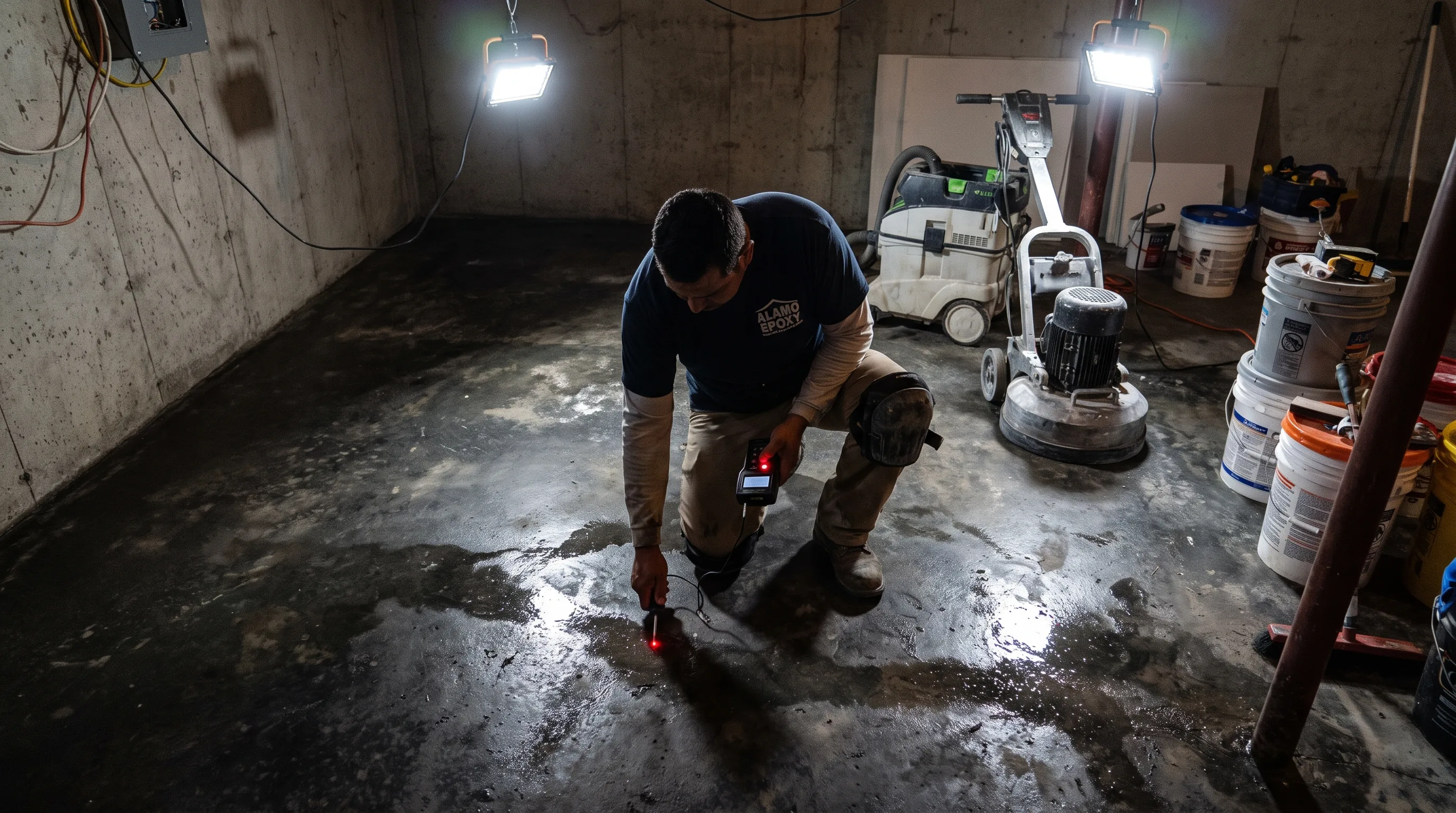
Probes drilled 40% deep into slab, sealed 72 hours. Measures relative humidity at depth - the gold standard for epoxy go/no-go decisions.
Sealed dish of calcium chloride absorbs surface vapor for 60–72 hours. Reports MVER (lbs/1,000 sq ft/24 hrs). Good surface metric but misses deep slab conditions.
18"×18" poly sheet taped to floor for 16–24 hours. Condensation under plastic = moisture present. Pass/fail only - no quantitative reading.
Handheld meter reads surface or shallow resistance/impedance. Fast screening tool but not accepted as standalone pass/fail data for epoxy manufacturers.
Moisture Thresholds for Epoxy Systems
| Epoxy System Type | Max RH (F2170) | Max MVER (F1869) | Typical Use |
|---|---|---|---|
| Standard 2-part epoxy | 75% | 3 lbs | Dry residential garages |
| Moisture-tolerant epoxy | 85% | 8 lbs | Light residential basements |
| Moisture-mitigating primer | 98% | 25 lbs | Wet basements, problem slabs |
| 100% solids vapor barrier epoxy | 98%+ | 25+ lbs | High water table, severe cases |
In San Antonio, we commonly measure RH readings of 80–90% in basement slabs - well above standard epoxy limits but manageable with the right primer system.
Step-by-Step: Testing Your Basement Floor
- Profile and clean first. Shot blast or grind the surface to open the concrete. Contaminants on the surface produce false low moisture readings. Do not test on unprepped concrete.
- Install F2170 probes. Drill holes to 40% of slab depth (typically 1.5"–2" for a 4" slab). Insert probes, seal with foam backer. Wait minimum 72 hours before reading.
- Run calcium chloride simultaneously. Place CaCl dishes across the floor (one per 1,000 sq ft minimum, corners and center). Seal and weigh after 60–72 hours per F1869 protocol.
- Record readings by zone. Moisture varies across a slab. A corner near an exterior wall or a low point in the floor often reads higher. Map the worst-case zones.
- Select system based on worst-case reading. Your epoxy system must be rated for the highest number measured, not the average.
- Apply appropriate primer within 24 hours of profiling. Surface oxidation begins quickly - don't wait days between grinding and priming.
Epoxy Solutions for San Antonio Basement Moisture
Low Moisture (RH < 75%, MVER < 3 lbs)
Standard two-part water-based or solvent-based epoxy primer followed by broadcast chip or solid color topcoat. This is rare in San Antonio basement applications - verify with actual testing before assuming you're in this range.
Moderate Moisture (RH 75–85%, MVER 3–8 lbs)
Moisture-tolerant epoxy primer rated for this range, applied in two coats. The primer's chemistry includes amine-blush inhibitors that allow proper cure in humid conditions. Follow with standard topcoat system after primer cures.
High Moisture (RH 85–98%, MVER 8–25 lbs)
This is the most common San Antonio basement scenario. Requires a moisture-mitigating primer - a high-build, 100% solids epoxy formulated specifically to block vapor transmission. Applied at 10–20 mils DFT. After cure (typically 24–48 hours), topcoats apply normally.
Severe Moisture (RH > 98%, Hydrostatic Pressure)
Active water intrusion - visible water or seepage - requires addressing the source before any coating. This may involve exterior waterproofing, interior drain tile, or sump installation. Once water intrusion is controlled, apply vapor-barrier epoxy primer system rated for extreme conditions.
Common Mistakes That Lead to Epoxy Failure
- Testing moisture before profiling the surface (false readings)
- Using plastic sheet test as the only method (pass/fail only, misses subsurface vapor)
- Reading probes before 72-hour equilibration period
- Averaging readings and selecting system for the average (should use worst case)
- Applying standard epoxy over readings that require moisture-mitigating primer
- Skipping primer and applying color coat directly
- Not accounting for San Antonio's seasonal humidity swings in system selection
What Proper Moisture Mitigation Looks Like
A professional San Antonio basement epoxy installation with moisture management includes: concrete profiling, documented F2170 and F1869 testing, moisture-mitigating primer applied to specification, an intermediate broadcast or base coat, and a UV-stable polyaspartic or urethane topcoat. The topcoat matters because epoxy alone yellows under ambient UV - polyaspartic maintains clarity and color stability in a livable basement.
Total system thickness typically runs 20–30 mils DFT, enough to handle the vapor pressure under San Antonio conditions without delaminating.
Frequently Asked Questions
The most reliable method is ASTM F2170 in-situ relative humidity testing - probes are sealed into drilled holes and read after 72 hours. Calcium chloride (ASTM F1869) tests surface emission rate. Simple plastic sheet tape tests catch obvious moisture but miss subsurface vapor.
Standard epoxy systems require RH below 75% and MVER below 3 lbs/1,000 sq ft/24 hrs. In San Antonio's humid climate, many basements exceed these limits, requiring moisture-tolerant or vapor-barrier epoxy primers.
Not with standard epoxy. You need moisture-mitigating epoxy primer (rated for up to 98% RH or 25 lbs MVER), followed by appropriate topcoats once the primer cures and seals vapor transmission.
New concrete needs at least 28 days to cure. For existing slabs with moisture issues, apply moisture-mitigating primer regardless of cure time, since ongoing ground vapor is the real concern in humid San Antonio.