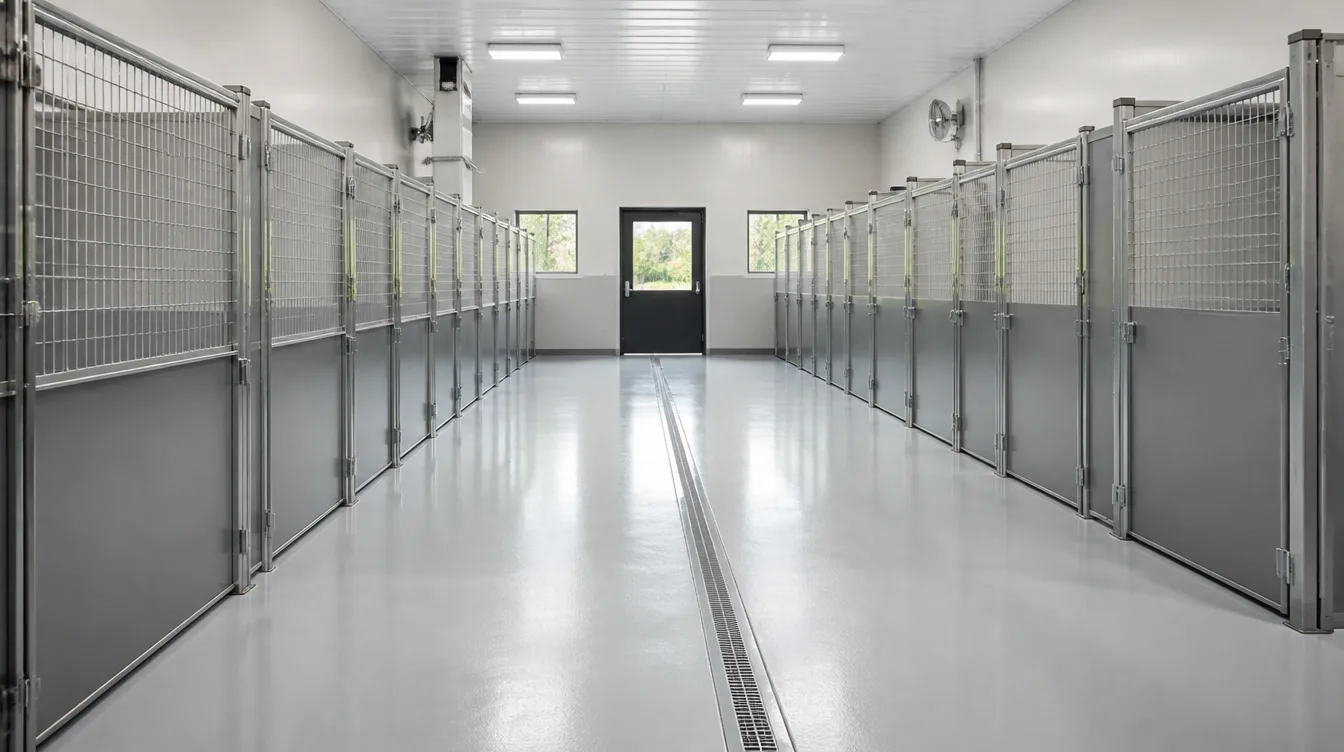
A kennel or boarding floor has to survive standing urine, daily sanitizing and constant wet cleaning, which a clinic floor rarely sees, so the floor needs to be seamless, coved up the wall, sloped to a drain and chemically resistant. Urine salts attack the coating and its bond at joints and edges, wash water pools wherever the slab is flat, and the wrong disinfectant can soften a resin that is otherwise sound. For the full range of animal facility systems, see our veterinary and animal facility epoxy flooring page, then use this guide for the specific problems of runs and boarding areas.
Quick answer: what a kennel floor has to survive that a clinic floor does not
A kennel floor has to survive four things a clinic floor mostly avoids: urine left standing for hours, hose-down cleaning that sends water to the walls and drains, strong daily disinfectants, and the scrape of claws and rolling carts. A clinic floor is wiped and mopped. A kennel floor is flooded.
That difference changes the specification. In an exam room the priorities are a smooth, cleanable, antimicrobial surface and a tidy floor-to-wall transition. In a boarding run the priorities are moisture control and chemical durability: where the water goes, how the floor meets the wall, and whether the resin tolerates what you wash it with. Our guide to epoxy flooring for veterinary clinics covers the clinic side, including hygiene requirements, and this post deliberately does not repeat it.
The rest of this guide takes the problems in the order they usually cause failures: urine chemistry, the wall and drain details, slope, slip resistance and finally disinfectant compatibility. A comparison table at the end sets urethane cement, epoxy and sealed concrete side by side for kennel use.
Urine salts and ammonia: how they attack a coating and its bond
Urine attacks a kennel floor by concentrating as it dries and then working into joints, edges and any place the coating is thin or not fully bonded. Fresh urine is mostly water, but as it evaporates the dissolved salts and urea stay behind, and bacteria break the urea down into ammonia, which is the sharp smell most kennels fight.
The coating itself is rarely the first thing to go. The failure usually starts where liquid can get underneath: at the edge of a run, around a drain, along a control joint or at a crack that was not repaired. Once urine and wash water get under the film, repeated wet and dry cycles lift the coating from the slab, and what starts as a small blister becomes a section that peels.
Porous concrete adds the odor problem. Bare or sealed-only concrete absorbs urine into the pores, and cleaning the surface does not reach what is below it. Odor returns on humid days because moisture reactivates the residue. A seamless, non-porous resin floor stops the absorption at the surface, which is the main reason kennels switch from sealed concrete to a coating. The key phrase is seamless: a coating with open joints or unsealed edges lets urine reach the slab and the odor returns.
Bond strength is what keeps a kennel floor intact under that chemical load. Surface preparation by diamond grinding to a defined profile, described by the ICRI 310.2R scale of CSP 1 to 9, gives the coating something to grip, and a pull-off test under ASTM D4541 verifies adhesion when a specification calls for it. Preparation matters more in a kennel than in a dry space, because every weak point gets tested daily by water.
Integral coving and the transition into trench drains
Integral coving is the single most useful detail in a kennel floor, because it removes the joint where the floor meets the wall, which is where urine and wash water collect and get behind a base. The coating is formed up the wall in a continuous curve, commonly four to six inches high, so there is no seam and no right-angle corner to trap moisture.
Compare that to a vinyl or rubber cove base glued to the wall, or a plain right-angle joint with a bead of caulk. Both leave a line that fails over time, and once the line opens, liquid reaches the substrate behind it. An integral cove is part of the same continuous film as the floor, so hosing a run down does not drive moisture behind the base.
The drain needs the same attention. A trench drain along a corridor or the back of the runs is the usual way to move water out, and the transition between the floor and the drain body is a common failure point. The coating should be terminated into the drain frame with a detail that seals the edge, so water cannot get under the film at the steel or plastic. Drain frames also move slightly with temperature, which is why the termination is usually a flexible sealant rather than a rigid coating stopped at the edge.
Runs separated by block walls or gates need the cove detail at every wall and every post base. It is a lot of linear footage, which is why coving is priced per linear foot on most quotes and why it is worth confirming that it is included. The same detail is required in food plants, and our guide to urethane cement for food processing facilities shows how it is built in that setting.
Slope to drain: the fall a run actually needs to dry out
A kennel run needs enough slope that water leaves the run rather than pooling, because persistent moisture is what shortens a coating's life and keeps odor alive. Flat floors stay wet. Even a thin film of water left after cleaning sits on the surface for hours and keeps the area damp for the next day.
Slabs for animal facilities are usually formed or ground to fall toward a trench drain, and a fall commonly in the range of one eighth to one quarter inch per foot is typical for wet floors, with the exact figure set by the designer and local requirements. If the existing slab was poured flat, a coating alone cannot create slope. The floor then needs either a sloped cementitious overlay or a grinding and build-up detail before the resin goes on.
Check the slope before choosing a system. Pour water on the floor and watch where it goes. If it travels to a drain, the slope is working. If it sits in a pool, the coating will not fix it, and a quote that ignores the problem is incomplete. This is one of the questions to ask any contractor before work begins.
Slope also interacts with slab moisture. A slab on grade can pass vapor upward, and ASTM F1869 (calcium chloride) and ASTM F2170 (in-situ relative humidity) are the common tests for it. A kennel that is wet from above should not also be wet from below, so moisture testing belongs in the plan. Our guide to moisture testing for epoxy flooring explains what those tests tell you.
Slip resistance for wet runs, with and without claws
A wet kennel floor needs a textured finish, and the aim is grip for people and animals without a surface so rough that it abrades paws or traps waste. Both staff and dogs move on wet surfaces, and a high-gloss smooth floor is the most dangerous when wet.
Slip resistance on interior wet floors is commonly judged by dynamic coefficient of friction under ANSI A326.3, and a value of 0.42 or higher is the widely used benchmark for level interior floors that may be wet. Ask for the tested figure for the specific system and finish, not a general claim that it is non-slip. Our guide to epoxy floor slip resistance explains the aggregate options and what they do to cleaning.
Animals add their own considerations. Claws scratch a coating, and a very coarse aggregate that grips well for a person can wear on paw pads, so kennels tend toward a fine, even texture rather than a heavy broadcast. A clear topcoat over a fine aggregate gives grip without the rough feel, and it keeps the surface sealed so urine does not reach the film below.
The right balance depends on the animals. A run for large, active dogs needs more grip and a tougher surface than a cattery or a quiet small-animal room, and the specification should reflect the heaviest use in the area.
Disinfectant compatibility: quats, bleach and peroxide against resin chemistry
The disinfectant you plan to use should be checked against the coating manufacturer's chemical resistance chart before the system is chosen, because resins differ in how long they tolerate each product. Kennels typically rotate through three families of disinfectant, and each interacts with a resin floor differently.
Quaternary ammonium compounds (quats) are the most common kennel disinfectant and are generally well tolerated by cured epoxy and urethane systems at label dilution. The usual issue is residue: quats leave a film that can make a floor slippery if it is not rinsed, so a rinse step belongs in the cleaning routine.
Sodium hypochlorite (bleach) is effective and inexpensive, and many resin systems tolerate it at dilution but not indefinitely. Repeated use at strong concentrations can dull or soften some coatings over time, and bleach should never be mixed with ammonia-containing cleaners or with urine-heavy residue because of the toxic gas it can release.
Hydrogen peroxide based products, including accelerated peroxide, are well tolerated by most cured resins and break down into water and oxygen, which suits facilities that want to limit chemical residue.
Temperature matters as much as chemistry. Hot water and steam cleaning produce thermal shock, which stresses a thin epoxy film more than a thick cementitious urethane. That is one of the reasons urethane cement is specified where cleaning is most intense. Whatever the chemistry, follow the manufacturer's cure time before the first wash-down, since a floor put into service too early can fail at any disinfectant.
Specification table: urethane cement against epoxy and sealed concrete for kennel use
| Property | Urethane cement | Epoxy coating | Sealed concrete |
| Urine and chemical resistance | High | Good, depends on system | Low, porous |
| Thermal shock and steam cleaning | Tolerates well | Limited, can fail | Tolerates, but absorbs |
| Seamless with integral cove | Yes | Yes | No |
| Odor control | Non-porous, good | Non-porous, good | Poor over time |
| Typical film thickness | Thick, cementitious | Thinner | None, sealer only |
| Upfront cost | Highest | Moderate | Lowest |
| Typical use | Heavy-use runs, hot wash-down | Boarding rooms, lower-intensity areas | Short-term or dry storage |
The pattern is that urethane cement earns its higher upfront cost where cleaning is most intense, and epoxy fits areas with lighter use. Sealed concrete is the cheapest to install and the hardest to keep odor-free, which is why it usually loses once a facility has dealt with the smell. For how the two resin systems compare on cost and lifespan, see our urethane cement floor page.
What to ask before choosing a kennel floor system
Four questions screen out most problem quotes. Ask how the cove is formed and whether it is integral to the floor. Ask how the coating terminates at the drain and at every wall and post. Ask which disinfectants the system is rated for and for how long, in writing from the manufacturer. And ask whether the slab will be tested for moisture and checked for slope before the coating is applied.
If a contractor cannot answer the first two, the system is likely to fail at the joints, which is where kennel floors fail. If they will not put the disinfectant compatibility in writing, assume the answer depends on the product you use and ask again. Done carefully, a kennel floor is one of the more durable commercial coatings, because the problems it faces are well understood and each one has a specific detail that solves it.
Frequently asked questions
What is the best floor coating for a dog kennel?
A seamless resin floor with integral coving, a textured non-slip finish and a slope to drain. Urethane cement is specified where urine exposure and frequent sanitizing are heaviest, with epoxy used for lower-intensity boarding areas.
Does dog urine damage epoxy flooring?
Standing urine can, over time. The salts concentrate as it dries and attack the coating and its bond at joints and edges, which is why coving, drainage and a chemically resistant system matter more here than in a clinic.
How much slope does a kennel run need?
Enough that water leaves the run rather than pooling, which is why the slab is usually formed to fall toward a trench drain. Flat kennel floors stay wet, and persistent moisture is what shortens a coating's life.
Can a kennel floor be cleaned with bleach?
Many resin systems tolerate diluted bleach, but not all tolerate it indefinitely. The disinfectant you plan to use should be checked against the manufacturer's chemical resistance chart before the system is chosen.
Is coving necessary in a kennel?
It is the single most useful detail. Integral coving removes the floor-to-wall joint where urine and wash water collect, and it lets a run be hosed down without driving moisture behind the base.
If you are planning a kennel, boarding or animal care floor, call (830) 355-3303 for a free on-site measure and written quote, or review our veterinary and animal facility epoxy flooring page to compare systems before you request bids.