Why Standard Flooring Fails in Veterinary Environments
Veterinary clinics in San Antonio face a combination of challenges that eliminate most standard flooring options quickly: constant cleaning with aggressive disinfectants, exposure to bodily fluids (blood, urine, feces, vomit), heavy animal traffic that includes nails and claws that scratch surfaces, and the need for immediate decontamination of spills. VCT tile (vinyl composition tile), the default flooring in many older clinic builds, absorbs disinfectant residue, harbors bacteria in seams, and cracks under repeated scrubbing. Grout lines in ceramic tile trap pathogens and are impossible to truly sanitize.
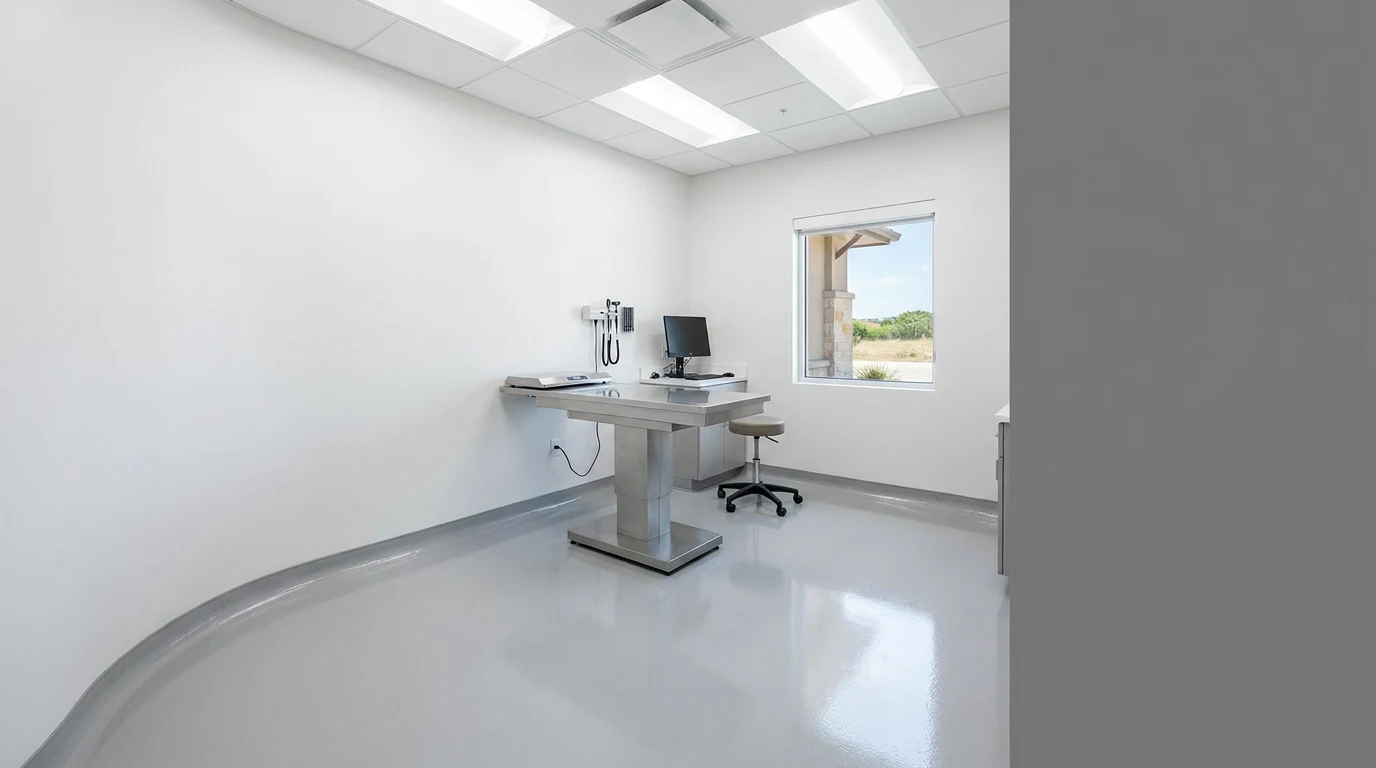
Seamless epoxy eliminates all of these failure modes. No seams means no pathogen reservoirs. Chemical resistance means disinfectants do their job without degrading the floor. The coved base (where the floor curves up the wall) eliminates the 90-degree corner where contaminated material accumulates and staff cannot clean effectively with a mop.
The Coved Base: Why It Matters in Veterinary Settings
A coved base is a curved epoxy transition that runs from the floor up 4–6 inches on the wall, eliminating the sharp corner where a standard baseboard meets the floor. In veterinary clinic environments, this detail is not cosmetic - it’s a hygiene requirement. Regulatory standards from the American Animal Hospital Association (AAHA) and Texas Department of State Health Services both reference seamless, easily cleanable wall-floor transitions in areas where animal patients are treated.
ProEpoxy installs coved bases in all veterinary flooring projects as standard, using the same epoxy system as the floor field. The cove radius is typically 1–2 inches, providing a sweepable, moppable curve rather than a scrub-resistant corner.
Chemical Resistance Requirements for Veterinary Floors
The disinfectants used in San Antonio veterinary clinics are among the most chemically aggressive cleaning products in any commercial environment:
- Quaternary ammonium compounds (Quats): Used at high concentrations for surface disinfection. Quats degrade many standard epoxy formulations over repeated exposure - the topcoat softens and loses gloss.
- Sodium hypochlorite (bleach): Highly alkaline. Bleach solutions above 5% break down standard epoxy topcoats and cause color change over time.
- Accelerated hydrogen peroxide products (Rescue, Accel): Increasingly common in veterinary settings for their broad-spectrum efficacy. Require epoxy formulations with oxidation resistance.
- Phenolic compounds: Used in some kennel and boarding environments. Can cause surface crazing in inadequately specified coatings.
ProEpoxy specifies a 100% solids epoxy body coat with a chemical-resistant aliphatic polyurethane topcoat for veterinary environments. This combination provides resistance to all of the above chemical classes at working concentrations. We can provide chemical resistance test data from the manufacturer for your specific product list.
Kennel and Boarding Facility Floors
Kennel runs and boarding areas have additional requirements beyond exam rooms:
- Drainage: Kennel floors must slope 1–2% toward floor drains to handle daily pressure washing. The epoxy system must be watertight at drain connections - a common failure point where water infiltrates under the coating edge.
- Impact resistance: Large dog kennels see jumping, scratching, and impact from heavy breeds. A higher-build system (25–30 mils) is recommended over the standard 20-mil system used in exam rooms.
- Anti-slip aggregate: Wet kennel floors are a slip hazard for both animals and staff. Anti-slip aggregate broadcast into the topcoat at 12–16 oz/100 sq ft provides consistent slip resistance without significantly impacting cleanability.
Surgical Suite and ICU Floors
Veterinary surgical suites in San Antonio require the highest standard of cleanability and chemical resistance. An additional consideration is conductive grounding - anesthetic gases used in veterinary surgery can be flammable, and NFPA 99 (Health Care Facilities Code) addresses static electricity requirements in environments where flammable anesthetic agents are used. Consult with your facility’s safety officer about whether a conductive or static-dissipative floor coating is required in your surgical suite.
Color Selection for Veterinary Environments
Lighter floor colors (light gray, beige, off-white) serve two functions in veterinary settings: they make contamination visible for cleaning staff and create a less stressful visual environment for animals. Solid color epoxy is the standard for exam rooms and surgical areas. Chip broadcast systems - which hide minor surface texture and minor contamination - are sometimes preferred in kennel and grooming areas where the aesthetic is less clinical.
Texas Regulatory Compliance
The Texas State Board of Veterinary Medical Examiners (TBVME) facility standards require that floors in veterinary facilities be constructed of impervious materials that are easily cleaned and disinfected. Seamless epoxy with a chemical-resistant topcoat meets this standard. ProEpoxy can provide a letter of specification confirming compliance with TBVME facility requirements for new clinic construction or renovation permitting.
Call (830) 355-3303 or request a veterinary flooring consultation. We schedule around clinic hours and can complete most exam room floors over a weekend.
Get a Free Quote for Your San Antonio Floor
ProEpoxy installs epoxy, polyaspartic, urethane cement, and polished concrete in the San Antonio metro - using our own crews, not subcontractors. We test every slab before we quote and back our work with a written warranty.
Request Free Estimate →