Not Every Concrete Problem Is an Epoxy Problem
Some concrete conditions are perfect candidates for epoxy coating. Others require a different fix first - or a different floor solution entirely. Knowing which situation you're in before calling a contractor will save you time, money, and the frustration of a callback. Here are the five signs we see most often on San Antonio slab evaluations, and what each one means for your project.
Sign #1: Surface Staining That Won't Clean Up
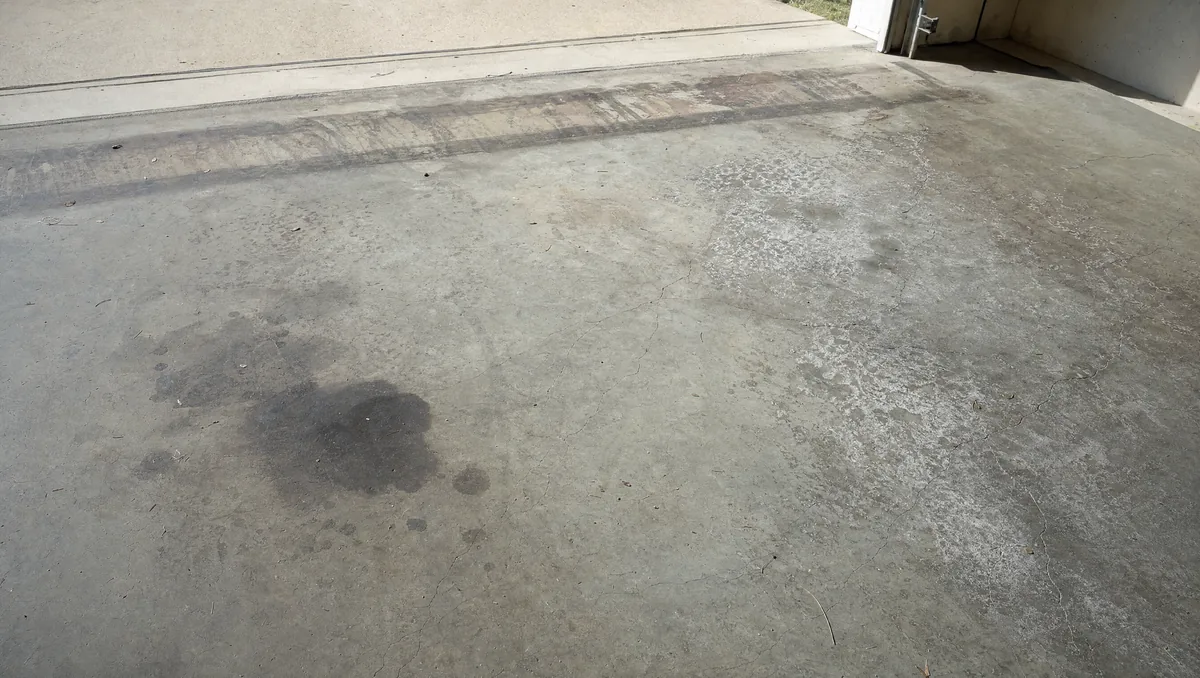
What it looks like: Oil stains from cars or equipment, rust rings, paint spills, chemical staining, or general gray grime that mopping doesn't remove.
What it means: Surface staining is almost always a cosmetic issue - and epoxy handles it beautifully. A shot-blasted or diamond-ground surface preparation removes the top layer of contaminated concrete, and epoxy covers the rest. The final result is a uniform, sealed surface that no longer absorbs spills.
The caveat: Oil that has penetrated 1 inch or more into the slab - common in San Antonio automotive service bays and older garages - needs degreasing and mechanical prep beyond standard shot blasting. An experienced contractor will test for deep oil contamination by dripping water on the suspected area: if water beads, oil is present. If water soaks in, the slab is ready for normal prep.
Verdict: ✅ Go ahead with epoxy. Specify degreasing in your contract if oil contamination is suspected.
Sign #2: Concrete Dusting
What it looks like: The floor leaves a chalky powder on your shoes, broom, or anything that drags across it. Sometimes visible as a light haze across the slab surface.
What it means: Dusting ("laitance") is a sign that the top surface of the concrete has a high concentration of water, fines, and cement that didn't hydrate properly. This layer is weak and won't hold epoxy adhesion - it will peel right along with the laitance layer. The solution is mechanical prep: shot blasting or diamond grinding removes the laitance layer and exposes sound concrete below.
San Antonio note: Laitance is more common in slabs that were poured during high-heat conditions (which describes most San Antonio summer pours before 2000). Rapid surface drying caused by 100°F July temperatures could cause the top cream to separate from the body of the slab - a problem that may not be visible until someone tries to coat it 20 years later.
Verdict: ✅ Excellent candidate for epoxy - once the laitance is ground off. Make sure your contractor specifies grinding or shot blasting, not just a chemical etch, in the prep scope.
Sign #3: Spider Cracks and Hairline Fractures
What it looks like: A web of fine cracks across the surface, typically ⅛ inch or less in width, not following a straight line. Common in slabs over 20 years old and in areas with expansive clay subgrade (much of the San Antonio metro).
What it means: Fine spider cracks are usually cosmetic - they formed as the slab cured and contracted, or as the subgrade moved seasonally. They typically don't indicate structural failure and don't compromise the slab's ability to hold an epoxy coating. A good installer fills them with flexible polyurea crack filler before applying the base coat.
What's different: Cracks wider than ¼ inch, cracks with vertical displacement (one side higher than the other), or cracks that are still actively moving need structural evaluation before coating. Epoxy bridges cosmetic cracks but cannot prevent a structurally moving crack from eventually reflecting through the coating.
Verdict: ✅ Fine cracks are normal and handled in prep. Wide or moving cracks need evaluation first.
Sign #4: Hot-Tire Marks and Rubber Staining
What it looks like: Discoloration or staining at the spots where car tires rest. May be yellow, brown, or simply a darker gray than the surrounding concrete. Common near garage doors.
What it means: This is one of the strongest arguments for professional epoxy in San Antonio. Hot tires - reaching 150°F or more in summer - bond slightly to bare concrete when the car sits, then pull away a micro-layer of the surface when it drives off. Repeated cycles leave visible marks that are impossible to clean. An epoxy system with a polyaspartic topcoat is resistant to hot-tire bonding because the topcoat's hardness and chemical cross-link density prevent the tire from bonding to the surface.
Important: Not all epoxy systems resist hot-tire pickup equally. A thin water-based epoxy (common in big-box DIY kits) will peel right where the tire sits. Specify a minimum 20 mils total coating thickness and a polyaspartic topcoat.
Verdict: ✅ Perfect use case for professional epoxy. The tire marks on your existing slab will be buried under the coating system.
Sign #5: Slab That Feels Damp or Shows White Efflorescence
What it looks like: A concrete surface that always feels slightly cool and damp to the touch, or white powdery deposits (efflorescence) that appear after rain or seasonal changes. Sometimes accompanied by a slight musty smell in enclosed spaces.
What it means: This is the one sign that requires careful attention before proceeding with epoxy. Efflorescence is caused by water moving through concrete and depositing dissolved salts at the surface - clear evidence of active vapor transmission. As discussed in our moisture testing article, epoxy applied over a high-vapor slab will delaminate within months.
San Antonio context: Given the Edwards Aquifer and the region's clay soils, this condition is more common here than in most U.S. cities. It doesn't disqualify a slab from epoxy - it means the spec needs a moisture mitigation primer, and the slab needs to be tested (ASTM F2170) before the project scope is finalized.
Verdict: ⚠️ Proceed with testing before coating. Don't skip this step - a $200 moisture test could save you a $4,000 re-installation.
What to Do Next
If you're seeing one or more of these signs on your San Antonio concrete floor, a free walkthrough is the most direct path to an accurate assessment. ProEpoxy's estimators test for moisture, evaluate cracks, and identify prep requirements on every visit - at no cost and with no obligation. Request yours here or call (888) 275-7078.
Get a Free Quote for Your San Antonio Floor
ProEpoxy installs epoxy, polyaspartic, urethane cement, and polished concrete in the San Antonio metro - using our own crews, not subcontractors. We test every slab before we quote and back our work with a written warranty.
Request Free Estimate →