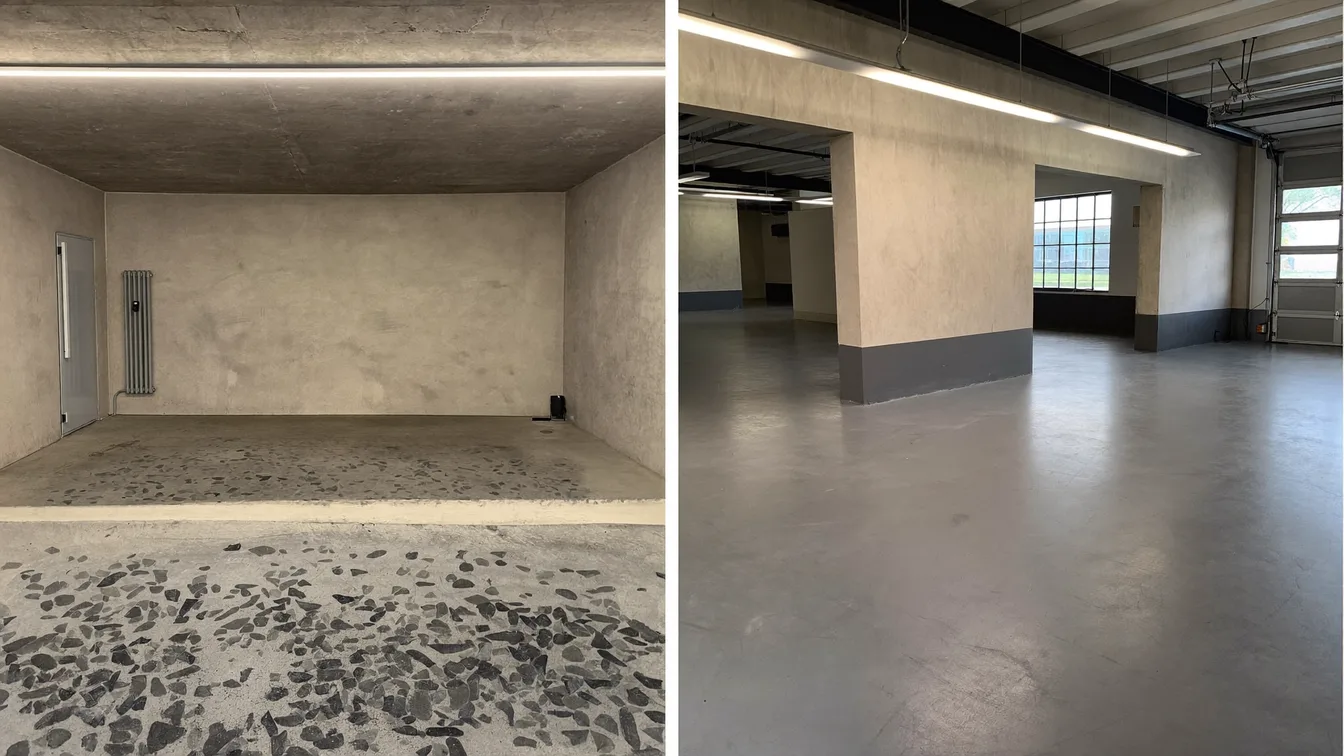
Commercial and residential epoxy are two different specifications sold under one word. A commercial system is built thicker, on a more aggressively prepared slab, with faster-curing chemistry and a warranty that addresses wear and use conditions. A residential system is usually thinner and chosen for appearance and cost. Our commercial epoxy flooring in San Antonio work is specified on the commercial side of every variable below, and this guide shows each one side by side so you stop comparing unlike quotes.
Quick answer: the same word covering two different products
The word "epoxy" describes a resin family, not a product. A garage kit from a hardware store, a decorative flake system in a home and a heavy-duty floor in a San Antonio distribution unit can all be called epoxy, and they share very little beyond that. They differ in how much solid material ends up on the slab, how the slab is prepared, how fast the coating cures and what the installer will put in writing.
That is why a residential quote and a commercial quote for the same square footage rarely match, and why neither is wrong. If you are holding two numbers that look far apart, the first job is to find out which of the six variables in this guide differ between them. Here is the short version of each.
- Film build: commercial specifications call for more dry mils per coat stack, and often a troweled or broadcast build well beyond what a home floor gets.
- Cure chemistry: commercial work leans on faster-curing systems so the space returns to service sooner.
- Preparation: commercial slabs are profiled deeper and tested for moisture more formally.
- Warranty: commercial terms tend to address wear rate and use conditions, while residential terms tend to address adhesion and defects.
- Scheduling: commercial installs often run at night or on weekends, which carries a cost.
- Use: the floor's job decides the grade, not the type of building.
Solids content and mil build
Commercial specifications call for more solid material per square foot than residential ones, and the gap shows up first in dry film thickness. A mil is one thousandth of an inch. A typical professionally installed home garage system is built to roughly 10 to 20 mils of dry film, as we explain in our guide to residential epoxy floor thickness in mils. A consumer kit leaves roughly 2 to 6 mils on the slab.
Commercial builds start where the residential build tops out and climb from there. The list below uses round figures to show the pattern, and the actual number on a given job depends on the product and the slab.
- Thin roll-applied commercial coating: commonly in the range of 8 to 12 mils, used on lightly trafficked retail, offices and corridors.
- Broadcast flake or quartz commercial system: commonly 20 mils and well above, because aggregate is thrown to refusal and sealed.
- Troweled epoxy mortar: often around a quarter inch, which is roughly 250 mils, for kitchens and heavy-wear areas.
Solids content matters as much as thickness. A 100 percent solids epoxy keeps essentially all of its wet film when it cures. A water-based or solvent-thinned product loses part of its wet thickness as the carrier leaves, so two floors with the same number of coats can differ by a factor of two in what is actually left on the concrete. Ask any bidder whether the number they quote is wet or dry, and whether the product is 100 percent solids.
The reason commercial specifications call for more build is simple. A warehouse floor sees pallet jack wheels, dropped loads and chemical spills every day, and thin film wears through where a home floor would last for years. For the industrial end of that range, including forklift loading, see our guide to industrial epoxy floor thickness in San Antonio, which covers the heavy-duty build in detail so this guide does not need to repeat it.
Cure chemistry and downtime tolerance
Commercial jobs are specified around how quickly the space can reopen, and that pushes the chemistry toward faster-curing systems. A home garage can sit untouched for several days while a standard epoxy cures. A restaurant, a retail unit or a shop cannot lose a week of trading, so the specification weighs cure speed alongside performance.
The common options behave differently, and the timings below are typical ranges that vary with temperature, humidity and the product's data sheet, so always confirm against the manufacturer's documentation.
- Standard two-part epoxy: typically allows light foot traffic after about a day and heavier loads after several days. It suits residential work where time is not tight.
- Polyaspartic topcoats and fast-cure systems: typically return to light traffic much sooner, which is why they appear on commercial specifications. Our comparison of polyaspartic versus epoxy cure time for commercial floors sets out the trade-offs.
- Urethane cement: specified where thermal shock and constant moisture are present, such as food plants.
San Antonio heat adds a second consideration. Warm slabs and warm air shorten the working time of fast-cure products, so an installer who is comfortable with them will schedule the pour and the crew size around the weather. A residential crew applying a slower product has more room for error. A commercial crew applying a fast product does not, and part of the higher commercial price is the experience that tolerance requires.
Surface preparation standards and why they diverge
Preparation is where commercial and residential specifications diverge most, because the coating is only as good as its bond to the slab. Commercial specifications generally call for mechanical profiling to a measured standard, formal moisture testing and a recorded adhesion check, while residential work often relies on grinding and an experienced eye.
Several published standards govern this work, and a commercial specification will usually name them:
- ICRI 310.2R: defines concrete surface profile from CSP 1 to CSP 9. Thin coatings are commonly applied to a lighter profile, and thicker broadcast and mortar systems call for a deeper one.
- ASTM F1869: measures moisture vapor emission with calcium chloride. Many resin manufacturers set a maximum emission rate for their products.
- ASTM F2170: measures in-situ relative humidity in the slab, which many manufacturers also limit.
- ASTM D4541: a pull-off test that records adhesion in psi, usually on a test area.
- ACI 302.1R: covers concrete floor and slab construction, including flatness and curing, and informs what the slab can be expected to do.
A home garage slab often receives diamond grinding, crack and joint repair and a clean-up before the primer goes down. A commercial slab may also need removal of old coatings, tile mastic or contamination, followed by moisture readings at several locations. That removal work is a separate line on a quote. Our epoxy floor coating guide for San Antonio businesses explains the basics of what a business owner is buying, so we will not repeat it here.
Slip resistance is a preparation and finish question too. Commercial specifications may cite wet dynamic coefficient of friction under ANSI A326.3, and older documents still reference ASTM C1028. A home garage rarely carries a written slip target, though a floor that is slick when wet is a hazard in either setting.
Warranty terms: what each market expects
Warranties differ in what they cover more than in how long they run, so comparing terms by years alone misleads. A residential warranty usually addresses adhesion failure such as peeling or delamination and defects in workmanship. A commercial warranty is more likely to address wear rate, specific use conditions and the maintenance the owner must keep up.
When you compare two warranties, read for these items:
- What is covered: adhesion, workmanship, discoloration, wear through, or some combination.
- What is excluded: hot tire pickup, impact damage, chemical exposure beyond a stated list and moisture-related failures are common exclusions.
- Use conditions: a commercial warranty may state the traffic type, such as pedestrian or rubber-tired, that it assumes.
- Owner obligations: cleaning methods, avoided chemicals and reporting windows.
- Who stands behind it: the installer, the manufacturer or both, and whether the document is in writing.
Get the warranty in writing at quote stage, and ask which of the standards above the installer will record in the project file. A warranty with no test record behind it is hard to claim against.
Side-by-side specification table across six variables
The table below puts the six variables next to each other. The figures are typical ranges for the San Antonio market and are meant to help you compare quotes, not to replace a manufacturer's data sheet or a site measure.
| Variable | Residential | Commercial |
|---|---|---|
| Dry film build | About 10 to 20 mils for a professional system | About 8 to 12 mils thin, 20 mils and up broadcast, around 250 mils troweled |
| Solids content | Consumer kits often water-based, professional systems 100 percent solids | 100 percent solids is the usual specification |
| Cure and return to service | Several days is acceptable | Hours to a day or two, using fast-cure systems |
| Surface profile | Diamond ground, often a lighter profile | ICRI CSP measured and recorded, often deeper |
| Moisture testing | Often a quick check or none | ASTM F1869 or F2170 with readings logged |
| Warranty focus | Adhesion and workmanship | Wear, use conditions and owner maintenance |
If two quotes differ, work down the table and mark which rows differ. In nearly every case the cheaper quote is simply a different specification, not a cheaper way to do the same one.
Why a residential quote looks cheaper than a commercial one
A residential quote looks cheaper because it carries less of everything that costs money on a floor: less material, less preparation, fewer coats and no shift premium. Each is a real cost, and the commercial version carries all of them.
Published San Antonio rates show the pattern. Our garage page publishes garage epoxy at roughly $3 to $7 per square foot installed, depending on system and condition. Our commercial cost guide publishes bands from about $3 to $5 per square foot for a thin roll-applied coating up to about $5 to $8 for broadcast flake or quartz, with troweled mortar above that. You can see the full breakdown in our guide to commercial epoxy installed cost per system. Note that the low ends overlap, which is exactly the point: a thin commercial coating and a basic residential coating are close cousins, and the price gap opens as the build and preparation increase.
Here is what moves a commercial price above a residential one on the same footprint:
- More material per square foot: every added mil is more resin on the floor.
- More preparation: deeper profiling, removal of old coatings and moisture testing.
- More coats: primer, body, broadcast and topcoat steps where a home system might use fewer.
- Off-hours work: night or weekend shifts to avoid disrupting operations, which add labor cost.
- Documentation: test records and written specifications that a business may need for audits or insurance.
- Scale effects: larger areas often price lower per square foot, so a small commercial unit can price higher per foot than a large warehouse.
None of this makes a residential system a worse choice for a home. A well-installed 10 to 20 mil system on a ground slab serves a typical garage for years. The mistake is carrying that assumption into a setting with heavier use and expecting the same result.
Choosing the right grade for a home workshop or small business unit
Price the floor on how it will be used rather than on the type of building. A workshop with vehicle traffic, dropped tools and chemical exposure needs a commercial-grade system even if it sits inside a house, and a quiet storage room in a business can take a lighter system than its address suggests.
Use these questions to place a floor on the spectrum:
- What rolls on it? Foot traffic and cars sit at one end. Pallet jacks, carts and forklifts sit at the other.
- What spills on it? Water and oil are manageable. Brake fluid, solvents, acids and sanitizers need a stated chemical resistance.
- What gets dropped? Hand tools and metal stock concentrate impact. Thicker build resists chipping.
- How long can it be closed? If the answer is a day or less, specify a fast-cure system.
- Does the slab have moisture? Test it, because it limits every system and no coating overrides it.
- Is paperwork needed? If an insurer, landlord or auditor will ask for records, specify testing from the start.
For a home, residential epoxy flooring for home applications walks through which rooms suit a resin floor and which do not, and the epoxy garage floor service page covers the standard garage build. For a workshop that behaves like a business, the commercial route costs more and prepares more, and it tolerates abrasion and chemical spills far better.
If you are unsure which side your floor falls on, call (830) 355-3303 for a free on-site measure and written quote. Tell us what rolls on the floor, what spills on it and how long it can be closed, and we will quote the specification the floor needs, with the build, the preparation standard and the warranty terms written out so you can compare it line by line.
Frequently asked questions
What is the difference between commercial and residential epoxy flooring?
Commercial systems specify higher mil builds, more rigorous surface preparation and faster cure chemistry to limit downtime. Residential systems are usually thinner and chosen primarily for appearance and cost. The two share a resin family, but the film, the slab preparation and the cure window all differ.
Can I use a commercial grade epoxy in my garage?
Yes, and it is worth considering for a workshop or a garage that sees real use. It costs more and takes more preparation, but it tolerates abrasion and chemical spills far better than a standard residential build, and it suits garages with heavy tools or equipment.
Why is commercial epoxy more expensive?
More material per square foot, more preparation, more coats and often night or weekend shift work to avoid disrupting operations. Each of those is a cost the residential version does not carry, and commercial jobs may also need test records and written specifications.
Do residential epoxy floors have shorter warranties?
Generally the terms differ in what they cover rather than only in length. Commercial warranties are more likely to address wear rate and specific use conditions, while residential warranties focus on adhesion and workmanship. Read the exclusions before comparing the number of years.
Is a home business workshop a residential or commercial job?
Price it on use rather than on the building. A workshop with vehicle traffic, dropped tools and chemical exposure needs a commercial grade system even in a house. A light craft room in the same house can take a residential build.