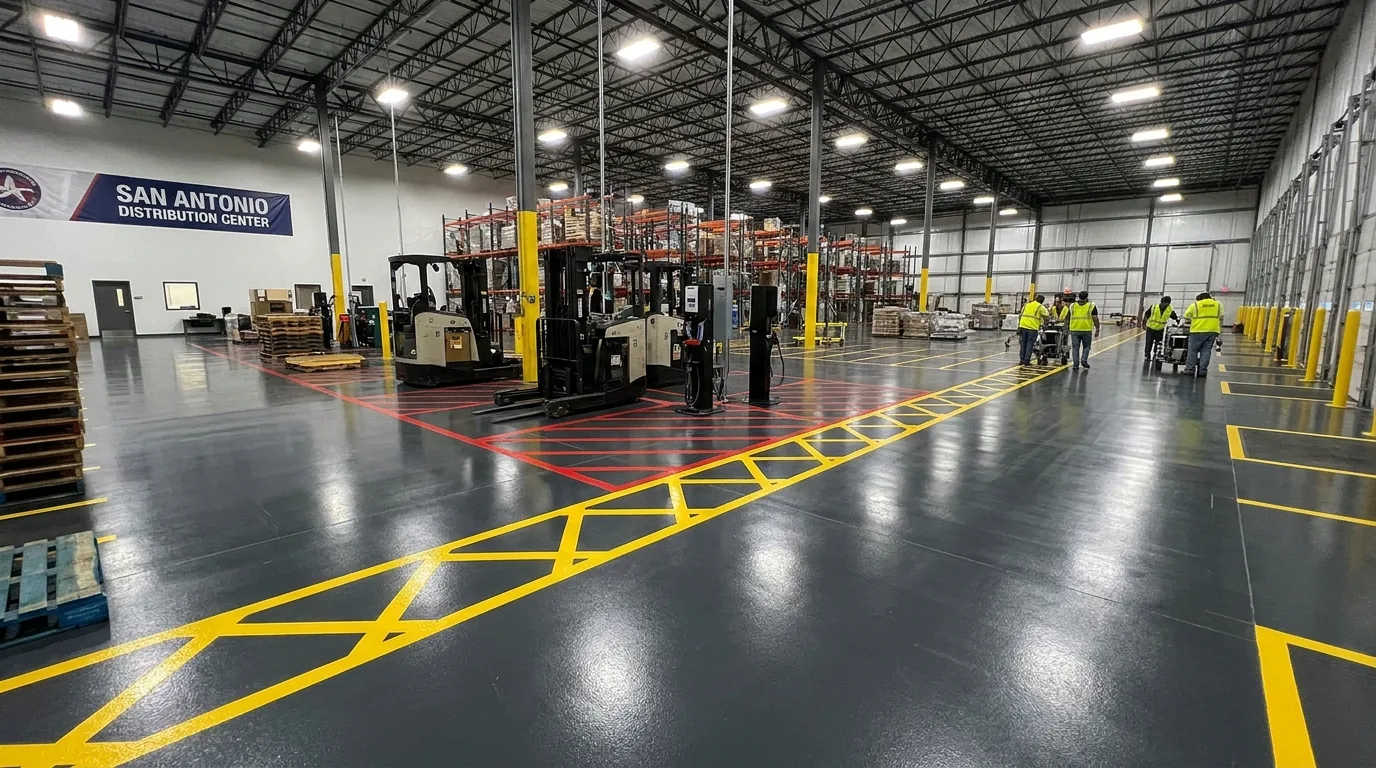
What OSHA Actually Requires for Floor Markings
OSHA 29 CFR 1910.22(b)(2) states: “Aisles and passageways used or intended for use by mechanical handling equipment shall be kept clear and in good repair, with no obstruction across or in aisles that could create a hazard. Permanent aisles and passageways shall be appropriately marked.”
That word “appropriately” is where most San Antonio facility managers get confused. OSHA doesn’t specify a color code, minimum width, or marking method for floor lines. What it does specify, through reference to ANSI/ASSP Z244.1 and industry guidance documents, is that markings must be visible, durable enough to remain visible through normal operations, and consistent throughout the facility.
In practice, painted floor lines fail quickly in forklift environments - the tire rubber and load wheels grind through paint within weeks. Epoxy and polyaspartic line marking systems, applied in-process and protected under the same topcoat as the field, survive years of forklift traffic without repainting.
ANSI Z535.1 Color Code: What Each Color Means
While OSHA doesn’t mandate specific colors, ANSI Z535.1 provides the de facto color standard adopted by most San Antonio facilities:
- Yellow: Traffic lanes, aisles, and areas where caution is required. The most common marking color in warehouses and manufacturing facilities.
- White: Work cell boundaries, equipment locations, material staging areas, and finished goods storage zones.
- Red: Fire equipment locations (extinguisher floor outlines, sprinkler valve markers), emergency stop areas, and defective/rejected material zones.
- Green: First aid station locations, safe pathway markings, and designated safe areas in emergency evacuation plans.
- Orange: Warning of physical or health hazard - electrical panels, hazardous material storage proximity markers.
- Blue: Informational markings, visitor routes, and non-hazard identification.
Consistency matters more than the specific color scheme. Whatever system you establish, apply it uniformly across the facility and document it in your safety program.
Epoxy Line Marking vs. Painted Lines: Why It Matters
The two most common approaches to warehouse floor marking in San Antonio are painted lines and epoxy/polyaspartic in-process markings. They are not equivalent:
Painted Lines
Paint is applied to the surface of an existing floor coating or bare concrete. Advantages: low initial cost, fast application, no downtime beyond paint cure. Disadvantages: Paint fails rapidly under forklift traffic - typically 3–12 months in active areas. Repainting requires stopping production in the affected zone. Over time, paint buildup in joints and cracks creates a safety hazard as it chips into debris.
In-Process Epoxy Markings
Applied as part of the floor coating system - the marking color is laid down before the topcoat is applied, so it’s protected by the same chemical and abrasion-resistant film as the field color. In-process markings last the life of the floor system - typically 10–15 years in a properly maintained industrial environment. The additional cost over painted lines is recovered in 1–3 years by eliminating repainting downtime.
ProEpoxy installs all line markings in-process as part of the floor installation. Markings can be modified - if an aisle needs to move, the topcoat can be re-applied over the marking - but under normal operating conditions they are permanent.
Minimum Aisle Width Requirements
OSHA 29 CFR 1910.22(b)(1) requires: “Where mechanical handling equipment is used, sufficient safe clearances shall be allowed for aisles, at loading docks, through doorways and wherever turns or passage must be made.”
For counterbalanced forklifts, industry standard minimum aisle widths:
- Two-way traffic: Minimum 10 feet (plus load width + 3 feet clearance each side in practice)
- One-way traffic: Minimum 6 feet (plus load width + 18 inches clearance in practice)
- Pedestrian aisles: Minimum 4 feet (ADA compliant accessible path)
- Combined pedestrian/forklift: Minimum 10 feet, with physical barrier preferred over line marking alone
When ProEpoxy marks your facility, we layout the aisle network before painting to confirm widths meet both OSHA requirements and your operational flow.
Special Zone Markings in San Antonio Facilities
Loading Dock Safety Zones
Dock edges are fall hazards. A 12-inch yellow perimeter line set back 3 feet from the dock edge is standard - some facilities add diagonal hatching inside the setback zone as an additional visual warning. Combined with dock safety lights (red/green) and wheel chocks, floor markings are one layer of a dock safety program, not the entire program.
Fire Equipment Clearances
NFPA 10 requires 18-inch clearance around portable fire extinguishers, and fire hose cabinets and sprinkler control valves must remain accessible. Red floor outlines (36 inches × 36 inches minimum) mark the access zone. Blocking these zones is a fire code violation that results in citations from the San Antonio Fire Prevention Bureau.
Electrical Panel Clearances
NEC 110.26 requires 3 feet of clear working space in front of electrical panels up to 150V. For higher voltage equipment, the required distance increases. Orange floor markings defining the clear working zone help maintain OSHA 29 CFR 1910.303 compliance.
How ProEpoxy Handles Line Marking Projects
For new floor installations, line markings are included in the scope and applied in-process before topcoating. For existing floors where only the markings need to be refreshed, we can apply a compatible polyaspartic marking system over the existing floor coating after light abrasion - this is faster than a full floor replacement and appropriate for floors that are otherwise in good condition.
Every line marking project includes a layout plan reviewed with your safety or operations team before application starts. Call (830) 355-3303 or request a floor marking assessment.
Get a Free Quote for Your San Antonio Floor
ProEpoxy installs epoxy, polyaspartic, urethane cement, and polished concrete in the San Antonio metro - using our own crews, not subcontractors. We test every slab before we quote and back our work with a written warranty.
Request Free Estimate →