Why Commercial Epoxy Is a Different Animal Than Residential
If you've looked at epoxy flooring for your San Antonio business and found yourself comparing quotes that don't seem to be describing the same thing, you're not wrong. Commercial epoxy specifications are genuinely different from residential ones - in mil thickness, product chemistry, compliance requirements, and installation logistics. A residential garage system optimized for aesthetics and weekend DIY durability won't hold up in a commercial environment with forklifts, chemical exposure, and daily cleaning with industrial detergents.
This guide gives San Antonio business owners the framework to understand what they're buying, what their specific industry requires, and how to plan an installation that doesn't shut their operation down for three days.
Specs by Industry: What Your Floor Actually Needs
Retail Spaces
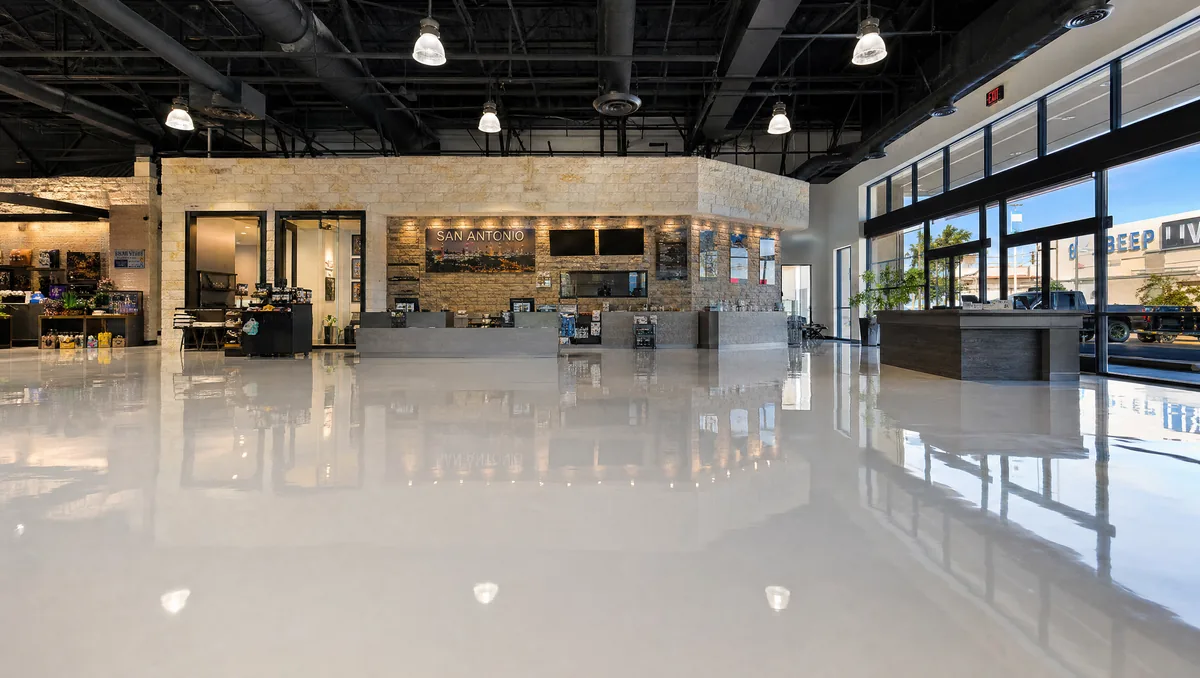
Retail floors carry foot traffic, rolling merchandise carts, and need to look professional for years without constant refinishing. The spec here balances aesthetics with durability: a high-build epoxy base (8–10 mils) with a UV-stable aliphatic polyaspartic topcoat (3–5 mils) in a solid color or broadcast chip finish. The topcoat gloss level can be specified to match your brand - high gloss for modern retail environments, satin for a more industrial aesthetic. Total system: 12–16 mils. Slip resistance coefficient should meet ADA requirements (DCOF ≥ 0.42 wet).
Warehouses and Distribution Centers
Warehouse floors need to handle forklift traffic, pallet jack loads, heavy point-load impacts, and often chemical spills from battery acid or hydraulic fluid. The spec here prioritizes structural performance over aesthetics: a heavy-build epoxy system at 20–30+ mils total, often with a broadcast aggregate layer for additional slip resistance and surface hardness. Chemical-resistant topcoats (aliphatic urethane or polyaspartic) protect against the specific chemicals present in your operation. Concrete joint treatment is critical - joints under forklift traffic will chip and fail if not properly filled and reinforced.
Food Service: Restaurants, Commercial Kitchens, and Food Processing
Food service floors face a unique combination of requirements: grease resistance, seamless surface (no joints to harbor bacteria), thermal shock resistance (hot water cleaning), chemical resistance to cleaning agents, and compliance with health department standards. The system of choice is urethane cement (also called cementitious urethane), not standard epoxy. Urethane cement handles the thermal cycling that cracks standard epoxy, provides a seamless, coved base connection (required by most health codes), and resists the sanitizing chemicals used in food service. A coved base - where the floor coating turns up the wall 4–6 inches - eliminates the floor-wall joint entirely, which is a major sanitation requirement. Budget $8–$12/sq ft installed for a food-service-compliant system.
Healthcare Facilities and Medical Offices
Healthcare floors must be seamless (no joints to harbor pathogens), easy to clean with hospital-grade disinfectants, slip-resistant, and in many cases antimicrobial. Systems incorporating antimicrobial additives (silver ion-based additives are common) meet infection control requirements. The floor-to-wall junction should be coved and sealed. Slip resistance is specified to meet ANSI A137.1 wet DCOF minimums. Color selection often follows healthcare design standards (warm, non-clinical tones for patient areas; high-visibility safety markings for utility areas).
Planning Installation Downtime
The biggest practical concern for San Antonio business owners is usually the same: how long will my operation be down? The honest answer depends on system chemistry and square footage, but here's the framework:
- Standard epoxy systems: 24–48 hours to light foot traffic, 72 hours minimum before vehicle or heavy equipment traffic, 7 days to full cure.
- Polyaspartic systems: 4–6 hours to foot traffic, 24 hours to vehicle traffic. This is the primary advantage of polyaspartic for commercial installs - much faster return to service.
- Urethane cement: 12–24 hours to foot traffic, 48–72 hours to full service. Slightly faster than standard epoxy.
For businesses that can't afford a multi-day closure, ProEpoxy can structure phased installations - coating one section of the floor while the rest remains operational, then returning to complete the adjacent sections. This requires more planning and coordination but is frequently the right solution for operating restaurants, retail stores, and manufacturing operations in San Antonio.
Night and weekend scheduling is also available for businesses with predictable off-hours. A 5,000 sq ft warehouse section can often be prepped, coated, and returned to service across a single weekend.
ROI Framework for Commercial Epoxy Flooring
Commercial epoxy flooring is a capital expenditure, and it deserves the same ROI analysis as other major facility investments. Here's a simple framework San Antonio business owners can use:
- Installation cost: Total installed price for your system and square footage.
- Expected lifespan: 8–15 years for properly maintained commercial systems.
- Annual maintenance cost: Cleaning supplies, periodic topcoat refresh (typically needed at 3–5 years). Far lower than carpet replacement, tile grout cleaning, or bare concrete dusting control.
- Downtime value recovered: Phased or after-hours installation means zero or minimal lost operating hours.
- Compliance value: Avoiding health department violations, OSHA citations, or slip-and-fall liability in facilities where floor condition affects safety.
On a typical San Antonio warehouse or light manufacturing floor, the cost per square foot per year over a 10-year system life often comes in under $0.50/sq ft/year - less than virtually any alternative flooring solution that provides comparable chemical and impact resistance.
Commercial Quotes vs. Residential Quotes
A commercial epoxy quote includes everything in a residential quote - but with additional elements. Expect to see: concrete condition assessment (not just a visual walk, but hardness testing and pH measurement), a specific product specification by manufacturer and product line, joint treatment protocol, cove base specification if applicable, compliance documentation (data sheets confirming DCOF, chemical resistance ratings, antimicrobial certifications), installation phasing plan, and return-to-service timeline with warranty terms covering commercial use. If a contractor is quoting your 10,000 sq ft warehouse the same way they'd quote a two-car garage, ask questions.
Compliance Considerations
Depending on your industry, your floor may need to meet specific regulatory standards:
- OSHA: Walking-working surfaces must meet slip resistance requirements. OSHA 1910.22 sets general housekeeping and condition standards; slip resistance specification in wet areas should be documented.
- FDA food facilities: 21 CFR Part 110 (Current Good Manufacturing Practice) requires floors in food contact areas to be smooth, easily cleanable, and maintained in good repair. Seamless coatings with coved bases are the standard compliance approach.
- ADA: All public-access commercial floors must meet ADA slip resistance minimums (DCOF ≥ 0.42 wet for level surfaces). ProEpoxy can provide topcoat specifications with documented DCOF values.
How to Brief ProEpoxy for a Commercial Project
When you reach out for a commercial quote, the more information you provide upfront, the faster and more accurate the proposal. Tell us: the square footage and layout of the space, your primary industry and what activities happen on the floor, any existing floor coating or contamination (oil, chemicals, old paint), your compliance requirements if any, your preferred installation timeline, and whether you need phased installation or off-hours scheduling. We'll schedule a site visit within three to five business days and provide a written commercial proposal with full product specifications.
Get a Commercial Epoxy Quote for Your San Antonio Business
ProEpoxy handles commercial and industrial epoxy flooring across the San Antonio metro - warehouses, restaurants, retail, healthcare, and manufacturing. We work around your schedule to minimize downtime. Call (888) 275-7078 or request a site visit online.
Request Commercial Quote →