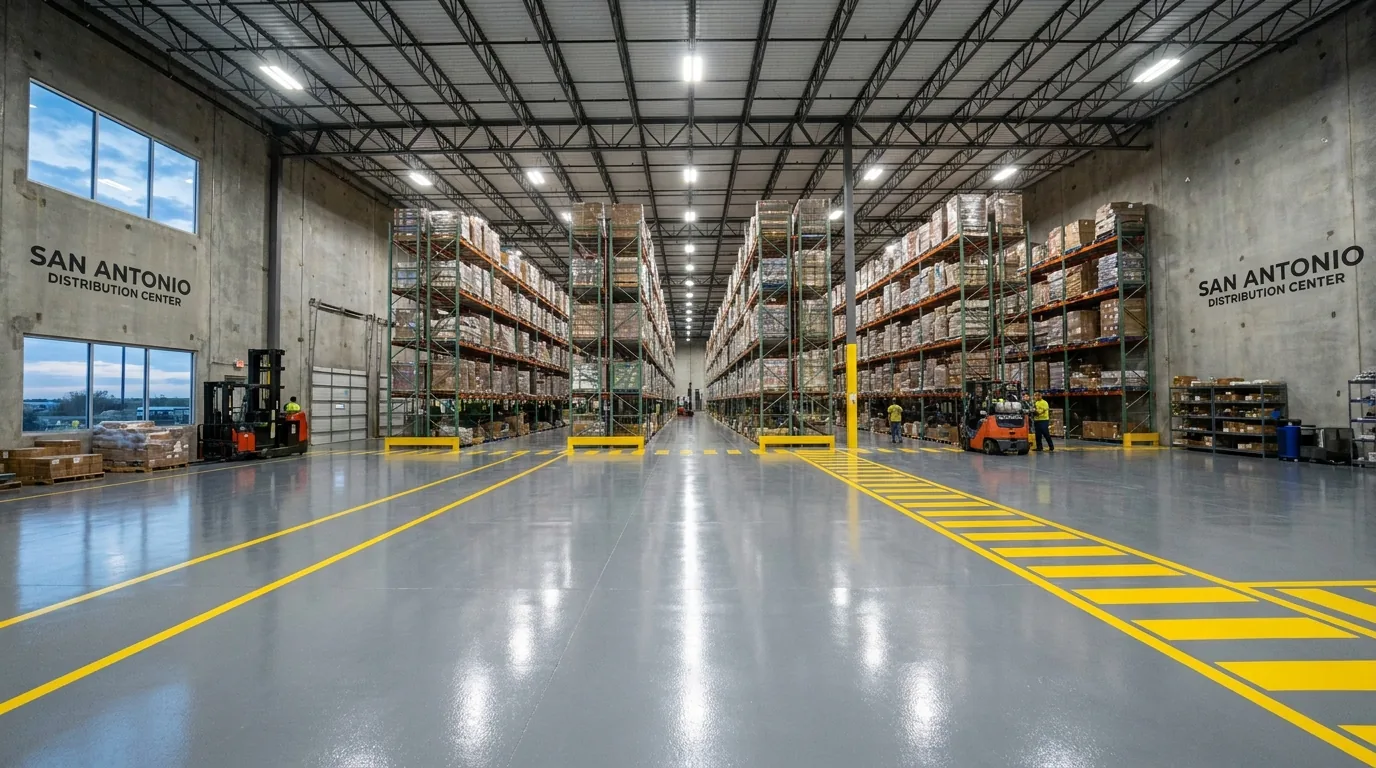
The Problem With Most Warehouse Floor Coatings in San Antonio
The majority of warehouse floor coating failures we see in San Antonio come down to three things: coating systems chosen without a moisture test, inadequate surface preparation on dense-troweled slabs, and products specified for the price column rather than the load requirement. A warehouse that runs two forklift shifts per day needs a system rated for point loads, not a coating designed for light foot traffic marketed as “industrial.”
This guide is for San Antonio facility managers, operations directors, and property owners who need to understand the difference before they get a quote - so they can evaluate bids based on specification, not just price.
Understanding Forklift Load Requirements
Before selecting a floor coating, identify the heaviest rolling load in your facility. A standard counterbalanced sit-down forklift at 8,000 lb capacity with a loaded pallet exerts a concentrated wheel load of approximately 10,000–14,000 psi on a small tire contact patch. Your floor coating must:
- Bond to the concrete substrate at a tensile pull-off strength exceeding the coating’s own film strength (typically 200–400 psi minimum)
- Resist hot-tire pickup (forklift tires run warmer than automotive tires)
- Provide sufficient hardness to resist scuffing and gouging under load
- Maintain bond integrity through thermal cycling in San Antonio’s climate
The surface preparation method - shot blasting vs. diamond grinding - directly determines bond strength. Shot blasting to ICRI CSP 3–4 is the minimum profile for high-build epoxy in forklift environments. Grinding alone to CSP 2 is insufficient for continuous forklift traffic.
Coating Systems Compared
High-Build Solid Color Epoxy (100% Solids)
The most common specification for San Antonio warehouses. A 100% solids epoxy at 20–30 mils total (primer + body coat + topcoat) provides:
- Compressive strength of 8,000–10,000 psi
- Tensile strength of 4,000–6,000 psi
- Resistance to oils, fuels, and mild acids
- Surface hardness that resists forklift tire marking
Cost range in San Antonio: $3.50–$5.50/sq ft installed. Best for: distribution centers, general warehousing, light manufacturing. Not ideal for: areas with extreme thermal cycling, food processing (where chemical resistance to sanitizers is paramount), or wet areas.
Polyurea and Polyaspartic Systems
Fast-cure alternatives to traditional epoxy that are increasingly popular for San Antonio warehouses. Polyurea and polyaspartic coatings cure to light traffic in 4–6 hours (vs. 24–72 hours for epoxy), which matters when a warehouse can’t take a weekend downtime. They also perform better in the temperature swings between San Antonio’s outdoor docks and climate-controlled interior zones.
Cost range: $5–$8/sq ft. Best for: operations that can’t afford extended downtime, facilities that need UV-stable coatings near dock doors or skylights, or re-coat projects over existing sound epoxy.
Urethane Cement
The correct specification for food manufacturing, beverage production, or any San Antonio warehouse where floors are regularly hosed down with hot water or strong cleaning chemicals. Urethane cement resists thermal shock (from hot water cleaning), chemical attack, and hydrostatic moisture pressure from below - the condition that causes standard epoxy to blister in San Antonio’s high water table areas.
Cost range: $8–$12/sq ft. Best for: commercial kitchens, food processing, breweries, pharmaceutical manufacturing, meat packing.
ESD Conductive Epoxy
Required in electronics assembly, semiconductor manufacturing, and data center environments. ESD epoxy is specified to ANSI/ESD S20.20 with resistance values between 10⁵ and 10⁹ ohms, verified by field testing after installation. Standard warehouse epoxy provides no ESD protection - if you’re coating a warehouse that handles sensitive electronics, this is a non-negotiable specification.
Floor Flatness: The Specification Nobody Talks About
A coating is only as flat as the concrete under it. San Antonio warehouses built for narrow-aisle racking require floor flatness numbers (F-numbers per ASTM E1155) that existing slabs may not meet. A floor coating cannot correct an out-of-flat slab - it follows the surface profile. If your operation requires narrow-aisle reach trucks or automated guided vehicles (AGVs), check your slab’s F-number before specifying a coating. Grinding can improve localized low spots; grinding an entire bay flat is cost-prohibitive.
Joint Treatment in San Antonio Warehouses
Control joints and construction joints are the most common failure point in warehouse floor coatings. Forklifts crossing unsealed joints transmit impact loads directly to the coating edge, which chips and delaminates over time. ProEpoxy fills all working joints with semi-rigid polyurea joint filler (ASTM C1193 compliant) to provide edge support for the coating while allowing the joint to flex with thermal movement. Rigid fillers crack; flexible fillers hold.
Line Marking for Warehouse Safety
OSHA 29 CFR 1910.22(b) requires permanently marked aisles in San Antonio warehouses where mechanical handling equipment operates. ProEpoxy applies line marking as part of the installation process - not as a painted overlay that peels under forklift traffic. Markings are applied in-process using pigmented epoxy or polyaspartic and protected under the same topcoat as the field, so they last as long as the floor.
Call (830) 355-3303 or request a warehouse floor consultation. We’ll visit your facility, assess your slab condition, and provide a written specification proposal matched to your operation’s actual load requirements.
Get a Free Quote for Your San Antonio Floor
ProEpoxy installs epoxy, polyaspartic, urethane cement, and polished concrete in the San Antonio metro - using our own crews, not subcontractors. We test every slab before we quote and back our work with a written warranty.
Request Free Estimate →