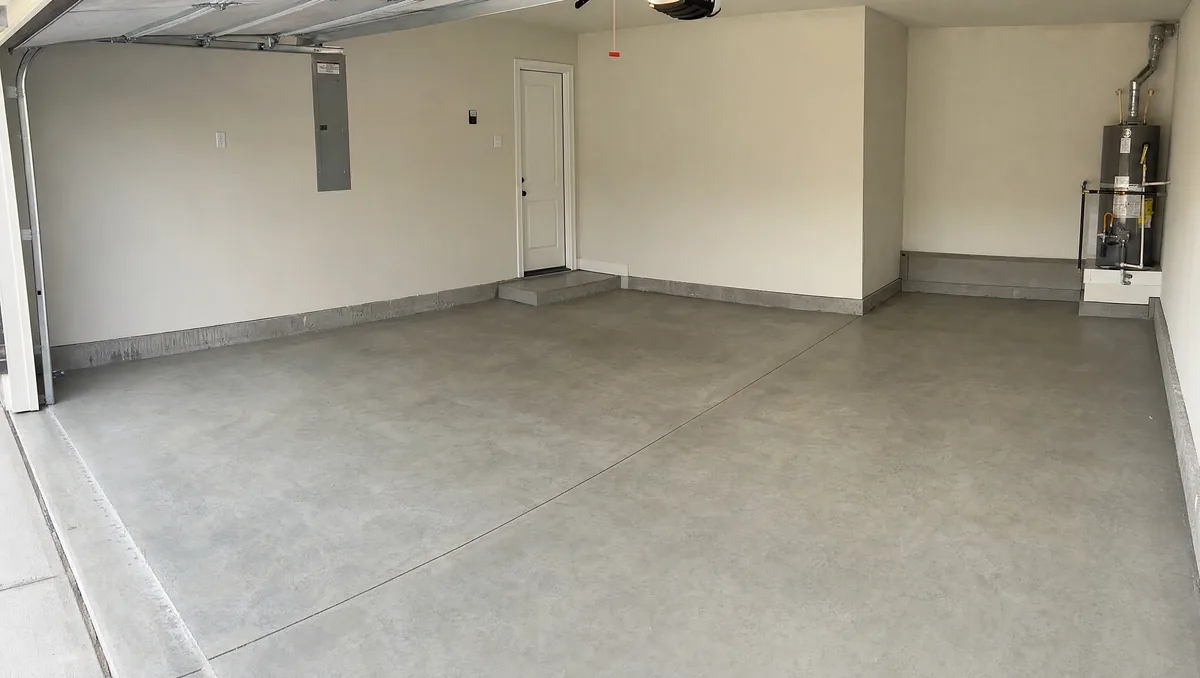
New Construction Offers the Best Possible Starting Point - If You Time It Right
Building a new home in Cibolo, Schertz, Helotes, Boerne, or one of San Antonio's other booming suburbs? The garage slab that gets poured during construction represents the ideal canvas for an epoxy floor: no contamination, no old coatings, no prior damage. But "new" doesn't mean "ready." Coating a slab before it's properly cured is one of the most common - and most expensive - mistakes new construction homeowners make. This guide explains the timing, the hidden obstacles specific to new slabs, and how to coordinate with your builder to get it right.
Why New Slabs Need Time: The 28-Day Minimum Rule
Concrete doesn't dry - it cures. The hydration reaction between cement and water continues for weeks after the pour. For epoxy adhesion, the slab needs to reach sufficient hardness and, critically, needs its internal moisture content to drop to acceptable levels. The industry minimum is 28 days from the pour date. That's when most quality epoxy contractors will accept a slab for coating - with moisture testing to confirm it's ready.
However, 28 days is a minimum, not an ideal. Under San Antonio's summer heat and humidity, slabs often take 60–90 days to reach stable moisture levels. Coating too early traps residual moisture beneath the epoxy. As that moisture vapor later drives upward under the sealed slab, it pushes the coating off from below - delamination that has nothing to do with the product or the application and everything to do with timing.
Wait a minimum of 60 days from the pour date before scheduling your epoxy installation. If your closing and move-in timeline allows 90 days, that's even better. We'll moisture-test the slab at the pre-installation walkthrough and confirm it's within spec before scheduling the crew.
The Curing Compound Problem
This is the issue that catches the most new construction homeowners off guard. Many builders apply a liquid curing compound to freshly poured concrete immediately after the pour. Curing compounds seal the surface to retain moisture during the critical early hydration phase - they're a legitimate construction practice. The problem is they also seal the surface against epoxy adhesion.
Curing compounds are essentially a wax or acrylic film sitting on top of the concrete. Epoxy needs to penetrate the concrete surface and bond mechanically - if there's a curing compound layer in the way, the epoxy bonds to the compound instead of the concrete. When the compound eventually fails (from foot traffic, UV, or time), the epoxy peels with it.
How to Test for Curing Compounds
The field test is simple: pour a small amount of water on the slab. If it beads or sits without absorbing within 30–60 seconds, there's likely a surface sealer or curing compound present. If it absorbs quickly and darkens the concrete, the surface is open and ready for coating (after moisture testing).
A more definitive test is the concrete surface profile check during diamond grinding - our crew will know immediately when they begin grinding whether a surface film is present.
How to Remove Curing Compounds
Mechanical removal via diamond grinding is the only reliable method. Chemical strippers exist but are unreliable on all compound types and can leave residue that creates its own adhesion problems. Diamond grinding removes the compound, creates the proper surface profile, and opens the concrete for primer penetration - all in one step. This is why grinding is our standard prep regardless of slab age.
New Slab Advantages
Despite the timing and compound considerations, new slabs offer real advantages over existing ones:
- No oil or chemical contamination: An oil-saturated old garage slab requires extensive mechanical removal and chemical treatment. A new slab has none of that history.
- No previous coatings to remove: Old paint, previous epoxy attempts, or adhesive residue from flooring are common problems on existing slabs. New slabs start clean.
- Consistent moisture profile: Older slabs in San Antonio neighborhoods can have localized high-moisture zones from landscape irrigation, plumbing leaks, or clay soil settling. New slabs in properly graded lots start with a more predictable moisture profile.
- No old cracks with movement history: Active cracks in old slabs can reflect through new coatings. New slabs typically haven't developed the shrinkage or settlement cracking patterns that older slabs show - though control joints still need to be addressed.
New Slab Watch-Outs
- Curing compound: Discussed above - always test and grind.
- Power-troweled finish: Many residential slabs are finished with a power trowel, which creates a burnished, very smooth surface with low porosity. Diamond grinding opens this surface up to the CSP 2–3 profile needed for epoxy adhesion.
- Vapor emission profile: New slabs sometimes have higher-than-expected vapor emission rates in San Antonio, particularly in neighborhoods with high water tables or clay-heavy soil. Don't skip moisture testing on new slabs - the assumption that "it's new, so it's fine" has caused many delamination callbacks.
How to Coordinate with Your Builder
The best time to bring an epoxy contractor into the conversation is before your slab is poured - or immediately after. Here's what to discuss with your San Antonio builder (Perry Homes, David Weekley, Chesmar, Meritage, and other large regional builders are all building in the SA metro):
- Ask whether a curing compound will be applied, and if so, what type. Some builders use dissipating compounds that break down within 30 days; others use permanent acrylics that require mechanical removal.
- Get the pour date in writing. You'll need it to calculate your 60–90 day wait period.
- Ask if the finisher will power-trowel the slab. If so, note it - diamond grinding will be required regardless of compound status.
- Coordinate your epoxy installation into your construction draw schedule so it happens after move-in but before the garage becomes fully occupied with stored goods.
Scheduling ProEpoxy During Your Build
The ideal timing for epoxy installation in a new San Antonio home is during the final week before or the week of move-in - after the slab has met its cure time, after construction traffic through the garage has ended, and before you've moved in boxes and furniture. We recommend reaching out to ProEpoxy 4–6 weeks before your anticipated closing date so we can schedule a pre-installation site visit and hold a spot on the calendar.
We work with homeowners building in Cibolo, Schertz, New Braunfels, Helotes, Boerne, and throughout Bexar and surrounding counties. Just let us know your pour date and expected closing date when you call.
Building a New Home in San Antonio? Plan Your Epoxy Now.
ProEpoxy works with new construction homeowners throughout the San Antonio metro - Cibolo, Schertz, Boerne, Helotes, New Braunfels, and beyond. Contact us early in your build process and we'll help you nail the timing and coordination. Call (888) 275-7078 or reach out online.
Schedule a Pre-Install Consultation →