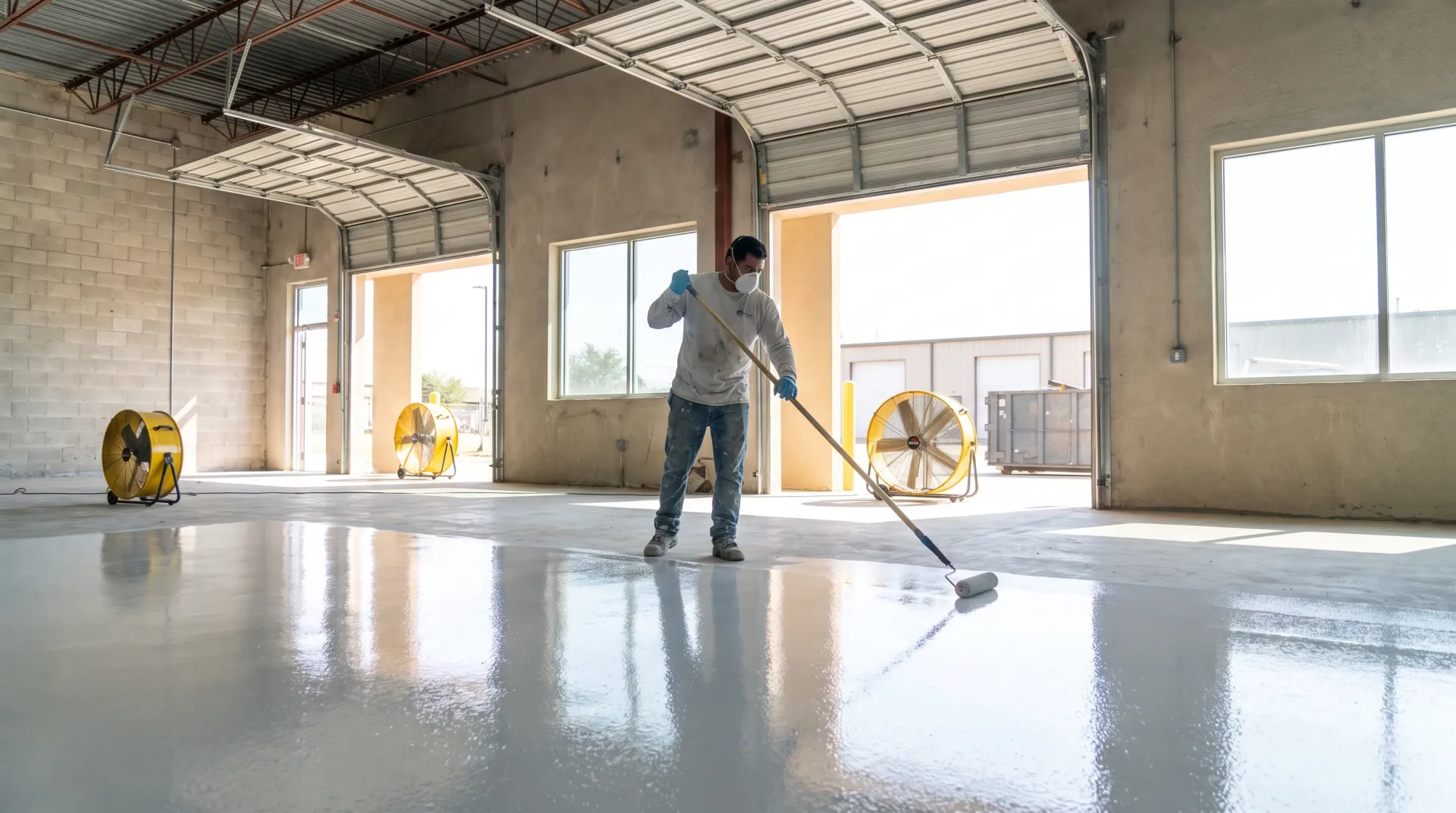
VOC regulations limit how many grams of volatile organic compounds per liter an epoxy floor coating can emit, and that limit is the main reason most epoxy sold today is water-based or low-VOC rather than the traditional solvent-based formulas common decades ago. Texas follows the less restrictive federal EPA standard, but most manufacturers formulate to the stricter national baseline anyway - which means the practical choice for San Antonio properties comes down to performance trade-offs, not legal compliance headaches.
What VOCs Are and Why They're Regulated
Volatile organic compounds are chemicals that evaporate readily at room temperature - in coatings, they're typically part of the solvent carrier that helps the resin apply smoothly before curing. Once airborne, VOCs contribute to smog formation outdoors and can affect indoor air quality during and after application. The EPA and various state agencies cap VOC content in architectural coatings specifically to reduce both effects.
How Regulation Levels Compare
| Jurisdiction | Typical VOC Limit (g/L) | Practical Effect |
|---|---|---|
| Federal EPA (Texas follows this) | ~340 g/L for floor coatings | Less restrictive baseline |
| California (SCAQMD) | ~100 g/L for floor coatings | Much stricter, drives national formulation trends |
| Most modern epoxy products | Under 100 g/L | Manufacturers often exceed compliance nationwide |
Why this matters less than it used to: because major coatings manufacturers sell nationally, most formulate to California's stricter limit across all 50 states rather than maintaining separate high-VOC formulas for less-regulated markets like Texas. In practice, San Antonio homeowners and businesses get the same low-VOC options as customers in stricter states.
What This Means for Your Coating Choice
Because most epoxy sold today already meets low-VOC standards regardless of Texas's more permissive baseline, the real decision isn't about legal compliance - it's about which formulation type fits your project. Water-based, low-VOC epoxy has become the default for occupied residential and commercial spaces because of reduced odor and faster safe re-occupancy, while some heavy industrial applications still specify higher-performance solvent-based systems where regulations allow. Our detailed comparison of water-based vs solvent-based epoxy floor coatings breaks down that performance trade-off in depth.
Indoor Air Quality During Installation
Regardless of the legal VOC threshold, lower-emission coatings simply off-gas less during and immediately after application - which translates directly into less odor, a more comfortable install experience for anyone nearby, and a shorter window before the space is safe to fully re-occupy. This is especially relevant for occupied homes, retail stores, and offices where installation happens while the building stays partially in use.
Have Questions About Coating Options for Your Space?
We'll walk you through which epoxy formulation fits your project's occupancy needs and performance requirements.
Request a Free QuoteChoosing a Compliant, Well-Suited System
For most San Antonio homeowners and business owners, VOC regulations are effectively a non-issue since reputable manufacturers already build to the stricter national standard - the decision comes down to matching the coating to your specific traffic, chemical exposure, and occupancy needs. Our broader guide to epoxy floor coating 101 for San Antonio business owners covers those decision factors, and our epoxy floor coating service page details the specific systems we install.