If you've been researching commercial flooring in San Antonio, you've probably run into two very different answers depending on who you ask: "epoxy will handle it" or "you need urethane cement." Both can be true, but they're not interchangeable, and picking the wrong one costs businesses real money in downtime, premature failure, and re-installs.
At ProEpoxy, we get calls every month from restaurant owners, brewery operators, and facility managers whose epoxy floor is bubbling, delaminating, or cracking under conditions it was never designed to survive. Almost every time, the fix is the same: rip it out and install urethane cement flooring instead. This guide explains what urethane cement actually is, how it's different from standard epoxy, and - most importantly - how to know whether your business needs it.
What Is Urethane Cement?
Urethane cement is a rigid, cementitious flooring system made from polyurethane resins blended with cement fillers. Unlike epoxy, which is a resin-only coating that sits on top of the slab, urethane cement is a hybrid material - it behaves more like a heavy-duty structural topping than a paint-like coating. It's typically installed at 1/4 inch thick (compared to epoxy's 20–30 mils), which gives it enormous impact resistance and the ability to bridge cracks and imperfections in the underlying concrete rather than just coating over them.
Because it contains cement, urethane cement can be installed and cured on damp or "green" concrete slabs, and it tolerates moisture vapor transmission that would cause an epoxy system to blister and fail. That single characteristic is why urethane cement dominates in kitchens, coolers, and processing facilities where moisture is a constant fact of life.
It also handles thermal shock - the rapid temperature swings from a walk-in freezer door opening next to a hot kitchen line, or a steam-cleaning cycle blasting a warm floor with near-freezing rinse water. Standard epoxy resins are rigid and will crack under repeated expansion and contraction; urethane cement's cement-hybrid composition absorbs that stress without fracturing.
How It Differs from Standard Epoxy
We install a lot of epoxy in San Antonio, and for good reason - it's cost-effective, attractive, and more than tough enough for the vast majority of commercial and industrial spaces. If you run a warehouse, retail floor, office, or standard commercial facility, epoxy is very likely the right call, and urethane cement would be overkill.
The differences that matter in demanding environments:
| Property | Standard Epoxy | Urethane Cement |
|---|---|---|
| Thickness | 20–30 mils (~1mm) | ¼ inch (~6mm) - 6–8× thicker |
| Moisture tolerance | Requires dry slab - moisture causes blistering | Installs on damp/green concrete, tolerates vapor |
| Thermal shock | Rigid - cracks under rapid temp cycles | Absorbs expansion/contraction without fracturing |
| Chemical resistance | Good for oils, fuels, most commercial cleaners | Superior against organic acids, fats, sugars, caustics |
| Impact resistance | Good for foot traffic and light equipment | Absorbs heavy drops, steel wheels, forklift impact |
| Cost per sq ft | Lower upfront | 2–4× more upfront; better 10-year economics |
Industries That Require It
Commercial Kitchens and Restaurants
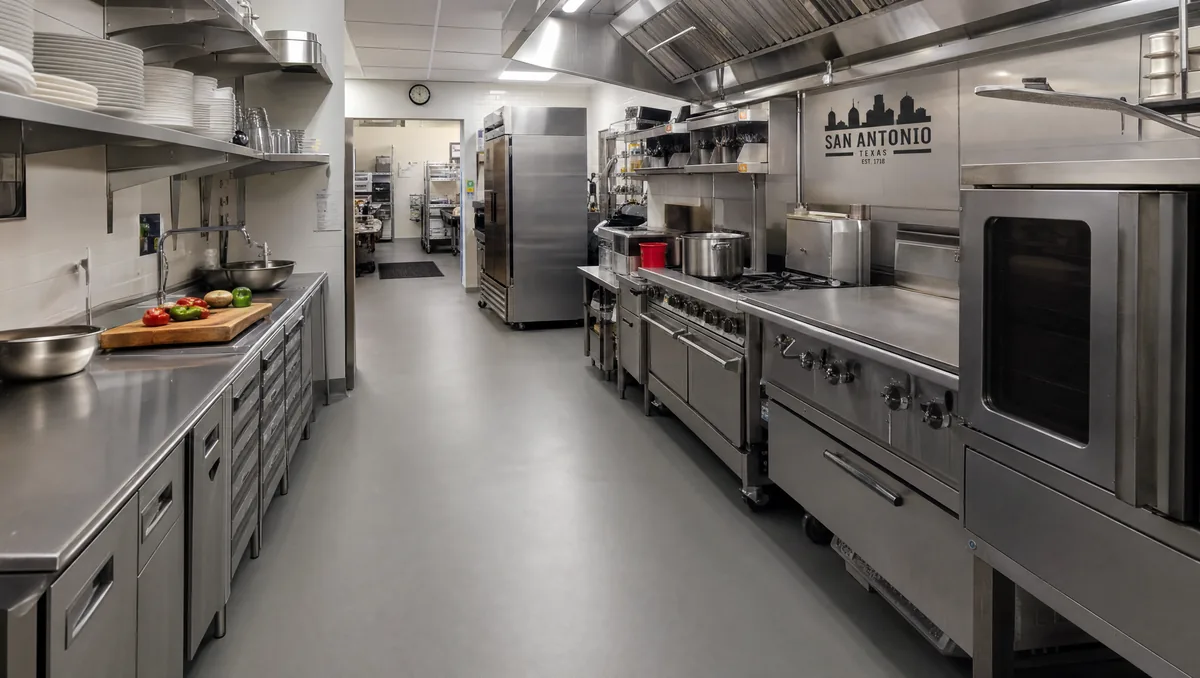
San Antonio's restaurant scene runs hot, wet, and fast. Standard epoxy in a busy kitchen often shows wear within a year or two - thermal shock from steam cleaning, grease penetration, and constant moisture vapor from floor drains eventually win. Urethane cement is the industry standard for commercial kitchen floors. See our restaurant and kitchen flooring page for environment-specific guidance.
Breweries and Beverage Production
Constant water exposure, caustic cleaning chemicals (CIP cycles), sugar and wort spills, and heavy stainless steel equipment make urethane cement the nationwide standard for brewhouse and production floors. Epoxy won't survive a CIP cycle. Urethane cement is built for it.
Pharmaceutical and Cleanroom Environments
Seamless, non-porous, chemically resistant flooring is non-negotiable in controlled sanitation environments. Urethane cement meets USDA and FDA surface requirements while tolerating the aggressive cleaning agents required in pharmaceutical manufacturing.
Cold Storage and Freezer Facilities
One of the clearest cases where epoxy fails and urethane cement is correct. Freeze-thaw cycling and condensation on a freezer floor create conditions that delaminate epoxy within months. Urethane cement's vapor tolerance and flexibility keep it bonded through thousands of temperature cycles.
Healthcare Sterile Processing
Central supply and sterile processing areas depend on urethane cement's seamless, chemical-resistant surface. Learn more about our healthcare and medical epoxy flooring solutions for San Antonio facilities.
Key Performance Properties
- Compressive strength far exceeding standard epoxy - resists heavy point loads without cracking
- Thermal shock resistance from sub-zero freezer temperatures to 200°F+ steam cleaning cycles
- Moisture vapor tolerance for damp slabs and perpetually wet environments
- Chemical and acid resistance against fats, oils, sugars, and industrial cleaning agents
- Slip resistance via customizable aggregate broadcast - meets health department requirements
- Seamless, non-porous surface meeting USDA/FDA sanitation standards
- Service life of 10–15+ years in environments where epoxy degrades within 12–24 months
Cost vs Regular Epoxy
Urethane cement typically runs 2–4× the cost of standard epoxy per square foot. That premium is real, and for the wrong environment it's unnecessary. But an epoxy floor in a hot, wet, high-traffic food production environment is often recoated or replaced every 1–3 years, while a properly installed urethane cement system commonly lasts 10–15+ years.
Cost per year of service frequently favors urethane cement - before even factoring in the operational cost of shutting down a kitchen or production line for repeat re-installs. If your environment doesn't demand it, epoxy is the smarter spend. If it does, skipping urethane cement to save money upfront usually costs significantly more within two years.
Installation Process and Timeline
A standard urethane cement installation runs in five steps:
- Surface preparation - diamond grinding or shot blasting to remove existing coatings and open the concrete profile. Crack and spall repair as needed.
- Priming - moisture-tolerant primer coat for maximum adhesion, even over damp concrete.
- Base coat - trowel-applied or self-leveling urethane cement mortar, typically 1/4 inch. This is the structural layer.
- Broadcast and texture - aggregate broadcast into the wet mortar where slip resistance is required. Texture degree is customizable by zone.
- Sealing and topcoat - urethane topcoat for chemical resistance, cleanability, and final appearance.
Cure timeline: Light foot traffic within 24 hours, full service typically in 3–5 days. Most commercial kitchens and mid-size industrial spaces complete in 2–5 days total. We schedule around your operating hours including overnight and weekend installs to minimize downtime.
The Bottom Line
Urethane cement flooring is a specific tool for specific conditions: heat, moisture, thermal shock, heavy impact, and aggressive chemical exposure. If your business operates a commercial kitchen, brewery, pharmaceutical facility, cold storage room, or healthcare sterile processing area anywhere in San Antonio, it's very likely the floor system that will actually hold up long-term.
For most other commercial environments, standard epoxy remains the right choice - and we'll tell you honestly which one fits your operation when we come out to assess.
Free Assessment for San Antonio Commercial Floors
We evaluate your facility's actual demands - substrate condition, thermal exposure, chemical environment, traffic loads - before recommending a system. No upselling urethane cement where epoxy will do the job.
Request Your Free Quote →