Why School Floors Fail Early - and What to Do About It
A typical San Antonio public school sees 600–2,000 students per day crossing the same hallways, gyms, cafeterias, and science labs. That traffic load, combined with spilled food, cleaning chemicals, and chairs dragged across concrete, destroys inferior floor coatings within two to three years. What looks good at ribbon-cutting often begins delaminating before the first major summer break.
The root cause is almost always the same: coatings specified without accounting for concrete moisture, chemical exposure, or the specific use case for each zone. A hallway coating is not a gym coating. A cafeteria coating is not a science lab coating. ProEpoxy installs zone-appropriate systems that hold up through the full building lifecycle - not just the warranty period.
OSHA and ADA Requirements for School Floors in Texas
Texas educational facilities must meet overlapping federal and state requirements that directly dictate floor coating specifications:
- ADA Section 4.5: Floor surfaces must be stable, firm, and slip-resistant. The Americans with Disabilities Act doesn’t specify a coefficient of friction number, but the Access Board recommends a minimum static COF of 0.6 for ambulatory surfaces and 0.8 for ramps.
- OSHA 29 CFR 1910.22: Applies to school maintenance areas, loading docks, and custodial facilities. Requires walking surfaces to be kept clean, dry, and free of hazards - which epoxy’s seamless, easily-mopped surface directly supports.
- Texas Education Agency (TEA) Facility Standards: TEA guidelines require floor materials to be cleanable, durable, and appropriate for the occupancy type. Gyms, labs, and food service areas each carry specific recommendations.
- ASTM E648 (Critical Radiant Flux): Flooring in school corridors and exits must meet Class I (minimum 0.45 W/cm²) or Class II (minimum 0.22 W/cm²) fire ratings depending on occupancy. Epoxy coatings from reputable manufacturers carry ASTM E648 documentation - always request it.
Epoxy vs. Polished Concrete for School Zones
The best floor for a school depends on the zone. Here’s how ProEpoxy specifies systems across the building:
Gymnasiums and Multi-Purpose Courts
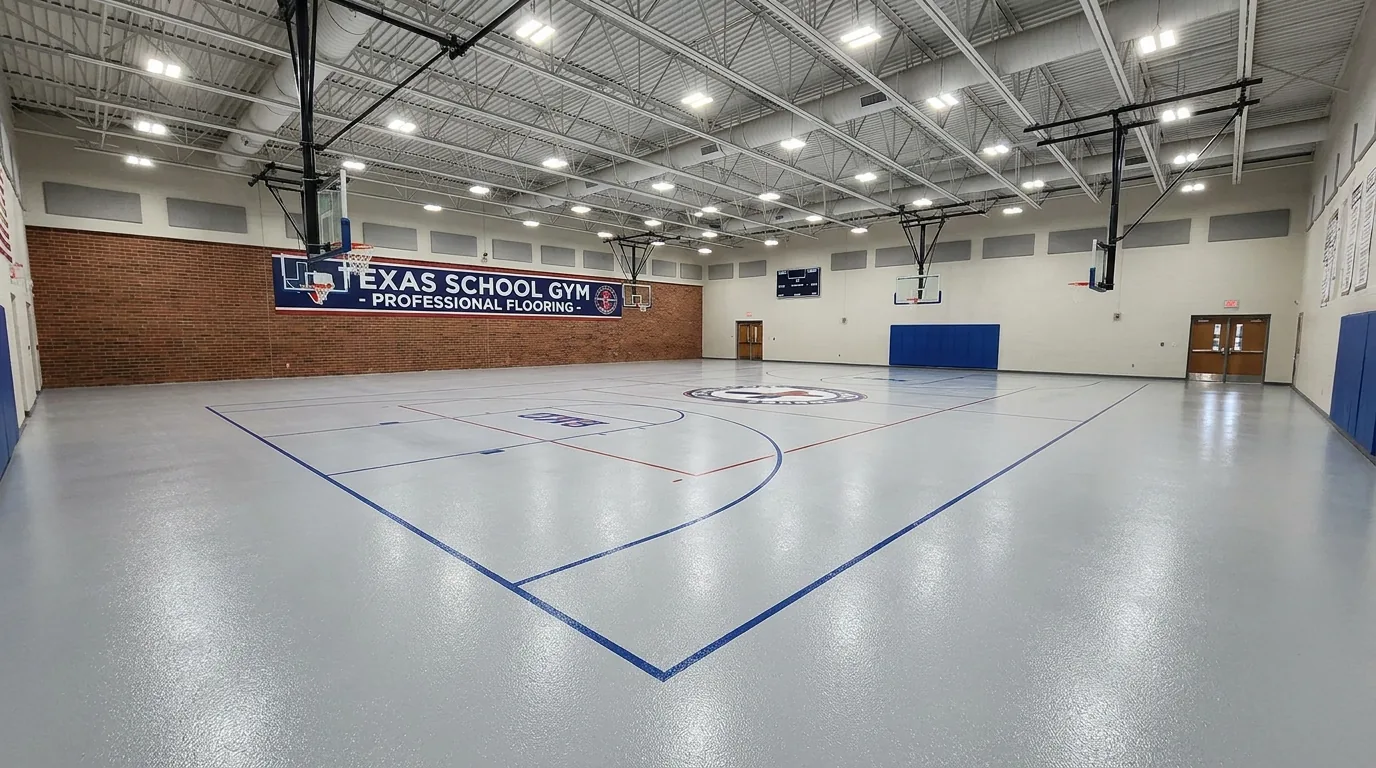
Gym floors in San Antonio take the hardest daily beating: bleacher feet, basketball shoes, folding chairs, and industrial cleaning equipment. We install a high-build two-part epoxy base at 20–25 mils with a polyaspartic topcoat and anti-slip aggregate broadcast. The polyaspartic topcoat resists the scuff marks that standard epoxy picks up from rubber-soled athletic shoes. Line markings for basketball, volleyball, and multipurpose use are applied in-process, not painted on top - they’re locked under the topcoat and last the life of the floor.
Cafeterias and Food Service Areas
Kitchen and cafeteria floors need chemical resistance against grease, acidic food spills, and the cleaning chemicals used to comply with Bexar County health code. Urethane cement is the correct system for full commercial kitchen zones - it handles thermal shock (hot water from cleaning equipment) and resists oils that penetrate standard epoxy. For dining areas outside the kitchen, a chip-broadcast epoxy with a polyaspartic topcoat provides the slip resistance and cleanability required by the health department.
Corridors and Common Areas
High-build polished concrete is increasingly popular in San Antonio school renovations for corridors and common areas. It requires no coating to maintain, eliminates the delamination risk entirely, and gets more reflective - not less - with traffic. For schools on a tighter budget, a mid-range epoxy system at 12–16 mils with an anti-slip topcoat provides a cost-effective 8–10 year service life.
Science Labs and Technical Education Rooms
Chemical resistance is the primary specification requirement. Lab floors in San Antonio schools regularly encounter dilute acids, solvents, and cleaning chemicals. A 100% solids epoxy system with a chemical-resistant polyurethane topcoat is the correct spec. Avoid water-based epoxy systems in these areas - they don’t provide adequate resistance to the chemical exposures a working lab sees.
Maintenance Schedules That Protect Your Investment
School custodial teams often use the wrong cleaning chemicals on epoxy floors - typically alkaline floor strippers or high-pH degreasers designed for VCT tile, which degrade epoxy topcoats over time. ProEpoxy provides written maintenance specs with every commercial installation, including:
- Approved mop chemicals (pH 7–9 neutral cleaners)
- Scrubber pad selection (non-abrasive recommended)
- Annual inspection checklist for delamination, edge lifting, and surface scuffing
- Re-topcoat schedule based on traffic load (typically 5–7 years for high-traffic corridors)
Working with San Antonio School Districts
ProEpoxy is experienced with the procurement and scheduling constraints of public school projects in Bexar County. All work is scheduled during summer breaks, extended weekends, or approved school holidays to minimize disruption. We carry the bonding, liability, and workers’ compensation coverage required for public school contracts and can provide certificates of insurance directly to district facilities managers.
Call (830) 355-3303 or submit a project inquiry to discuss your facility schedule and get a written, zone-by-zone floor specification proposal.
Get a Free Quote for Your San Antonio Floor
ProEpoxy installs epoxy, polyaspartic, urethane cement, and polished concrete in the San Antonio metro - using our own crews, not subcontractors. We test every slab before we quote and back our work with a written warranty.
Request Free Estimate →