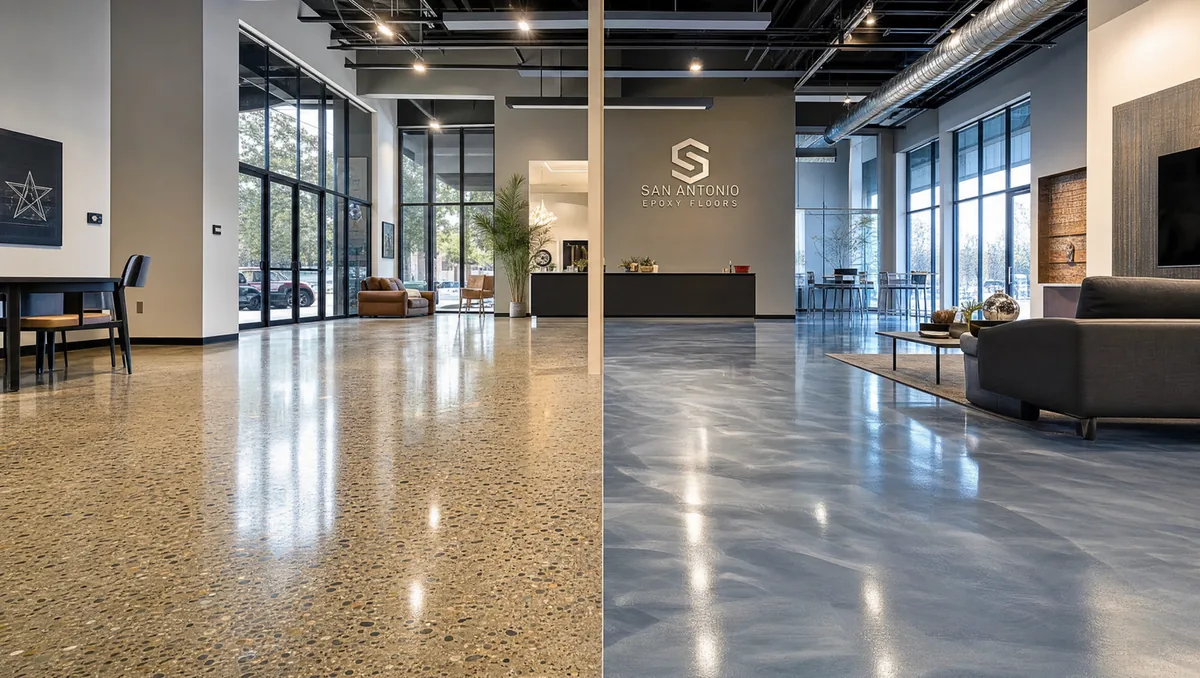
Two Different Approaches to the Same Problem
Both polished concrete and epoxy flooring solve the same fundamental problem: raw concrete is porous, dusty, hard to clean, and ugly. But they solve it in completely different ways - and those differences have real implications for maintenance, durability, cost, and which types of spaces each system suits. This guide is written for San Antonio homeowners and business owners who are trying to decide between the two.
What Is Polished Concrete?
Concrete polishing is a mechanical process, not a coating. Diamond abrasive tooling progressively grinds and burnishes the existing concrete surface through a series of passes - from coarse (usually 30–50 grit) to medium (100–400 grit) to fine (800–3000 grit) - until the surface is densified, sealed from within, and reflective. A penetrating chemical densifier (typically colloidal silica or lithium silicate) is applied mid-process to harden the slab's surface by filling microscopic pores with silicates. The result is a hard, reflective surface that is an integral part of the concrete itself - not a layer on top of it.
The appearance of polished concrete is limited by what's already in the slab: aggregate type, color, and any existing staining or blemishes. Some of these can be worked with (exposed aggregate can be beautiful; rust stains can sometimes be treated); others become part of the floor's character. Polished concrete cannot be made white, bright, or a solid color unless concrete dye is used.
What Is Epoxy Flooring?
Epoxy flooring is a multi-coat system applied on top of the existing slab. The concrete is mechanically profiled (shot blasted or ground to create surface texture), and then layers of epoxy primer, base coat, decorative elements (chips, metallic pigments, solid color), and a topcoat are applied to build a coating system that sits above the original slab surface. The final surface is defined by the coating system, not the concrete below - which means virtually unlimited color and texture options.
Because epoxy adds thickness (typically 15–25 mils total for a residential system), it also fills minor surface voids and hairline cracks, producing a more uniform appearance than polished concrete on a flawed slab.
Comparison: San Antonio Conditions
Durability Under Traffic
Polished concrete: Extremely durable under wheeled traffic and foot traffic. The hardened surface can withstand forklifts, pallet jacks, and heavy equipment that would crack or gouge a coating. It does not delaminate because there's no layer to delaminate - it's the slab itself. However, it can be scratched by sand and grit tracked in from outside, and high-heel traffic creates point loads that can dull the finish over time.
Epoxy: Durable under most residential and commercial traffic. Excellent impact resistance. Vulnerable to deep gouges from dropped metal tools or dragged steel equipment, and to hot-tire pickup on thinner systems. A properly specified system (20+ mils, polyaspartic topcoat) handles normal garage and commercial use without visible wear for 15–20 years.
Maintenance in San Antonio's Climate
Polished concrete: Very low maintenance. Dust-mopping and occasional damp mopping with a pH-neutral cleaner is all that's needed. No stripping, no waxing, no recoating. In San Antonio's sandy, dusty environment (particularly in the western suburbs near Helotes and Boerne), dust-mopping frequency increases - the reflective surface shows tracked-in dust more clearly than matte epoxy.
Epoxy: Also low maintenance. Sweep or dust-mop, occasional wet mop with mild cleaner. Avoid abrasive cleaners that scratch the topcoat. The textured chip surface hides dust and grit better than a polished surface. Over years, the topcoat may dull slightly in high-traffic zones and can be re-topcoated without removing the base system.
Moisture Resistance
Polished concrete: A densified, polished slab reduces but does not eliminate surface porosity. The floor will still transmit vapor from below. Spills penetrate more slowly than on raw concrete but can still stain if not cleaned promptly. For commercial kitchens or food-processing areas, polished concrete alone doesn't meet USDA or FDA hygienic flooring requirements.
Epoxy: A fully cured epoxy system is impermeable to water, oils, and most chemicals at the surface. Spills don't penetrate - they bead up for easy cleanup. However, moisture from below remains the critical variable (see our moisture testing article): an epoxy system applied over a high-vapor slab will fail. A polished concrete system is actually more forgiving of subgrade moisture because there's no adhesive layer to fail.
Cost in San Antonio
Polished concrete: $3–$8 per square foot for standard commercial polish (cream polish with densifier and guard). Higher-gloss or exposed-aggregate residential finishes run $5–$10/sq ft. Staining or dyeing adds $1–$3/sq ft.
Epoxy: $4–$9 per square foot for a full system (primer + base coat with chips or color + polyaspartic topcoat). Metallic epoxy runs $6–$9/sq ft. The starting cost of epoxy is slightly higher than entry-level polished concrete, but they overlap at the mid-range.
Aesthetics
Polished concrete has a natural, sophisticated look that has become popular in retail, restaurant, and upscale residential settings. It doesn't hide flaws in the slab - it reveals them. On a San Antonio slab poured in the 1970s with surface repairs and staining, "polished" may mean "polished but imperfect," which some clients embrace and others don't.
Epoxy offers a clean, uniform finish with essentially unlimited color and texture options. A chip broadcast floor can mimic granite, terrazzo, or a custom palette. Metallic epoxy creates a dramatic effect impossible to achieve with polished concrete. If you want a specific look - bright white, charcoal, a custom company color - epoxy is the system.
Which One Is Right for Your Space?
- Warehouse or distribution center (San Antonio): Polished concrete - lower cost at scale, handles forklifts, no coating to delaminate.
- Residential garage: Epoxy - better hot-tire resistance, wider aesthetic options, sealed surface for oil and chemical spills.
- Upscale restaurant (Southtown, Pearl, Alamo Heights): Polished concrete - the natural aesthetic suits the setting, easy maintenance, durable under server foot traffic.
- Commercial kitchen or food facility: Urethane cement or epoxy - polished concrete isn't hygienic enough for regulated food environments.
- Retail showroom: Either - polished concrete for a sophisticated natural look; metallic epoxy for a dramatic branded look.
- Basement (moisture concern): Epoxy with moisture mitigation - polished concrete doesn't seal the slab against vapor infiltration into the living space.
Still not sure? ProEpoxy installs both systems in San Antonio and we'll recommend the right one for your slab, your traffic, and your budget - without trying to upsell you on something you don't need. Request a free walkthrough or call (888) 275-7078.
Get a Free Quote for Your San Antonio Floor
ProEpoxy installs epoxy, polyaspartic, urethane cement, and polished concrete in the San Antonio metro - using our own crews, not subcontractors. We test every slab before we quote and back our work with a written warranty.
Request Free Estimate →