Why Parking Garage Floors Fail Faster Than Other Concrete
Parking garage concrete is among the most aggressively attacked concrete in any commercial building. It faces vehicle traffic loads, oil and fuel drips, brake dust, tire rubber, and - in San Antonio’s climate - extreme thermal cycling between outdoor ambient temperatures and the cooler interior. Multi-level structures add the complexity of drainage management, structural deck movement, and the chemical attack from de-icing products used on vehicles entering from treated roads during winter events.
Most parking garage floors in the San Antonio metro were built without any coating. Bare concrete slowly carbonates, allowing chlorides from brake fluid and occasional road salt to penetrate and reach the rebar. Once chloride contamination reaches reinforcing steel, corrosion begins - and concrete repairs in a parking structure cost 10–50x more than a protective coating applied before damage starts.
The Right Coating System for San Antonio Parking Garages
Not all epoxy systems are appropriate for parking garage decks. The specific requirements are:
UV Stability
Standard epoxy yellows and chalks under UV exposure within 6–18 months. Parking structures with open sides or skylights need a UV-stable topcoat. Polyaspartic and polyurethane topcoats are UV-stable and maintain both their color and mechanical properties under San Antonio’s intense summer sun.
Thermal Cycling Resistance
San Antonio surface temperatures on concrete decks in summer can exceed 150°F. At night, temperatures drop to the 70s. This thermal cycling - repeated daily for the life of the structure - stresses the bond between the coating and concrete. Systems with flexible topcoats (polyurea, polyaspartic) outperform rigid systems in thermal cycling environments. Hot-tire pickup resistance is also a requirement: a coating that softens and bonds to a hot tire when a vehicle parks is a failure.
Chemical Resistance
Vehicle fluids - motor oil, brake fluid, transmission fluid, gasoline - degrade standard coatings over time. Brake fluid is particularly aggressive: it’s glycol-based and strips many epoxy topcoats on contact. The coating system must be tested against the specific chemical exposures expected in an automotive parking environment.
Slip Resistance
ANSI A137.1 and the Ceramic Tile Institute of America both provide COF targets for pedestrian surfaces. For parking garage ramps and walking surfaces, a static COF of at least 0.6 (wet) is recommended. Anti-slip aggregate broadcast into the topcoat achieves this without significantly impacting the floor’s cleanability.
ProEpoxy’s Standard Parking Garage System
For San Antonio parking structures, we typically specify:
- Surface prep: Shot blast to ICRI CSP 3–4, mechanical saw-cutting and sealing of control joints with semi-rigid polyurea
- Moisture mitigation primer: Applied where ASTM F2170 in-situ RH readings exceed 75% - common in below-grade garage levels
- Body coat: High-build 100% solids epoxy at 20–25 mils
- Topcoat: Aliphatic polyurethane or polyaspartic at 4–6 mils, UV-stable, with anti-slip aggregate broadcast at 12–16 oz/100 sq ft
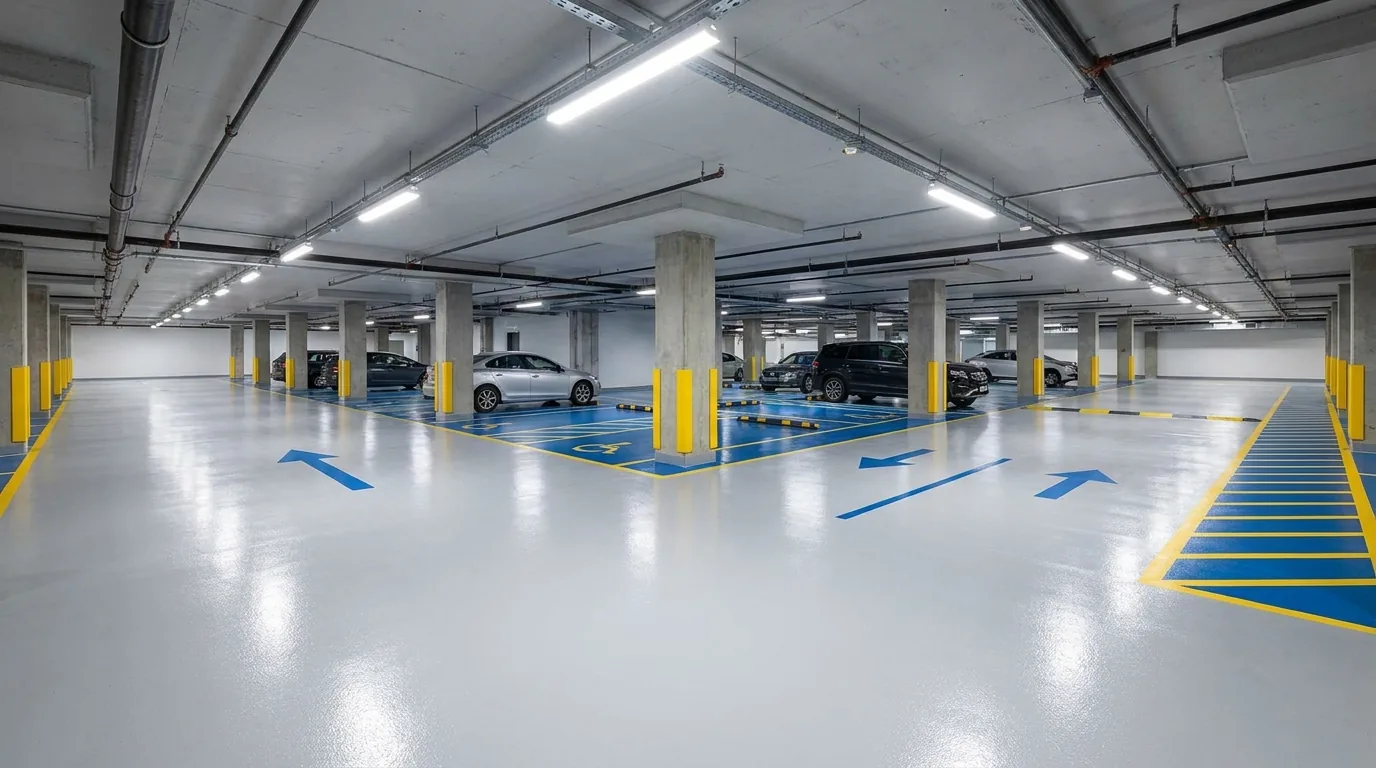
- Traffic markings: Stall lines, directional arrows, pedestrian pathways, and ADA accessible stall markings applied in-process
Total system thickness: 26–32 mils. Expected service life: 8–12 years under normal parking garage traffic before topcoat refresh is required.
Drainage Slopes and Ponding Water
Parking garage floors should slope a minimum of 1.5% toward drains. Ponding water under a vehicle fleet is both a slip hazard and an accelerant of concrete deterioration. If your garage floor ponds, the problem is with the concrete slope - not the coating. Coating over a ponding floor encapsulates the problem. ProEpoxy assesses drainage during our pre-install walkthrough and flags slope deficiencies before quoting.
Maintenance to Maximize Coating Life
Parking garage coatings require less maintenance than most facility managers expect:
- Pressure wash quarterly (or after winter weather events) to remove oil accumulation and brake dust
- Inspect coating for delamination, peeling, or tire damage annually
- Re-apply anti-slip topcoat in high-wear zones (ramp entries, pay station approaches) on a 3–5 year cycle
- Seal any cracks that develop in the concrete substrate promptly to prevent water ingress to rebar
Call (830) 355-3303 or schedule a parking garage assessment with our commercial flooring team.
Get a Free Quote for Your San Antonio Floor
ProEpoxy installs epoxy, polyaspartic, urethane cement, and polished concrete in the San Antonio metro - using our own crews, not subcontractors. We test every slab before we quote and back our work with a written warranty.
Request Free Estimate →