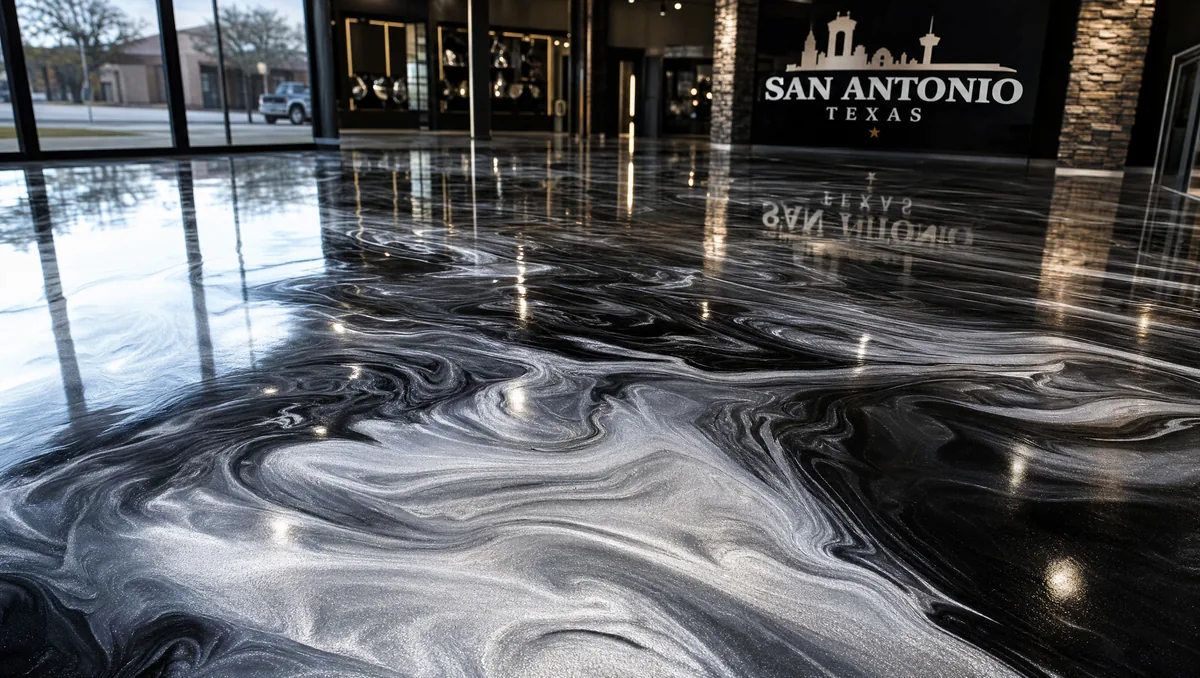
Walk into any high-end San Antonio showroom, auto dealership, or remodeled garage lately and there's a good chance the floor stopped you cold. That swirling, three-dimensional surface catching the light from every angle - that's metallic epoxy flooring, and it's become one of the most requested finishes we install across the city.
It's also one of the most misunderstood. Homeowners call us thinking it's paint. Contractors quote it like standard epoxy. Neither is accurate. Metallic epoxy is a specialty system that requires different materials, different application technique, and a different mindset about what "consistent" looks like. This guide covers everything - designs, where the system works (and where it doesn't), what it actually costs in San Antonio, and how to keep it looking good for the long haul.
What Makes Metallic Epoxy Different
Standard epoxy flooring is a two-part system: a resin and a hardener that bond together to create a durable, chemical-resistant surface. Epoxy floor coatings in their standard form produce a solid-color, semi-gloss or high-gloss finish. It looks clean and professional, but it's uniform.
Metallic epoxy adds a third element: ultra-fine metallic pigment particles suspended in the base coat. These particles - typically made from aluminum, copper, or mica - don't sit still during application. As the epoxy self-levels, the pigments drift, collide, and settle in unpredictable patterns. The installer uses tools, heat guns, and compressed air to guide those patterns, but no two floors ever come out identical. That's intentional. It's the defining characteristic of the system.
The result is a floor that appears to have depth - swirls, veining, and movement trapped under a high-build clear topcoat with a glass-like finish. In the right light, it genuinely looks like polished stone or liquid metal. The visual effect comes from how light scatters differently across particles oriented at different angles, not from any surface texture you can feel underfoot.
From a performance standpoint, metallic epoxy carries the same advantages as any quality epoxy system: seamless surface, excellent chemical resistance, easy cleaning, and substantial hardness. The difference is purely in the pigment system and the technique required to work with it.
The Five Most Popular Metallic Designs
While every metallic floor is unique, most installations fall into recognizable design families. Here are the five we install most often in San Antonio:
1. Marble Effect
Soft veining in white, gray, and silver pigments creates something that reads as natural stone from across the room. The appeal is obvious - it carries the visual weight of marble without the cost, the weight, or the cold maintenance requirements. Popular in residential living rooms, restaurant dining areas, and medical office lobbies. Works best in lighter color palettes where the veining stays subtle.
2. Ocean / Coastal
Deep blue-green pigments layered with silver and white to create a wave or current effect. One of our most-requested residential designs, particularly for pool decks, bathrooms, and open-plan living spaces with outdoor connections. The movement in the pattern mimics water convincingly. Pairs well with light cabinetry and natural wood accents.
3. Lava / Copper
Rich copper, bronze, and black pigments that flow into each other to create a volcanic or molten-metal appearance. Dramatic and masculine - this is the floor you see in auto dealerships and showrooms that want the space to feel premium and powerful. Also works well in gyms, man caves, and industrial-style commercial spaces. The warm tones absorb light more than they reflect it, making the room feel grounded.
4. Single-Tone Metallic
One dominant pigment color - often charcoal, champagne, gunmetal, or pearl - with natural variation from the application process rather than deliberate color mixing. The result is more restrained than multi-color designs: still clearly metallic, still clearly handcrafted, but quieter. Clients who want the durability and uniqueness of metallic epoxy without a bold statement usually land here. It also pairs more easily with varied interior design styles.
5. Multi-Tone Blend
Two or more contrasting pigments - common combinations include silver and black, gold and brown, or teal and copper - applied together and manipulated to create defined zones of color rather than uniform blending. The effect can be dramatic or subtle depending on how aggressively the applicator moves the material. This is our most technically demanding design category. It rewards experience. If a contractor hasn't done dozens of these, request to see their portfolio before committing.
Where Metallic Epoxy Works Best - And Where It Does Not
Metallic epoxy is genuinely versatile, but it's not the right call for every space. Matching the system to the environment prevents expensive regret.
Strong fits:
- Residential garages and garage floors: Durable enough for vehicle traffic and chemical exposure, distinctive enough to make the space feel finished. One of the highest-ROI applications we see.
- Living rooms and open-plan interiors: The seamless surface reads as high-end tile or stone without grout lines, cold touch, or cracking risk. Works well with radiant heating underneath.
- Showrooms and dealerships: The reflective surface amplifies lighting and makes products pop. A well-executed metallic floor in a showroom is a sales tool.
- Restaurant dining areas and bars: Easy to clean, visually distinctive, and holds up to foot traffic and spilled liquids when properly sealed.
- Basement renovations: Transforms a utilitarian space into something that genuinely functions as living area. The seamless application also eliminates grout lines where moisture could infiltrate.
Weaker fits:
- Exterior surfaces: Standard metallic epoxy systems are not UV-stable. The pigments fade and the topcoat yellows under prolonged sun exposure. For outdoor applications in San Antonio's intense climate, you need a UV-stable polyaspartic topcoat specified explicitly for exterior use.
- High-moisture areas without proper prep: Epoxy and moisture vapor are a poor combination. Concrete slabs on or below grade that haven't been tested for moisture transmission can fail, trapping vapor under the coating and causing delamination. In San Antonio, this is particularly relevant in basements and areas near the Olmos Creek drainage basin where water tables fluctuate.
- Commercial kitchens: The smooth surface becomes dangerously slippery when wet. We recommend urethane cement or broadcast epoxy flake systems for kitchen environments where water and grease are constants.
- Spaces expecting heavy abrasion: While metallic epoxy is durable, it scratches more visibly than matte-finish systems because the high-gloss topcoat reflects light that highlights imperfections. Warehouse loading docks, forklift areas, or spaces with consistent abrasive debris are better served by a more utilitarian system.
Cost Breakdown: What to Expect in San Antonio
Metallic epoxy costs more than standard solid-color epoxy, and the reasons are straightforward: the materials are more expensive, the application takes longer, and the skill ceiling is higher. Here's how pricing typically breaks down across the San Antonio market.
| System Type | Typical Range (per sq ft) | Best For |
|---|---|---|
| Single-color solid epoxy | $3 – $5 | Utility garages, storage areas |
| Epoxy flake / broadcast system | $4 – $7 | Garages, commercial floors needing slip resistance |
| Single-tone metallic epoxy | $7 – $10 | Garages, basements, residential interiors |
| Multi-tone metallic epoxy | $9 – $14 | Showrooms, living spaces, high-visibility commercial |
| Designer / custom metallic | $12 – $18+ | Luxury residential, hospitality, branded retail |
These ranges reflect full installation including surface preparation, primer coat, metallic base coat, and clear topcoat (typically two coats of polyaspartic or urethane). Surface prep is where many quotes diverge significantly - a contractor skipping shot-blasting or acid etching to save time is a red flag, not a deal.
What drives the cost up:
- Larger surface area (economy of scale helps, but complexity compounds)
- Existing coatings or adhesives that need removal
- Cracks, spalling, or uneven surfaces requiring patching
- Complex color patterns with multiple pigment blends
- Premium topcoat specifications (UV-stable, anti-static, food-safe)
- Tight scheduling windows (weekend work, overnight shifts)
For a typical San Antonio garage - two-car, roughly 450–500 square feet - expect a quality metallic installation to run $3,200–$5,500 depending on design complexity and current concrete condition. Larger commercial spaces benefit from lower per-square-foot pricing but higher total project costs due to complexity.
Maintenance and Long-Term Care
One of the reasons metallic epoxy has taken hold in residential and commercial applications alike is that maintenance is genuinely simple. The sealed, seamless surface has no grout lines to stain and no texture to trap debris.
Daily and weekly care:
- Dry mop or sweep to remove grit. In San Antonio, the combination of construction debris and mesquite and oak leaf litter means regular sweeping is important - fine particles act as abrasives underfoot.
- Damp mop with a pH-neutral cleaner. Avoid vinegar, bleach, or citrus-based cleaners - they break down the topcoat chemistry over time.
- Clean spills promptly. The topcoat is stain-resistant, not stain-proof. Oil and chemical spills left overnight can etch the surface.
Annual care:
- Inspect the topcoat for fine scratches or dull zones in high-traffic paths. Light burnishing with a commercial floor machine can restore gloss without recoating.
- In garage applications, check the perimeter where floor meets wall for any signs of moisture intrusion. Catching this early prevents larger delamination issues.
Long-term recoating:
A quality metallic epoxy system installed over properly prepared concrete, with a premium topcoat, should maintain its appearance for 10–20 years in residential applications. Commercial spaces with heavy foot traffic may need topcoat refreshment every 5–8 years. Recoating is significantly less expensive than full reinstallation - the metallic base coat remains bonded to the concrete, and only the worn topcoat needs replacement.
What to Ask Your Contractor Before Booking
Metallic epoxy installations vary enormously in quality depending on who applies them. The material is unforgiving - mistakes in mixing ratios, application temperature, or humidity produce permanent visual defects you'll look at every day. Here are the questions that separate confident professionals from those learning on your floor:
- Can I see photos and addresses of completed metallic jobs in San Antonio? Anyone can source stock photos. Ask for local references you can verify.
- How do you prepare the concrete surface, and what equipment do you use? The correct answer involves shot-blasting or diamond grinding. Acid wash alone is insufficient for metallic systems.
- What brand and product line of metallic pigments are you using? Quality metallic systems use MICA-grade or aluminum-based pigments with documented performance data. Be skeptical of contractors who can't name the brand.
- What is your topcoat specification? Polyaspartic topcoats offer better UV resistance and faster cure times than standard epoxy clears. Ask what you're getting.
- What are your temperature and humidity limits for installation? In San Antonio, summer ambient temperatures often exceed the working window for some epoxy systems. Knowing your contractor has a clear protocol for heat management matters.
- What's the warranty and what does it cover? Material and labor warranties are separate. Understand what voids the warranty - typically moisture issues pre-existing in the slab.
The Bottom Line
Metallic epoxy flooring is one of the few upgrades that delivers both function and genuine visual drama. It's durable, low-maintenance, and - when properly installed - holds up for decades in residential and commercial environments alike. The catch is that it requires skilled installation more than most flooring systems. The wrong contractor can ruin a floor that can't be partially repaired.
In San Antonio's competitive flooring market, the installers worth hiring will readily show you local completed work, explain their surface prep protocol in detail, and be honest about where the system isn't the right fit. If a quote seems too good to be true for a metallic job, it usually means prep shortcuts or inferior materials.
Ready to see what metallic epoxy could look like in your space? Contact ProEpoxy for a free on-site assessment. We'll look at your concrete condition, talk through design options, and give you a detailed quote - no sales pressure, just accurate information so you can make a confident decision.
Get a Free Metallic Epoxy Quote in San Antonio
Our team evaluates your concrete, walks you through design options, and provides a detailed written estimate - all at no charge. Most residential assessments take under 45 minutes.
Request Your Free Quote →