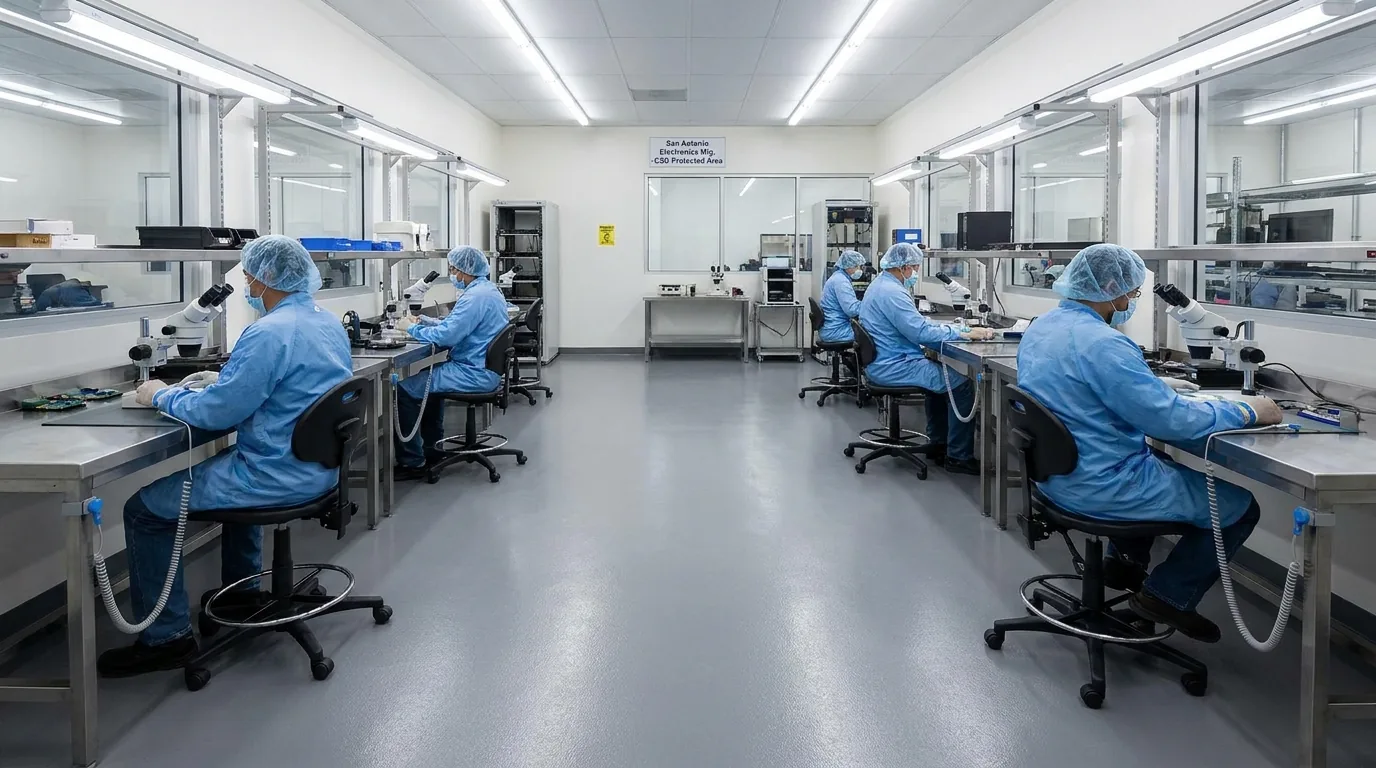
Why Standard Epoxy Isn’t Enough for Electronics Facilities
A standard high-build epoxy floor is an electrical insulator. In electronics manufacturing, semiconductor assembly, data centers, and medical device production, that’s not just a problem - it’s a liability. A worker walking across an insulating floor can build up 35,000 volts of static charge. Touching a sensitive component with that charge can destroy it instantly - often without any visible damage or operator awareness. ESD (electrostatic discharge) damage to electronics costs manufacturers billions of dollars annually in invisible defects that only surface during field failure.
San Antonio’s growing advanced manufacturing sector - including aerospace suppliers, medical device manufacturers, and defense contractors - needs floors that actively manage static charge. ProEpoxy installs ESD-compliant flooring systems tested to ANSI/ESD S20.20, the governing standard for ESD control programs in the United States.
Conductive vs. Dissipative: Understanding the Difference
ANSI/ESD S20.20 defines two categories of ESD flooring, each with distinct resistance ranges:
- Electrically Conductive: Surface resistance 1.0×10⁴ to 1.0×10⁵ ohms. Provides the fastest charge drain. Required in areas where rapid discharge is essential - explosive environments, detonator assembly, and some semiconductor fab areas. The lower resistance also means that a charged person who touches a grounded point drains faster.
- Electrically Dissipative (Static Dissipative): Surface resistance 1.0×10⁵ to 1.0×10³ ohms. The most common specification for electronics manufacturing. Dissipates charge at a controlled rate - fast enough to prevent damage to sensitive components, slow enough to not create a shock hazard.
The correct specification depends on your ESD program requirements. ProEpoxy works with your ESD coordinator or EH&S manager to confirm the resistance range before installation and provides verified test data at project completion.
How ESD Epoxy Works
ESD epoxy systems incorporate conductive carbon black, graphite fibers, or specialized conductive additives into the resin matrix. A conductive primer connects the floor to ground points at specified intervals. The system is tested with a surface resistance meter (ANSI/ESD STM7.1) before and after installation to verify compliance.
Key installation requirements that affect performance:
- Grounding frequency: Ground points are installed at intervals specified in your ESD control plan - typically every 10–20 feet in work areas
- Concrete surface profile: The conductive primer must bond to the concrete to complete the circuit. Shot-blast preparation to ICRI CSP 3 is required - grinding alone is inadequate
- Topcoat compatibility: Any protective topcoat must also be ESD-compliant - applying a standard polyaspartic topcoat over a conductive primer breaks the ground path
- Testing frequency: ANSI/ESD S20.20 requires floor resistance testing at minimum annually; high-production environments test quarterly
ESD Flooring Applications in San Antonio
Electronics Manufacturing
PCB assembly, SMT lines, and component handling areas all require ESD flooring. San Antonio’s electronics manufacturing facilities - from automotive component suppliers to defense electronics - typically specify dissipative flooring at 10⁵–10³ ohms for production floors and assembly areas.
Data Centers and Server Rooms
Data center floors need ESD control beneath raised access flooring systems, at server rack installation areas, and in storage rooms where equipment is staged before installation. The flooring must also resist the specific cleaning chemicals used in data center environments - isopropyl alcohol, for example, is commonly used for equipment cleaning and must not degrade the floor coating.
Medical Device Manufacturing
FDA CFR Part 820 quality system regulations and ISO 13485 certification requirements can both include provisions for ESD control in device assembly areas. ProEpoxy provides documentation packages suitable for inclusion in your quality management system records.
Explosive and Hazardous Environments
In facilities where flammable vapors or explosive dusts may be present (chemical blending, munitions, certain pharmaceutical manufacturing), a fully conductive floor at 10⁴–10⁵ ohms is required to prevent static ignition. This is a life-safety specification - not simply a product quality concern.
What to Ask Your ESD Flooring Contractor
Before signing any ESD flooring contract, confirm the following:
- What is the specified resistance range, and how will it be verified post-installation?
- What grounding hardware is included, and at what interval?
- Does the topcoat carry ESD certification, or will it break the ground path?
- Will you provide a test report with coordinates and resistance readings?
- What is your installation crew’s experience with ANSI/ESD S20.20 compliance?
ProEpoxy provides written test reports with point-by-point resistance data on every ESD installation. Call (830) 355-3303 or submit your project specifications to discuss your ESD requirements.
Get a Free Quote for Your San Antonio Floor
ProEpoxy installs epoxy, polyaspartic, urethane cement, and polished concrete in the San Antonio metro - using our own crews, not subcontractors. We test every slab before we quote and back our work with a written warranty.
Request Free Estimate →