San Antonio summers regularly hit 100°F+, and that changes more about your epoxy floor than most homeowners expect - how it should be installed, which products actually hold up long-term, and what your finished floor will look and feel like five, ten, fifteen years from now. If you are planning a garage epoxy installation or any coating project in the area, here is what the heat actually does to the process, and what separates a floor that holds from one that does not.
Why San Antonio's Climate Changes the Equation
Epoxy is a chemical reaction - resin and hardener curing together - and that reaction is directly affected by ambient and substrate temperature. In cooler climates, installers have a wide comfort window. In San Antonio, especially May through September, slab surface temperatures can exceed 100–120°F in direct sun, and that changes the installation math significantly. The air temperature outside might read 98°F on a summer afternoon, but a concrete slab that has been absorbing sun all day can run 15–25°F hotter than that - which means your garage floor is effectively a 115°F substrate before the crew sets up a single piece of equipment.
That temperature affects every step of the process: how long the product stays workable, how fast it cures, and how it bonds to the concrete beneath. Getting those variables right in San Antonio requires product selection and scheduling discipline that not every contractor applies.
How Heat Affects Epoxy During Installation
Open Time Shrinks Fast
Epoxy's open time - the window between mixing and the point where it becomes too thick to spread - shortens dramatically in heat. A product with a 30-minute working window in mild weather can drop to 10–15 minutes when the slab is hot. That forces installers to work in smaller sections, mix smaller batches, and move quickly to avoid lap lines where one batch starts curing before the next overlaps it. Contractors who are not accustomed to summer Texas installs often over-mix, end up chasing the product across the floor, and create an uneven texture that is almost impossible to fix without a full strip and redo.
Moisture Vapor Increases
Hot concrete combined with San Antonio's humidity swings - especially after summer thunderstorms that can dump two inches of rain in an hour - drives increased moisture vapor emission from the slab. Moisture vapor is the leading cause of epoxy coating failure: it pushes up through the slab after the coating is applied, creating blistering and delamination from underneath. This is why moisture testing before installation is non-negotiable in this climate. A calcium chloride test or an in-situ relative humidity probe tells you the vapor emission rate of the slab, and determines whether a moisture-mitigating primer is needed before any coating goes down.
Cure Speed Accelerates
Heat accelerates the epoxy cure reaction, which sounds like a benefit - faster dry times, sooner back in service. The problem is that too-fast a cure can trap solvents in the film before they fully off-gas, or cause the surface to skin over before the coating has fully leveled. The result is either a hazy, slightly cloudy finish, or a textured surface instead of the smooth gloss the homeowner expected. Experienced summer installers in San Antonio adjust their hardener ratios or switch to slower-reacting formulations to compensate for the heat rather than fighting it.
Products That Perform Better in High-Heat Environments
Not all epoxy floor coating systems are built for Texas conditions. The formulation matters as much as the installer's skill.
100% solids epoxy systems handle heat-accelerated cure more predictably than water-based alternatives, and build more film thickness in a single pass. Water-based systems off-gas more aggressively in high heat, which creates more risk of surface texture issues.
Polyaspartic topcoats are especially valuable in San Antonio. A polyaspartic coating is UV-stable in a way that standard epoxy is not - epoxy yellows and chalks under sustained UV exposure, which is unavoidable in a south-facing garage that sees sun through an open door for hours every summer afternoon. A polyaspartic topcoat protects the epoxy layer beneath it from UV degradation and adds thermal resistance against hot tire pickup. For Texas garages, it is not an optional upgrade - it is the difference between a floor that looks the same in year five and one that has visibly yellowed and lost its gloss.
Aliphatic urethane topcoats offer similar UV protection at a higher price point and are the standard on commercial and showroom floors that see sustained sun exposure. For most residential San Antonio garages, a quality polyaspartic is sufficient.
| System Component | Heat Consideration | San Antonio Recommendation |
|---|---|---|
| Base coat | Open time shrinks 40–60% above 90°F slab | 100% solids; slow-cure hardener in summer |
| Broadcast layer | Minimal heat impact | Color chip or quartz for texture and grip |
| Topcoat | UV exposure degrades standard epoxy | Polyaspartic; UV-stable, thermal resistant |
| Moisture primer | Required when vapor emission is elevated | Always test; often needed May–September |
Best Times of Year to Install in San Antonio
Late fall through early spring - November through March - gives installers the most predictable conditions. Slab temperatures are moderate, humidity swings are smaller, and the full cure window is available without fighting the heat. If you are planning a basement epoxy floor or an interior coating where slab temperatures stay cooler naturally, the seasonal window widens considerably.
For outdoor-adjacent slabs - garages, patios, driveways - summer installs are absolutely doable and happen all the time in San Antonio. They just require a crew that knows the climate, the right product selection, and adjusted scheduling. Expecting the same results from a summer install as a fall install without any changes to the approach is how you end up with a failed floor.
Summer Installation: What Contractors Do Differently
A contractor experienced in San Antonio summers does not approach a July install the same way they approach a November one. The specific adjustments:
- Early starts: Crews begin at dawn when slab temperatures are lowest - often 6 or 7am - and aim to have base coats down before 10am before the sun angle starts driving slab temps upward.
- Direct slab temperature measurement: Air temperature is irrelevant. A slab in full sun can run 20–30°F hotter than the ambient air. Crews use an infrared thermometer on the concrete surface before mixing anything.
- Smaller batch sizes: Rather than mixing a full kit at once, experienced summer installers mix half-batches or smaller and work in tighter sections to avoid outrunning the open time.
- Shade management: When possible, closing the garage door or using a portable shade structure to keep direct sun off the slab before and during installation drops slab temperature significantly.
- Heat-adjusted hardeners: Many 100% solids epoxy systems offer a summer-formulation hardener with a slower reaction rate that extends open time at high temperatures. Using the standard hardener in July is leaving time on the table.
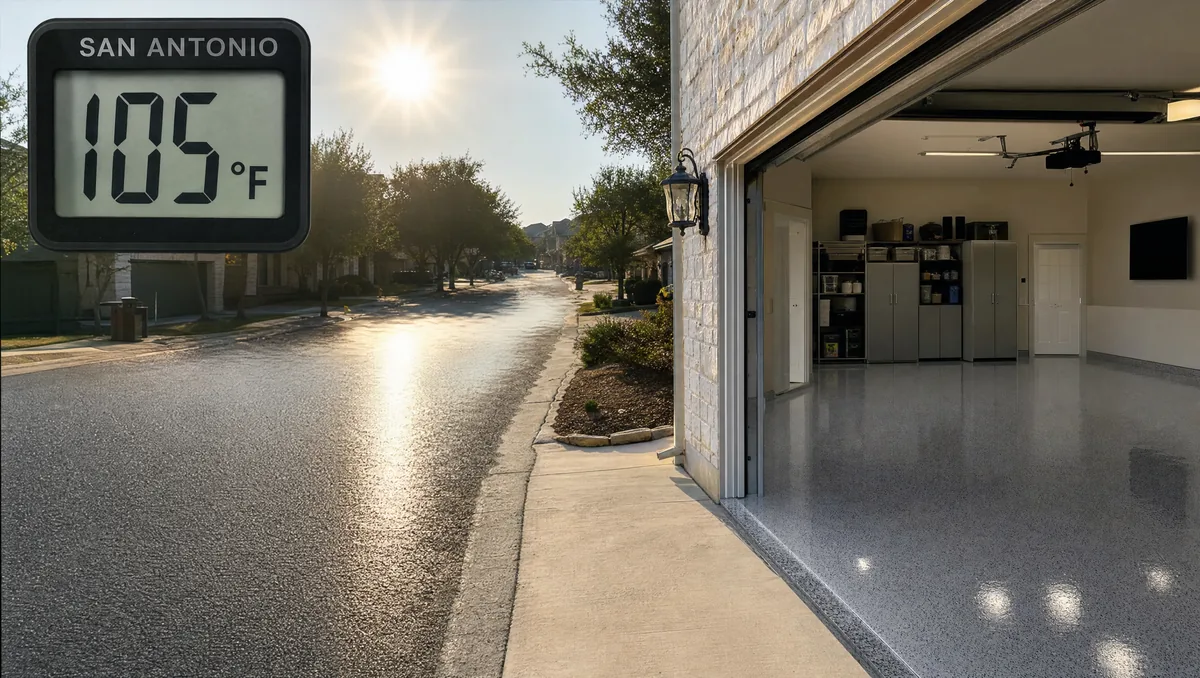
A budget contractor who is not asking about slab temperature, is not measuring it, and is mixing full kits on a 105°F July afternoon is setting up a difficult install. The results show up weeks or months later - uneven texture, cloudy finish, or early delamination - not on day one.
Long-Term Heat Effects on Your Finished Floor
Once fully cured, a properly installed epoxy and polyaspartic system handles San Antonio heat well across its 15–20 year lifespan. A cured coating is not damaged by ambient heat the way an uncured one is during installation. The concrete expands and contracts with temperature cycles, and a fully bonded coating flexes with it rather than delaminating - provided the bond was achieved properly during prep and installation.
The main long-term heat-related concern is hot tire pickup. When a vehicle drives at highway speeds, the tires heat up significantly. Parking on a garage floor immediately after highway driving deposits heat directly onto the coating - and a softened topcoat can bond to the tire and pull away from the floor when the vehicle next moves. Standard epoxy topcoats have moderate resistance to this; polyaspartic topcoats, with their higher thermal resistance, handle it substantially better. This is another reason the polyaspartic topcoat is the standard recommendation for Texas garages rather than an optional upgrade.
UV exposure through garage doors and windows is the other long-term consideration. Even indirect UV - reflected light, diffuse exposure - will yellow an unprotected epoxy surface over time. The polyaspartic layer blocks that UV, protecting the color chip broadcast layer beneath it and keeping the floor looking fresh for years longer than a bare epoxy finish would.
The Bottom Line
Texas heat does not rule out epoxy flooring - it just means the installation needs a contractor who understands slab temperature management, adjusted working windows, heat-tolerant product selection, and the specific moisture and UV demands of San Antonio's climate. Get those variables right and a San Antonio epoxy floor performs beautifully for 15+ years despite the summers it lives through. Get them wrong and you will be looking at a repair or full redo inside 24 months.
If you are planning a garage floor or any coating project in the San Antonio area and want to know exactly how we approach summer installations - or what makes a heat-tolerant system different from a standard spec - get in touch for a free estimate. We will assess your slab, walk you through the product spec, and give you a clear picture of what the install involves before any money changes hands.
Free Estimate for Your San Antonio Epoxy Project
ProEpoxy crews install year-round in San Antonio - summer included. We assess slab temperature, test for moisture, and spec the right system for your timeline and conditions. No surprises on install day.
Request Free Estimate →