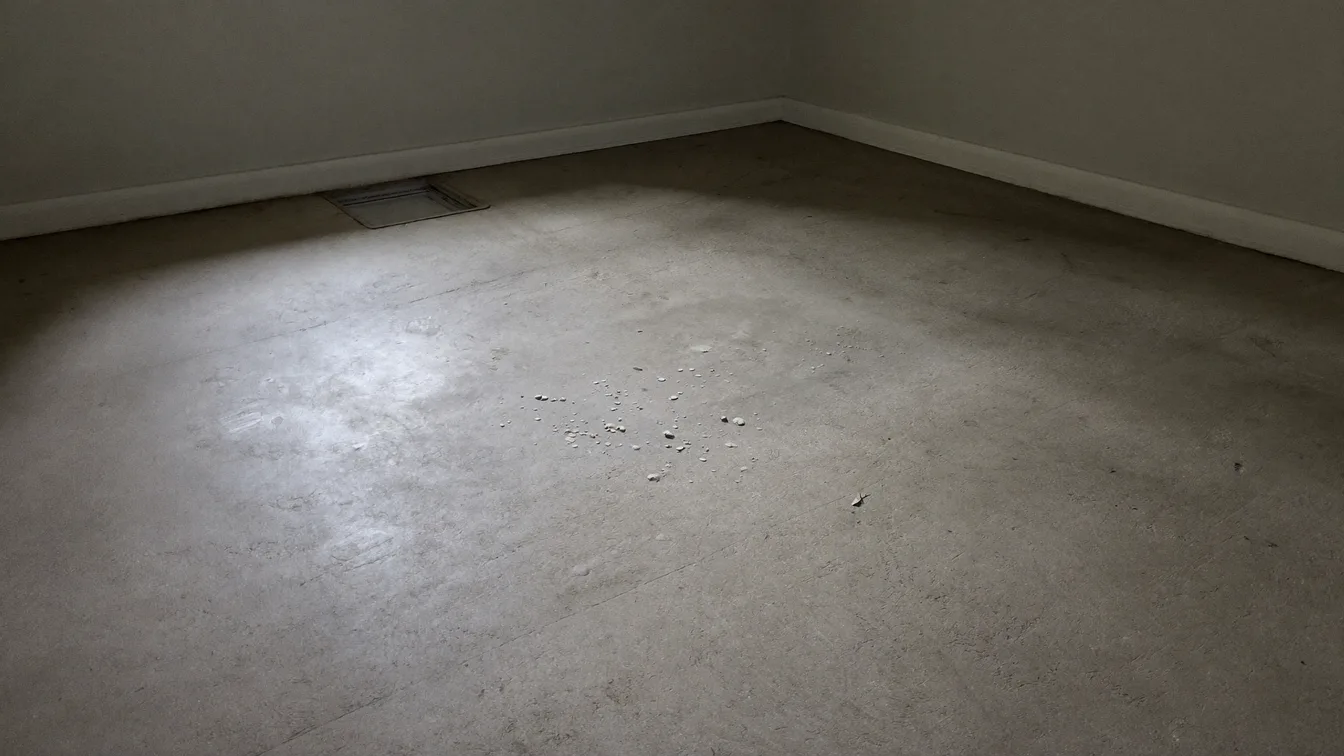
The four real disadvantages of an epoxy floor in a residential basement are moisture pressure from the slab beneath, a hard and cold surface underfoot, noise that bounces around a finished room, and repairs that are difficult once a below-grade coating fails. None of these rules epoxy out, but each one decides whether it is the right floor for your space. If you are weighing a basement epoxy floor in San Antonio, this guide argues against the product first, so you can see what you would be signing up for. We cover the slab, the feel, the sound, the repair problem, and who should pick something else.
Quick answer: the four real drawbacks, stated plainly
Epoxy is a thin, sealed, resin layer bonded to concrete, and almost every basement drawback comes from that description. It is sealed, so water vapor from the slab has nowhere easy to go. It is thin, so it adds no softness or warmth. It is hard, so it reflects sound. And it is bonded, so removing it means grinding it off rather than lifting it up.
- Moisture pressure. Vapor moving up through the slab can push on the coating from below and lift it at the weakest points.
- Cold and hard underfoot. A resin floor sits directly on concrete that tracks the temperature of the ground.
- Noise. Hard, smooth surfaces reflect sound instead of absorbing it.
- Repair difficulty. A below-grade failure is rarely a small, local fix.
Basements are less common in San Antonio than in colder states, so the ones that exist tend to be walkout lower levels, hillside cuts or finished lower floors. They still sit partly or fully below grade, which means they share the same drawbacks. Heavy rain can saturate the soil against a below-grade wall, and the slab feels it.
Hydrostatic pressure and blistering from below
Moisture is the drawback that causes actual failures, so it comes first. Concrete is porous, and a basement slab sits on soil that can hold water. Vapor and sometimes liquid water travel upward through the slab. Bare concrete lets that vapor escape into the room. A sealed epoxy coating slows that escape, so pressure collects at the bond line between slab and coating.
When the pressure is high enough, the coating lifts. The first sign is usually a cluster of small blisters, often a few millimeters to a few centimeters across, sometimes with a milky or damp look underneath. Later, a blister can break open and leave a lifted patch that peels back at the edges. Hydrostatic pressure, where liquid water pushes up through the slab, is the harshest form of this. Vapor emission, the slower and more common form, can do the same damage over months.
Blisters mean the test was skipped or the mitigation was too light. They are not a sign that epoxy is a bad material. They are a sign that the slab was coated without knowing how much moisture it was moving.
The industry measures this with ASTM F1869 (calcium chloride test for moisture vapor emission) and ASTM F2170 (in-situ relative humidity probes). Which tests apply and what the numbers mean is covered in our guide to moisture testing for basement epoxy floors, so we will not repeat the method here. The point for this article is simpler: moisture risk is a property of the slab you already own, and a coating cannot fix it by being thicker. Where readings are high, a moisture mitigation primer rated for the measured emission rate goes down first. That adds cost, adds a step, and still leaves a floor that depends on the primer for its life.
Ask for the test results in writing before any coating goes down. A contractor who will not measure the slab is guessing with your floor.
Hard and cold underfoot in a living space
Epoxy gives no cushion. A basement slab is typically 4 inches of concrete on soil, and the coating on top is often well under 1/8 inch thick, even with a flake broadcast. You are standing on concrete with a skin of resin. In practice that has two effects people notice within the first week.
The first is hardness. A dropped glass breaks, a child falling from a standing position lands on a stiff surface, and standing for long periods in a workout area or hobby space is tougher on knees and feet than a floor with any give. Rubber mats help, but then you are adding the very layer a different floor would have included from the start.
The second is temperature. Concrete in contact with the ground tends to stay cooler than the air above it, and a resin coating does not insulate it. In a conditioned basement the surface still feels cool to bare feet, especially in the morning. Our summers are long, so a cool slab can be a mild benefit for part of the year, but for a family room used barefoot or for a nursery, it is a real comfort cost.
| Comfort factor | Epoxy on slab | Floating floor over slab |
|---|---|---|
| Underfoot give | None, the slab sets the feel | Some, from the underlayment |
| Surface temperature | Follows the slab | Warmer, a layer separates you from concrete |
| Fall injury risk | Hard landing | Slightly softer landing |
| Bare feet in the morning | Cool | Noticeably less cool |
Qualitative comparison only. Actual feel depends on the product, the underlayment and the conditions in your home.
Noise: a resin floor in a finished basement
Hard, smooth, flat surfaces reflect sound. A bare basement with an epoxy floor, drywall or concrete walls and a hard ceiling has few surfaces that absorb anything, so footsteps, dropped objects, a bouncing ball and even a television seem louder than they would in the same room with carpet or a rug. That reverberation, or echo, is the most common surprise in finished basements after the floor goes in.
There are two kinds of noise to separate. Airborne noise is voices and speakers inside the room, and it bounces. Impact noise is footsteps and dropped objects, and in a basement most of that energy goes into the slab, where it travels to the structure above. The slab is heavy, so impact noise heading down is not usually the complaint. The complaint is the echo inside the room, and an epoxy coating contributes nothing to fixing it.
The workarounds are the same as with any hard floor: area rugs, acoustic panels on walls, soft furniture and ceiling treatment. They work, but they are extra spending and extra decisions that a carpeted or floating floor handles with its own surface. If the room will be a home theater, a music room or a playroom, plan the acoustics before choosing a hard floor, not after.
Repair difficulty when a below-grade floor fails
This is the drawback people underestimate. A scratch or chip in a garage epoxy floor is a spot fix. A moisture-driven failure in a basement is a different problem, because the cause is under the coating and it keeps working after you patch the surface.
A localized chip or gouge can be filled and recoated. Colors and flake blends are harder to match after years of light exposure, so the patch often shows. Delamination from moisture is different. If you grind down a blister and recoat without addressing the source, the pressure that lifted the first coating is still there, and the new coating usually fails in the same spot or next to it. The fix is to find out why the slab is moving that much moisture, and then often remove the coating across the whole affected zone and start again with mitigation.
Removal means mechanical grinding, with dust control, in a space that is usually finished or partly finished. Walls, trim and stored items have to be protected or moved. Cost and disruption are higher than the original job in many cases, because the surface work comes on top of the new system. We are deliberately not quoting figures for removal here, since scope varies with the extent of the failure. A written quote after a site visit is the only honest number. For published installed ranges on new work, see the basement epoxy page, and for the general cost picture see our epoxy flooring cost guide.
- Cosmetic damage (chips, scratches): usually patchable, color match may be imperfect.
- Isolated blisters: investigate the moisture source first, then repair.
- Widespread lifting: usually means removal and a new system with proper mitigation.
Comparison table: epoxy against sealed concrete, LVP and tile for basements
No basement floor wins on every point. Here is how the four common options trade off. The ratings are qualitative and describe typical products, not guarantees for any specific installation. For a detailed head-to-head of the two most common choices, see our basement floor epoxy versus tile comparison.
| Floor | Moisture tolerance | Comfort underfoot | Noise | Repair |
|---|---|---|---|---|
| Epoxy coating | Low where emission is high, needs testing and mitigation | Hard and cool | Reflective | Difficult if it delaminates |
| Sealed or stained concrete | Moderate, a breathable sealer lets vapor pass | Hard and cool | Reflective | Easy to re-seal |
| Luxury vinyl plank over underlayment | Good, floats over the slab | Softer and warmer | Quieter with underlayment | Replace individual planks |
| Tile over decoupling membrane | Good, membrane lets vapor spread | Hard, can be cold | Reflective | Replace individual tiles |
Two things stand out. First, epoxy and sealed concrete share the comfort and noise weaknesses because both leave you standing on the slab. Second, the floors that tolerate slab moisture best are the ones that do not bond to it across the whole surface, which is why floating and decoupled systems forgive trouble that a bonded coating cannot.
Who should choose something else
If any of these describe your basement, a different floor will probably serve you better than epoxy.
- Your slab shows active moisture. Damp patches after rain, efflorescence (white mineral deposits) on the concrete or walls, or a musty smell point to a moisture problem that should be solved before any coating, and may suggest a floating floor instead.
- The room is a family room, bedroom or nursery. Comfort and warmth matter more here than chemical resistance, which is the main thing epoxy adds.
- The space needs to be quiet. Home theaters, music rooms and playrooms suffer from echo on hard floors.
- You expect to renovate soon. A bonded coating is a commitment. Removing it later costs real money.
- The slab has not been tested and the owner will not pay for testing. Skipping the test is how most blistering stories start.
Choosing something else is not a failure of the idea. A floating luxury vinyl plank floor over a proper underlayment is a sensible answer for a living space, and many homeowners use epoxy only in the utility, laundry or workshop area of the same basement. For the full list of testing steps, reasons and sealing options, our moisture guide covers the slab side.
When epoxy is still the right basement floor
After all of that, epoxy still earns its place in a good number of basements. It is the right choice when the areas in question are utility spaces, workshops, laundry rooms, mechanical rooms, storage areas, or a gym corner where a mat covers the hard spot. In those spaces, chemical resistance, easy cleaning, a seamless surface with no grout lines to trap dirt and a bright, finished look matter more than warmth. A drain-adjacent laundry room is a fair example: water spills are routine, and a sealed floor shrugs them off.
It is also a good choice when the slab tests dry or when a rated mitigation primer brings it within the coating system's limits, and when the owner understands the trade-offs listed above. The way to remove surprises is a measurement visit, a written test result, and a quote that names the primer, the topcoat and the plan if readings come back high.
Our recommendation: test first, decide second. If the slab reads wet and the room is for living, we will say so and point you to another floor. If it is a good candidate, our basement epoxy floor service includes testing, mitigation where needed and a written scope. Call (830) 355-3303 for a free on-site measure and written quote.
Frequently asked questions
What are the disadvantages of epoxy flooring in a basement?
The main four are vulnerability to moisture pressure from beneath, a hard and cold surface underfoot, noise reflection in a finished space, and difficult repairs if the coating does fail below grade.
Will epoxy trap moisture in a basement slab?
A coating slows vapor movement, so where emission rates are high the pressure accumulates at the bond line and can cause blistering. That is why testing and, if needed, a rated mitigation primer come first.
Is epoxy a good choice for a finished basement living space?
It is durable and seamless, but it is also hard, cool and acoustically reflective. For a family room many people prefer a floating floor over the slab, with epoxy reserved for utility areas.
Can a failed basement epoxy floor be repaired?
Localized damage can be patched, but moisture driven delamination usually recurs unless the source is addressed. That often means removing the coating across the affected area rather than spot repairing.
What is a better basement floor than epoxy?
Where comfort matters more than chemical resistance, luxury vinyl plank over an underlayment or tile over a decoupling membrane handle slab moisture more forgivingly.