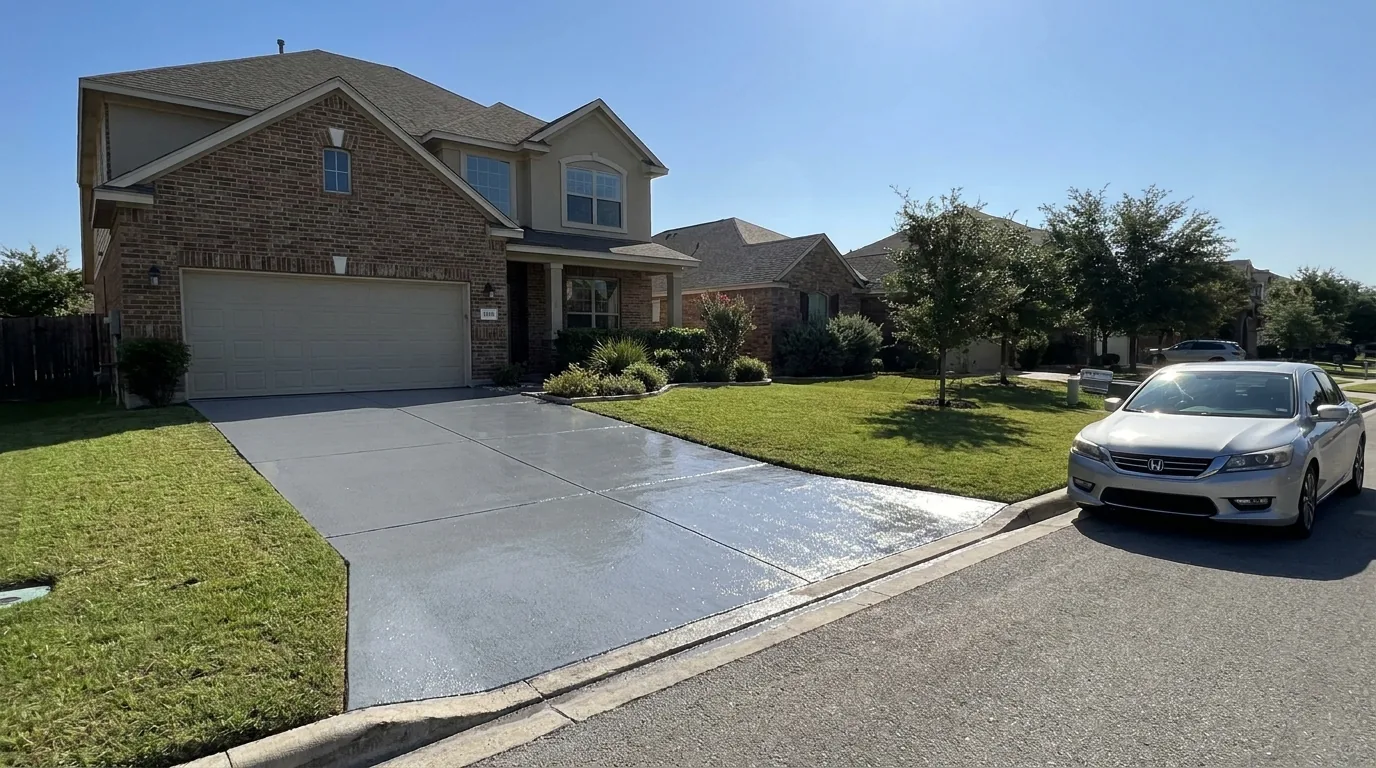
Driveway epoxy coating in San Antonio fails far more often than most homeowners expect - and in most cases, the failure is predictable. Standard epoxy applied to a concrete driveway in full Texas sun will yellow within one season, blister from vehicle heat, and begin delaminating within two to three years. The problem is not epoxy as a category - it is the wrong product applied to one of the most demanding outdoor environments in the country.
This guide covers why standard epoxy fails on driveways specifically, which coating systems actually hold up under San Antonio sun and vehicle load, and what realistic costs look like for professional patio and driveway epoxy coating San Antonio in 2026.
Why Standard Epoxy Fails on Driveways in San Antonio
Driveways face three stressors that garage floors and interior slabs do not:
- Continuous UV exposure. A south- or west-facing San Antonio driveway receives 6–8 hours of direct sun daily in summer. Standard aromatic epoxy degrades under UV - yellowing within months, chalking within a year, and becoming brittle enough to crack by year two.
- Hot tire pickup. Vehicles parked after a highway drive arrive with tire surface temperatures of 150–180°F. These hot tires soften standard epoxy coatings and pull the material as the vehicle moves, leaving tire marks or lifting sections of coating. This is called hot tire pickup and it is the most common complaint with box-store driveway epoxy kits.
- Vehicle load and point stress. A loaded pickup truck or SUV exerts 4,000–8,000 lbs per tire on the driveway surface. Thin coatings that are not anchored to adequate surface profile will debond under this cyclic load, especially at edges and expansion joints.
The same product that performs on an interior garage floor - never exposed to UV, with vehicle loads spread across a cured coating - degrades rapidly when all three driveway stressors are applied simultaneously.
UV-Stable Alternatives That Work
The coating systems that reliably hold up on San Antonio driveways share two properties: aliphatic chemistry for UV resistance, and sufficient film thickness and surface prep to resist vehicle load and thermal cycling.
Decorative Driveway Coating Options
San Antonio homeowners increasingly use driveway coatings for curb appeal as well as protection. Three decorative approaches work well with UV-stable systems:
- Flake chip systems: Vinyl or acrylic flake broadcast into the wet base coat, then sealed with a clear polyaspartic topcoat. Available in dozens of color blends. The flake layer hides surface imperfections and tire marks better than solid color. Most popular decorative option for residential driveways.
- Solid color: Full-hide pigmented topcoat in any custom color. Clean, contemporary look. Shows tire marks and surface texture more than flake systems. Best on newer, smoother slabs.
- Exposed aggregate style: A seeded or broadcast aggregate (quartz, granite chips) encapsulated in a clear polyaspartic. Heavy texture, high slip resistance, natural stone appearance. Higher labor cost but very durable and distinctive.
Thickness and Prep Requirements for Driveways
Driveway applications require more aggressive surface prep than garage interiors because vehicle load and thermal cycling demand better mechanical adhesion.
- Surface profile: ICRI CSP 3–4 (equivalent to 40–60 grit sandpaper) is the target for driveway coating. Shot blasting is the preferred method - it opens concrete pores consistently and removes contamination simultaneously. Diamond grinding is acceptable for smaller areas.
- Oil stain treatment: Oil-contaminated concrete must be degreased with a commercial oil-lift product and ground before coating. Oil-contaminated pores prevent epoxy bonding - untreated oil spots will delaminate within weeks. Test by pouring water on the surface: if it beads, oil contamination is present.
- Crack filling: Use flexible polyurea filler in all cracks before coating. Rigid epoxy paste in a driveway crack will re-crack under vehicle load and thermal movement.
- Film thickness: Professional driveway systems target 15–25 mils total dry film thickness across all coats. Box-store DIY kits typically achieve 4–8 mils - insufficient to resist hot tire pickup or vehicle impact loading.
Driveway Coating Lifespan in San Antonio's Climate
With the correct aliphatic system and professional prep, realistic service life expectations for San Antonio driveways:
- Epoxy base + polyaspartic topcoat: 8–12 years before topcoat refresh needed. Base coat typically remains bonded and intact.
- 100% polyurea system: 7–10 years, with better crack-bridging performance for active slabs.
- Topcoat refresh (without full strip): Possible at year 8–10 if the base coat is still bonded. Cost is 40–60% of a full recoat.
- Standard aromatic epoxy: 1–3 years before visible failure regardless of prep quality.
The most important factor for extending lifespan on San Antonio driveways is avoiding parking hot vehicles immediately after highway driving for the first 30 days after installation, while the coating reaches full cure.
Cost of Professional Driveway Coating in San Antonio
| System | Price per sq ft | 400 sq ft driveway | Lifespan |
|---|---|---|---|
| Epoxy base + polyaspartic topcoat (flake) | $4–$6 | $1,600–$2,400 | 8–12 years |
| 100% polyurea (2-coat, solid color) | $5–$8 | $2,000–$3,200 | 7–10 years |
| Acrylic sealer (light duty) | $1–$2 | $400–$800 | 2–4 years |
| Standard aromatic epoxy (not recommended) | $2–$4 | $800–$1,600 | 1–3 years |
Get the full picture on epoxy floor coating options and system specifications before requesting quotes - knowing what questions to ask separates a contractor using the right product from one cutting corners.
Ready to Coat Your Driveway?
We'll assess your concrete, identify any oil contamination or cracking, and recommend the right UV-stable system - with honest lifespan expectations for San Antonio conditions.
Get a Free Quote