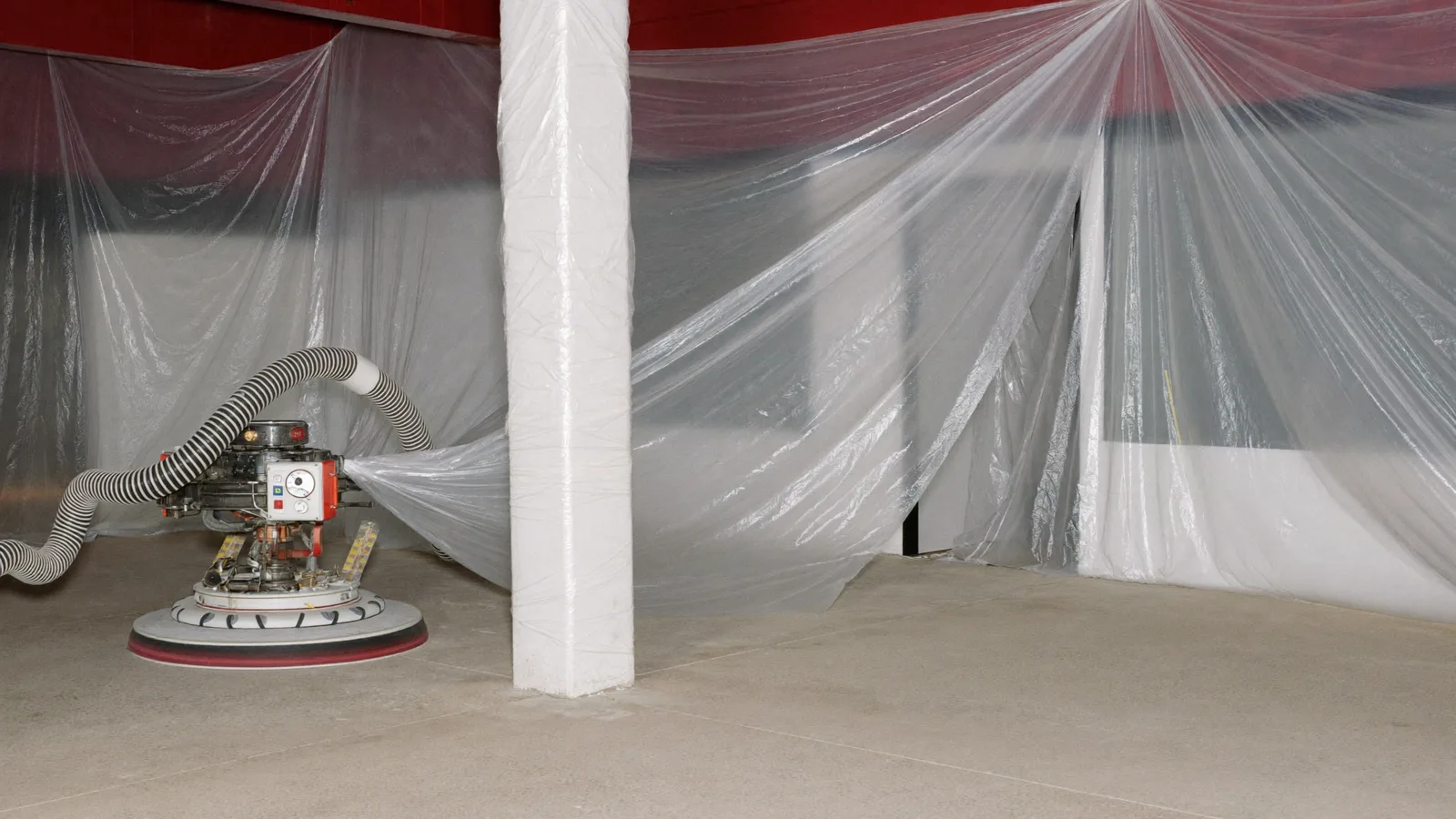
A properly run concrete grind should not dust the rest of the building. Dust is controlled at the tool with a shrouded grinder and a HEPA vacuum sized to it, the work area is sealed with containment, and crews follow the OSHA silica rules for the task. If you are hiring for concrete floor grinding in San Antonio in an occupied building, ask to see the controls before the first pass, not after the first complaint.
Dust is the first objection from any facilities manager or tenant when a floor needs to be ground. It is also a regulated hazard, because grinding concrete releases respirable crystalline silica. This guide explains what keeps a grind out of the rest of your building: why concrete dust is regulated, what OSHA's silica rule for construction expects, how HEPA shrouds and vacuums are matched to the grinder, how negative air containment protects occupied space, and what you should see on site before work starts.
We do not repeat how grinding works, because our guide to how concrete floor grinding works covers the process, and we do not cover scheduling, which our article on warehouse flooring downtime and scheduling installs already handles. This post is about air quality and compliance.
Why concrete dust is a regulated hazard, not just a nuisance
Concrete dust is regulated because grinding breaks quartz and other crystalline silica in the slab into particles small enough to be inhaled deep into the lungs. Fine particles of this kind are called respirable crystalline silica, and long-term exposure is linked to serious lung disease, which is why exposure limits exist.
Not all dust is equal. The visible cloud that settles on shelves is the coarse fraction, and it makes a mess. The respirable fraction is too small to see in normal light, stays airborne for a long time and travels through open doors and shared ventilation. A floor that looks clean after a grind can still have had a poor exposure profile during the work. That is why compliance is about controls and measurement, not appearance.
The regulated side is straightforward to describe. The federal OSHA standard for construction, 29 CFR 1926.1153, sets an exposure limit for respirable crystalline silica and requires employers to limit exposure, either by following a list of specified controls or by measuring exposure. It also expects a written exposure control plan and a designated competent person on the job. These requirements apply to the contractor's own workers. The practical benefit for a building owner is that a contractor who follows them is also protecting your occupants.
OSHA 1926.1153 Table 1 and what compliance looks like on site
Table 1 in the OSHA silica standard pairs common construction tasks with the engineering controls and, where needed, the respiratory protection that apply to each, so a contractor who follows the listed controls is treated as compliant without separate air monitoring for that task. Floor grinding is one of the tasks addressed.
For walk-behind grinders, the table points to dust control at the machine, through either water delivery or a dust collection system. The collection route relies on a shrouded machine connected to a dust collector or HEPA vacuum that provides at least the airflow the manufacturer specifies, with an efficient filter and a way to clean it. It also calls for operating and maintaining the equipment to limit dust. Respirator requirements in the table depend on the task and on whether the work is indoors or outdoors.
Read the current table and the full standard yourself or ask the contractor to show it to you, because OSHA can update the text. What matters for an owner is what compliance looks like on a job site:
- A written exposure control plan that names the tasks, the controls and the person in charge.
- A designated competent person on site, who can explain the plan in plain terms.
- Equipment that matches the table: a shrouded grinder and a connected dust collector, not a bare machine.
- Records of equipment maintenance, such as filter changes, available on request.
- Respiratory protection issued and worn as the task requires.
If a contractor cannot show these, treat that as information about how the rest of the job will run.
HEPA shrouds and vacuum sizing matched to the grinder
The first line of defence is capturing dust at the grinder, which means a shroud that seals around the grinding head and a HEPA-rated vacuum with enough airflow for that machine. A shop vacuum is not a substitute, because its filter and airflow are not built for fine silica.
The shroud is the skirt around the grinding head. It keeps dust from escaping at the edge, and a worn or poorly fitted skirt is one of the most common sources of leaks. The vacuum pulls air through the shroud, and it has to move the volume of air that the machine manufacturer specifies for that shroud size. An undersized vacuum cannot keep the shroud under negative pressure, so dust escapes even though a vacuum is connected.
A HEPA filter is a high-efficiency filter that captures nearly all fine particles. It only works when the filter is intact and the vacuum is sealed, so it needs regular changes, and the collection container needs to be emptied in a way that does not release the dust. Many commercial vacuums use a pre-separator or a continuous-bagging system to keep the filter from clogging, which keeps airflow steady during long grinds.
Ask the contractor three simple questions: what is the grinder model, what is the vacuum, and does the vacuum meet the airflow the grinder manufacturer calls for. A clear answer is a good sign.
Negative air containment and zip walls for occupied spaces
Containment keeps whatever escapes the tool inside the work area, and negative air makes sure air flows into the work area rather than out of it. In an occupied building, both are normal practice.
The work area is closed off with heavy plastic sheeting, often on a frame or zip-wall system, with a zippered door for access. Seams and floor edges are taped. A negative air machine with a HEPA filter exhausts air from the enclosure, either to the outside or through filtration, which keeps the pressure inside lower than the surrounding space. A gentle inward flow at the door is the visible sign that the system is working.
Containment also covers the route out. Workers should remove dust-laden clothing or vacuum themselves before leaving, and sticky mats or wet-wiped pathways at the door reduce tracking. Cleaning is done with HEPA vacuums or wet methods, never with dry sweeping or compressed air, because both put settled dust back into the air.
Protecting HVAC returns and adjacent tenancies
HVAC systems can carry dust to every part of a building, so the return grilles and ducts in or near the work area need to be isolated before grinding starts. This is the step that most often separates a tidy job from a building-wide complaint.
Typical measures include sealing return grilles in the work area with plastic and tape, switching off or isolating air handlers that serve the zone and checking that supply air is not pushing dust into neighbouring spaces. Where a floor is part of a multi-tenant building, adjacent tenants should be told when work will happen, what to expect and who to call. Doors between the work area and the rest of the building stay closed, and any shared corridors are protected with floor covering and cleaned at the end of each shift.
If a building has sensitive uses next door, such as a clinic, a food area or an electronics workspace, raise it early. Extra measures, such as more filtration or work outside operating hours, are easy to plan and hard to retrofit after a problem. For longer jobs that require a shutdown plan, see our related guide on shot blasting versus diamond grinding for how the choice of method changes the dust load.
Where dust control fails in practice
Dust control usually fails at the same few points, and each one is easy to spot if you know where to look. Knowing them helps you ask better questions and recognise a problem early.
- Worn shroud skirts. A brush skirt that is frayed or flattened leaves a gap at the floor, and dust escapes along the whole edge of the machine.
- Clogged filters. When a filter loads up, airflow drops and the shroud loses negative pressure. A vacuum that sounds strained or a cloud near the head is the sign.
- Long or kinked hoses. Extra hose length and tight bends cut airflow. Short, straight runs work best.
- Open doors and gaps in containment. A door propped open for convenience undoes the negative air setup in seconds.
- Dry sweeping. Sweeping or blowing off the slab between passes puts the settled dust back into the air. HEPA vacuum or wet methods are the right choice.
- Skipped shift-end clean-up. Dust left on the floor outside the enclosure is carried into the building on shoes and carts.
Because these failures are visible, a walk-through at the start and a quick look mid-job are usually enough to catch them. A contractor who welcomes the inspection is normally one who has the process under control.
Compliance table: task against control method, equipment and protection
The table below summarises how common prep tasks are typically controlled on a well-run job. It is a plain-language guide, not a replacement for the OSHA text, and the contractor's plan should name the exact controls for your floor.
| Task | Typical control method | Equipment to expect | Respiratory protection |
|---|---|---|---|
| Walk-behind floor grinding | Dust collection at the tool, or water delivery | Shrouded grinder with HEPA vacuum sized to the machine | As Table 1 requires for the task and location |
| Edge and corner grinding | Handheld grinder with shroud and vacuum | Handheld shroud, HEPA vacuum, flexible hose | As Table 1 requires for the task and location |
| Shot blasting | Enclosed blast head with dust collection | Closed-loop machine with dust collector | As Table 1 requires for the task and location |
| Clean-up between passes | HEPA vacuum or wet methods only | HEPA vacuum, damp mops | As the plan specifies |
| Containment and exhaust | Sealed enclosure under negative pressure | Plastic sheeting, zip wall, HEPA negative air machine | Not applicable to occupants |
What a tenant or facilities manager should see before work starts
Before the first pass, you should be able to see the plan, the equipment and the containment, and you should know who to call if something goes wrong. A short walk-through takes ten minutes and prevents most disputes.
- Ask for the plan. The contractor should provide a written exposure control plan and name the competent person.
- Check the equipment. Look for a shrouded grinder connected to a HEPA vacuum, and ask for the models.
- Inspect containment. Sealed edges, a zip door and a negative air machine running are the visible signs.
- Confirm HVAC isolation. Returns in the work zone should be covered, and air handlers adjusted.
- Agree on clean-up. HEPA vacuuming and damp wiping at the end of each shift, with no dry sweeping.
- Share a contact. One person, one phone number, for questions during the work.
If you are planning a floor prep project in an occupied commercial building, call (830) 355-3303 for a free on-site measure and written quote, and we will walk you through dust control for your space.
Frequently asked questions
Is concrete grinding dusty?
Uncontrolled, extremely. With a correctly sized HEPA vacuum and a shrouded grinder, the great majority of dust is captured at the tool, and containment handles the rest. A job that shows visible dust clouds is not using the controls it should.
Why is concrete dust dangerous?
Grinding releases respirable crystalline silica. The particles are fine enough to reach deep lung tissue, which is why exposure is regulated. The controls on a well-run job exist to keep worker and occupant exposure below permitted limits.
Can concrete be ground in an occupied building?
Yes, routinely, provided the area is contained under negative pressure, HVAC returns are isolated and dust extraction is working at the tool. Work is often scheduled outside operating hours as well to reduce disruption.
What is OSHA Table 1 compliance?
Table 1 in OSHA's silica standard lists construction tasks alongside the specified engineering controls and respiratory protection. Following the listed controls for a task is an accepted route to compliance without separate exposure monitoring.
How do I know a contractor is controlling silica properly?
Look for a shroud fitted to the grinder, a HEPA-rated vacuum sized to the tool rather than a shop vacuum, containment at openings, and crews wearing the respiratory protection the task requires. Ask to see the written exposure control plan.