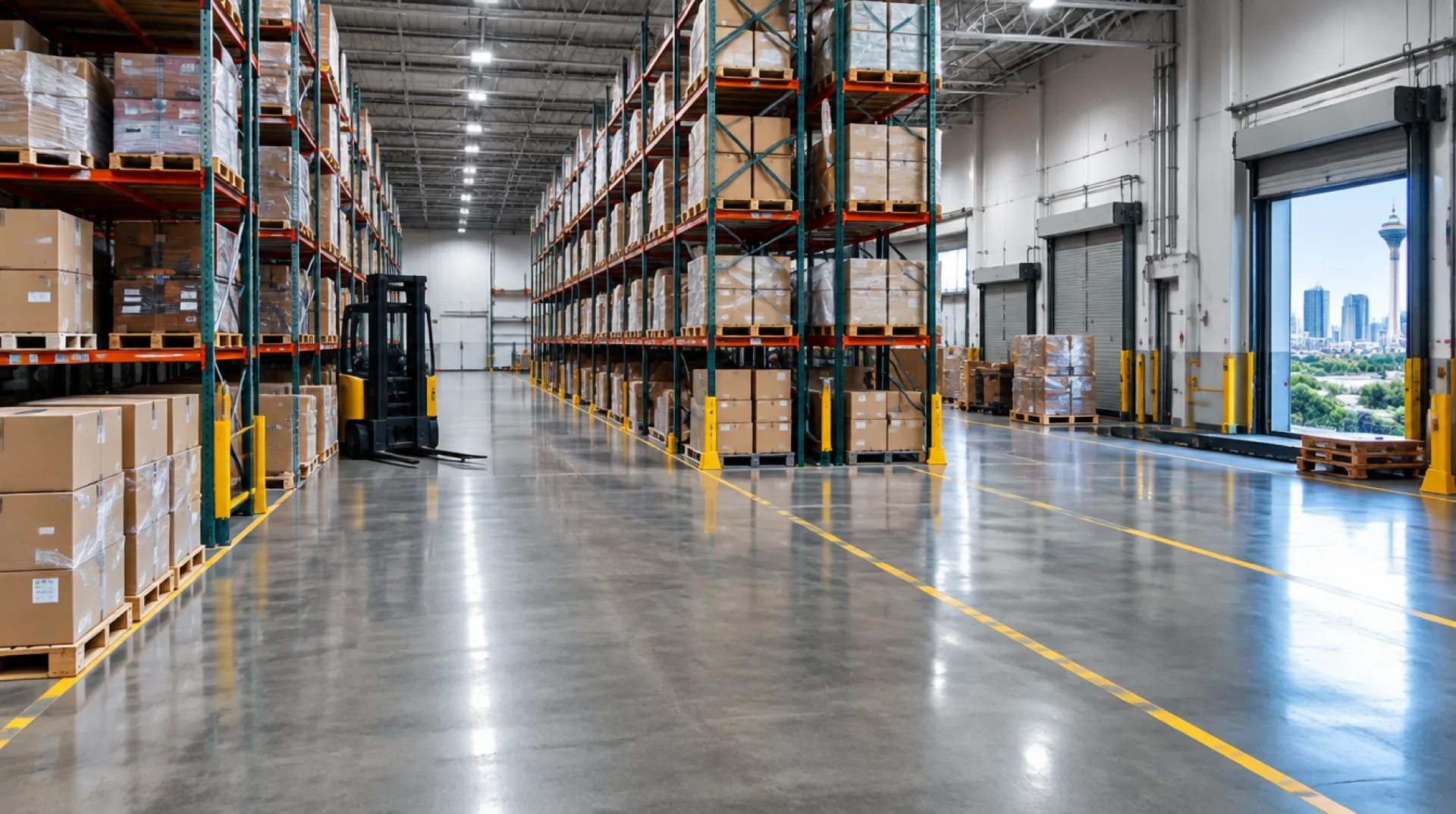
The best warehouse flooring for San Antonio e-commerce fulfillment centers is a heavy-duty epoxy or urethane cement system engineered for continuous forklift, pallet-jack, and automated-cart traffic - not a standard sealed-concrete or light-duty coating meant for lower-turnover storage. Fulfillment operations put far more cyclical stress on a floor than a typical warehouse, and the flooring system has to be specified accordingly from day one.
Why Fulfillment Center Floors Take More Abuse Than Typical Warehouses
A conventional storage warehouse might see a forklift pass through an aisle a few dozen times a day. A fulfillment center running a multi-shift picking and packing operation can see that same aisle crossed hundreds of times, often by a mix of sit-down forklifts, walkie pallet jacks, and battery-powered order pickers moving at higher speeds to hit throughput targets. That combination of high frequency and higher velocity concentrates wear in narrow wheel paths far faster than the same equipment moving occasionally through a low-turnover storage bay, which is why a floor that would hold up fine in a slower-moving warehouse can show rutting or delamination within a year or two inside a fulfillment operation.
Impact and Abrasion Resistance for High-Velocity Picking Operations
Beyond steady wheel traffic, fulfillment centers generate a lot of point-impact stress: totes and cartons dropped from conveyor height, pallets set down hard by an operator racing against a pick-rate target, and the occasional dropped case of dense inventory. A standard epoxy coating can handle rolling loads well but is more prone to chipping under sharp impact than a thicker urethane cement system, which is engineered specifically for impact and thermal-shock resistance in demanding industrial settings. For a full breakdown of how these systems compare under real-world impact, our guide on urethane cement vs. epoxy thermal shock resistance covers the underlying mechanics in more depth than we can here.
Choosing the Right System: Epoxy, Polyaspartic, or Urethane Cement
Most fulfillment centers end up with a hybrid approach rather than a single system across the whole building. High-traffic main aisles and dock staging areas - where forklift travel is heaviest and impact risk is highest - are strong candidates for urethane cement or a heavy-broadcast epoxy flake system with extra film thickness. Lower-traffic mezzanine storage or office-adjacent areas can use a standard or polyaspartic epoxy system at a lower cost, since the wear profile there is closer to a conventional warehouse. Getting this zone-by-zone specification right up front, based on our warehouse flooring assessment of actual traffic patterns in each area, avoids paying for over-specified coating in low-traffic zones while under-specifying the areas that will actually take the abuse.
Comparing Systems for Fulfillment Center Zones
| Factor | Standard Epoxy | Polyaspartic | Urethane Cement |
|---|---|---|---|
| Best zone | Office/mezzanine | Mid-traffic aisles | Main aisles, dock, impact zones |
| Impact resistance | Moderate | Moderate-good | Excellent |
| Install time per zone | 3-5 days | 24-48 hours | 3-5 days |
| Relative cost | Lowest | Moderate | Highest |
Line Striping and Zone Marking for Automated Sortation Areas
Fulfillment centers rely heavily on visual floor marking - pick-path lanes, staging zone boundaries, pedestrian walkways separated from forklift traffic, and often color-coded zones tied to specific carriers or shipping tiers. Line striping and zone marking should be planned as part of the coating install rather than added afterward with surface tape, since embedded striping applied during the coating process holds up under the same wheel traffic that would quickly wear away adhesive tape or paint applied on top of a finished floor. Coordinating this with warehouse management or operations staff before the install date ensures the marking layout matches how pickers and equipment actually move through the space once it's live.
Plan floor zones around actual traffic data, not assumptions: pulling even a rough count of forklift and pallet-jack passes per aisle over a typical shift gives a much more accurate basis for zone-by-zone system selection than guessing based on which areas "look" high-traffic.
Handling 24/7 Operations and Minimal Downtime Installs
Many fulfillment centers run around the clock or close to it during peak season, which makes a full-facility shutdown for flooring work impractical. Polyaspartic systems cure fast enough to return a zone to service within a day or two, which is why they're often the preferred choice for phased installs across a live fulfillment floor even when their impact resistance is somewhat lower than urethane cement. A typical phased approach coats one aisle or zone at a time overnight or across a weekend, keeping the rest of the facility fully operational, with the full site completed over several weeks rather than all at once. Scheduling around known peak shipping windows - avoiding the run-up to major holidays entirely - is worth building into the project timeline from the start.
Real-World Scenario: A Multi-Tenant Fulfillment Campus
A multi-tenant fulfillment campus on San Antonio's east side approached a floor refresh after several tenants reported wheel rutting along their busiest conveyor-feed aisles, roughly eighteen months after the original coating was installed. An assessment found the original system had been specified as a single standard epoxy across the entire building, with no differentiation between the light-traffic mezzanine storage and the heavy-traffic ground-floor pick aisles. The fix involved re-coating just the ground-floor traffic lanes with a broadcast urethane cement system while leaving the mezzanine's lighter epoxy in place, since it was still performing well under its lower traffic load - a targeted, zone-specific re-coat rather than a full-building replacement, which kept both the cost and the operational disruption well below what a complete redo would have required.
Chemical Resistance at Charging Stations and Loading Docks
Most general-merchandise fulfillment operations don't handle industrial chemicals, but battery-charging stations for electric forklifts and pallet jacks are a common exception, since a spilled or overcharged battery can leak acid onto the surrounding floor. These specific zones benefit from a chemical-resistant epoxy or urethane cement topcoat even in a building where the rest of the floor doesn't need that level of protection, and containment curbing or a slightly raised charging pad is worth considering alongside the coating itself. Loading dock aprons, which see diesel and hydraulic fluid drips from trailers and dock equipment, are another zone where chemical resistance matters more than in general picking aisles.
Planning the Install Around Racking and Conveyor Infrastructure
Fulfillment centers are dense with fixed infrastructure - pallet racking, conveyor supports, sortation equipment - that a warehouse without automation doesn't have to work around. Coordinating the coating install with any racking relocation or conveyor maintenance already on the facility's calendar can meaningfully cut project cost, since crews can work in open floor space without needing to mask off or hand-cut around equipment that would otherwise need to be temporarily moved. Facilities planning a racking reconfiguration or conveyor expansion in the near future should sequence the floor coating to happen during that same downtime window rather than as two separate disruptions to operations.
Point-Load Ratings for Racking and Automated Storage
Fulfillment centers increasingly use taller, denser racking than a traditional warehouse, and some are adding automated storage and retrieval systems (AS/RS) or robotic shuttle systems that place concentrated point loads on the slab through narrow footings rather than distributing weight across a wide footprint like standard pallet racking does. A floor coating itself doesn't change the slab's structural load capacity, but the coating and any leveling work done underneath it needs to account for these point loads so the finished surface doesn't develop stress cracking around footing locations. Our detailed breakdown of warehouse flooring load ratings walks through how point loads from racking and automated systems factor into both the slab assessment and the coating specification, which is worth reviewing before finalizing equipment layouts for a new or expanding fulfillment facility.
Maintenance Schedules That Keep Fulfillment Floors Running
A coated floor in a high-throughput fulfillment center still needs a maintenance rhythm suited to its traffic level, not the lighter cleaning schedule that works fine for a slower-moving storage warehouse. Daily or twice-daily auto-scrubbing along main traffic lanes keeps grit and debris from acting as an abrasive under wheel traffic, which is one of the biggest contributors to premature coating wear beyond the impact and load factors already covered above. Facilities should also schedule a walk-through inspection of high-traffic zones every few months specifically looking for early rutting, chipping near dock levelers, or coating lift at expansion joints, since catching these issues early usually means a localized touch-up rather than a full re-coat of an entire aisle or zone. Building this inspection into an existing preventive-maintenance checklist for material handling equipment is an easy way to make sure it doesn't get overlooked once a facility is fully operational and focused on throughput metrics.
Specify the Right Floor for Your Fulfillment Center
We assess traffic patterns zone-by-zone and recommend the right epoxy, polyaspartic, or urethane cement system for each area of your San Antonio facility.
Request a Free Quote