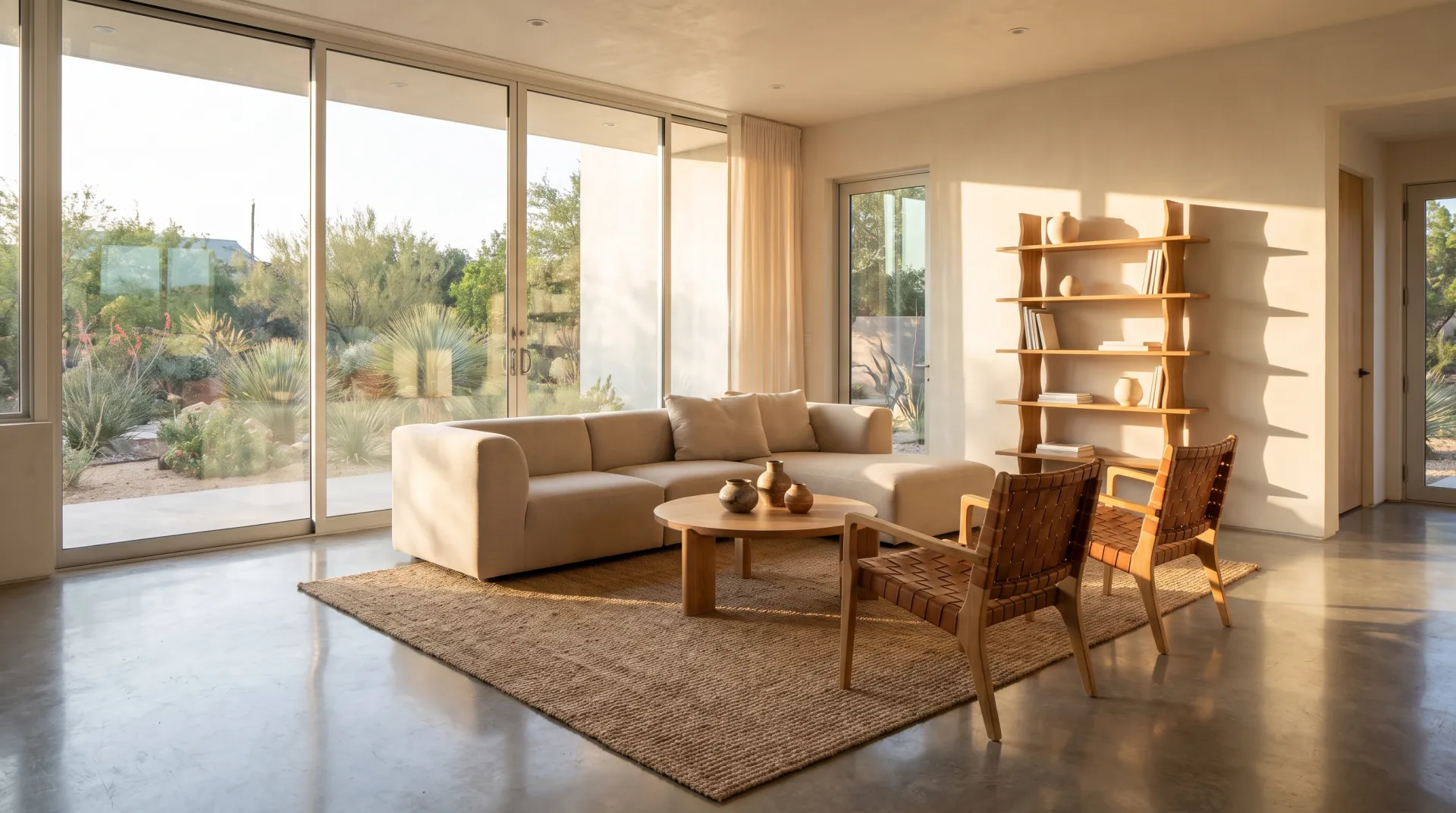
Polished concrete gives San Antonio homes a durable, low-maintenance floor with a modern, subtly reflective finish that reads anywhere from soft matte to high-gloss depending on the polish level chosen - and for homes already built on a slab foundation, it uses the concrete that's already there rather than covering it with a new material. It's not the right fit for every room or every homeowner's taste, but for the right space it can outlast tile, resist the wear that damages hardwood, and cut long-term maintenance significantly.
What Polished Concrete Actually Looks and Feels Like Indoors
Interior polished concrete is a different look from the utilitarian gray of a garage or warehouse floor. The polishing process progressively grinds the surface with finer diamond abrasives, which can reveal natural aggregate and subtle variation in the concrete for an organic, stone-like appearance, or leave a smoother, more uniform finish depending on the grind level chosen. Homeowners can also select from a range of polish sheens - satin to high-gloss - and add integral color or a translucent stain for a warmer, more residential tone rather than industrial gray. Underfoot, it feels hard and smooth, cooler than carpet or engineered wood, closer to natural stone or polished tile in temperature and texture.
Polished Concrete vs. Tile and Hardwood
| Factor | Polished Concrete | Tile | Hardwood |
|---|---|---|---|
| Durability | Very high, resists scratches | High, but grout wears | Moderate, dents/scratches |
| Maintenance | Sweep + damp mop | Grout needs sealing/cleaning | Refinishing every 7-10 yrs |
| Water resistance | Excellent | Excellent | Poor to moderate |
| Feel underfoot | Hard, cool | Hard, cool | Warmer, slight give |
| Typical cost/sq ft | $3-$8 (existing slab) | $5-$15 installed | $8-$15+ installed |
The honest tradeoff: polished concrete wins on durability and long-term cost, but it's a harder, cooler surface than hardwood - a difference some homeowners love and others prefer to offset with area rugs in living and bedroom spaces.
Where Polished Concrete Works Best in a Home
Open-concept living areas, kitchens, entryways, and mudrooms tend to be the strongest fits, since these spaces benefit most from a durable, easy-to-clean surface that handles foot traffic, spills, and pet activity without the maintenance tile grout or hardwood finish requires. Homes with large sliding doors to a patio or pool area also pair well with polished concrete, since it tolerates the moisture and sand tracked in from outdoor living far better than hardwood. Bedrooms are more a matter of personal preference - some homeowners polish the whole main floor for a consistent look and add rugs in bedrooms, while others keep bedrooms carpeted and polish only the main living areas.
Cost and What Drives the Price
For homes with an existing slab, polishing typically runs $3-$8 per square foot in San Antonio, varying based on the polish level (a basic satin finish costs less than a high-gloss, multi-step polish), whether integral color or stain is added, and the condition of the existing slab. A slab with significant cracking, unevenness, or old adhesive residue from removed flooring requires more prep work - grinding, patching, sometimes leveling compound - which adds to the cost compared to a clean, bare slab. This is one reason polished concrete is often most cost-effective as part of a renovation where old flooring is already being removed, since the slab is already exposed rather than requiring a separate demo step.
Curious If Your Slab Is a Good Candidate?
We'll assess your existing concrete and walk you through polish level, color, and cost options for your home.
Request a Free QuoteIs It Right for You? A Decision Guide
A few honest questions help most homeowners land on the right answer for their own space.
- Do you have pets or kids? Polished concrete resists scratches from claws and toys far better than hardwood, and spills wipe up without soaking in
- Do you prioritize low maintenance over a warmer feel? Sweeping and occasional damp mopping is essentially the full maintenance routine, versus periodic refinishing or grout resealing with other materials
- Is your home on a slab foundation? This determines whether true polished concrete is even an option, or whether an overlay system is the closer alternative
- Are you comfortable with a cooler, harder surface? If bare-foot warmth is a top priority, radiant floor heating under polished concrete or selective use of area rugs are the two common solutions
- What's your renovation timeline? Polishing an existing slab during a flooring renovation is typically faster than installing hardwood or tile from scratch, since there's no new material installation - just surface refinement
Maintenance Over Time
Long-term care for polished concrete is notably simpler than most residential flooring options. Regular sweeping and occasional damp mopping with a pH-neutral cleaner handles daily maintenance, and unlike hardwood, there's no periodic refinishing or resealing required for a properly polished and sealed floor in normal residential use. Our guide on how long polished concrete lasts in San Antonio covers the long-term durability question in more depth, including how often a maintenance polish or fresh sealer application is recommended to keep the shine and protection intact.
Choosing Between Polish Levels and Sheens
Homeowners sometimes assume "polished concrete" means one uniform look, but the grind and polish process actually offers a spectrum of finishes. A cream finish, achieved with a lighter grind, leaves the surface cement paste intact for a smoother, more consistent color with minimal aggregate exposure - a popular choice for a clean, contemporary residential look. A salt-and-pepper finish grinds slightly deeper, exposing fine aggregate for subtle texture and visual depth. A full aggregate exposure finish grinds the deepest, revealing larger stone aggregate for a bold, natural-stone-like appearance that reads more dramatic and less uniform. Sheen level - matte, satin, or high-gloss - is a separate choice from grind depth, and the two combine to create a wide range of final looks from understated to reflective and dramatic.
Comparing Polished Concrete to Epoxy for Interior Use
Homeowners researching durable interior flooring sometimes weigh polished concrete against a decorative epoxy coating instead. Both use the existing slab as the base, but the finished result differs meaningfully: polished concrete refines and seals the concrete itself, while epoxy adds a distinct colored or decorative coating layer on top. Our comparison guide on polished concrete vs. epoxy in San Antonio breaks down which option tends to suit different rooms and aesthetic goals, which is worth reviewing alongside this guide before finalizing a decision for a specific space in the home.
What the Installation Process Looks Like
Polishing an existing residential slab is typically less disruptive than installing a new flooring material, since there's no demo of old flooring or new material to source and lay. The process starts with an assessment of the existing slab for cracks, unevenness, and prior coatings or adhesive residue that need to be ground off before polishing can begin. Crack repair and any leveling work happen next, followed by a progressive series of diamond grinding passes using increasingly fine grits - this is what actually creates the polished surface, rather than a topical coating or wax. A penetrating densifier is typically applied partway through the process to harden and seal the concrete from within, followed by the final polishing passes to reach the chosen sheen level, and a protective sealer or guard to help resist staining in daily use.
Because the work generates dust, professional crews use dust-extraction equipment attached to the grinding tools to keep airborne particulate to a minimum - an important consideration for an occupied home versus a commercial job site. Most residential polishing projects for a typical living area or open-concept main floor can be completed within a few days, considerably faster than the multi-week timeline sometimes associated with hardwood installation and finishing.
Common Homeowner Concerns Addressed
A few concerns come up repeatedly from homeowners considering polished concrete for the first time. Slipperiness is one of the most common - a properly polished floor with the right sealer isn't inherently more slippery than tile, and slip-resistant additives can be included in the sealer for kitchens, bathrooms, or entryways where water exposure is more likely. Cracking is another frequent question: existing cracks in the slab are typically repaired and filled as part of the polishing prep, and while concrete can develop minor hairline cracks over time due to normal settling, this is a characteristic of the material rather than a defect specific to polishing, and it rarely affects the floor's function. Noise is sometimes raised as well, since hard surfaces reflect sound differently than carpet - area rugs and furniture placement address this in open living spaces the same way they would with tile or hardwood.