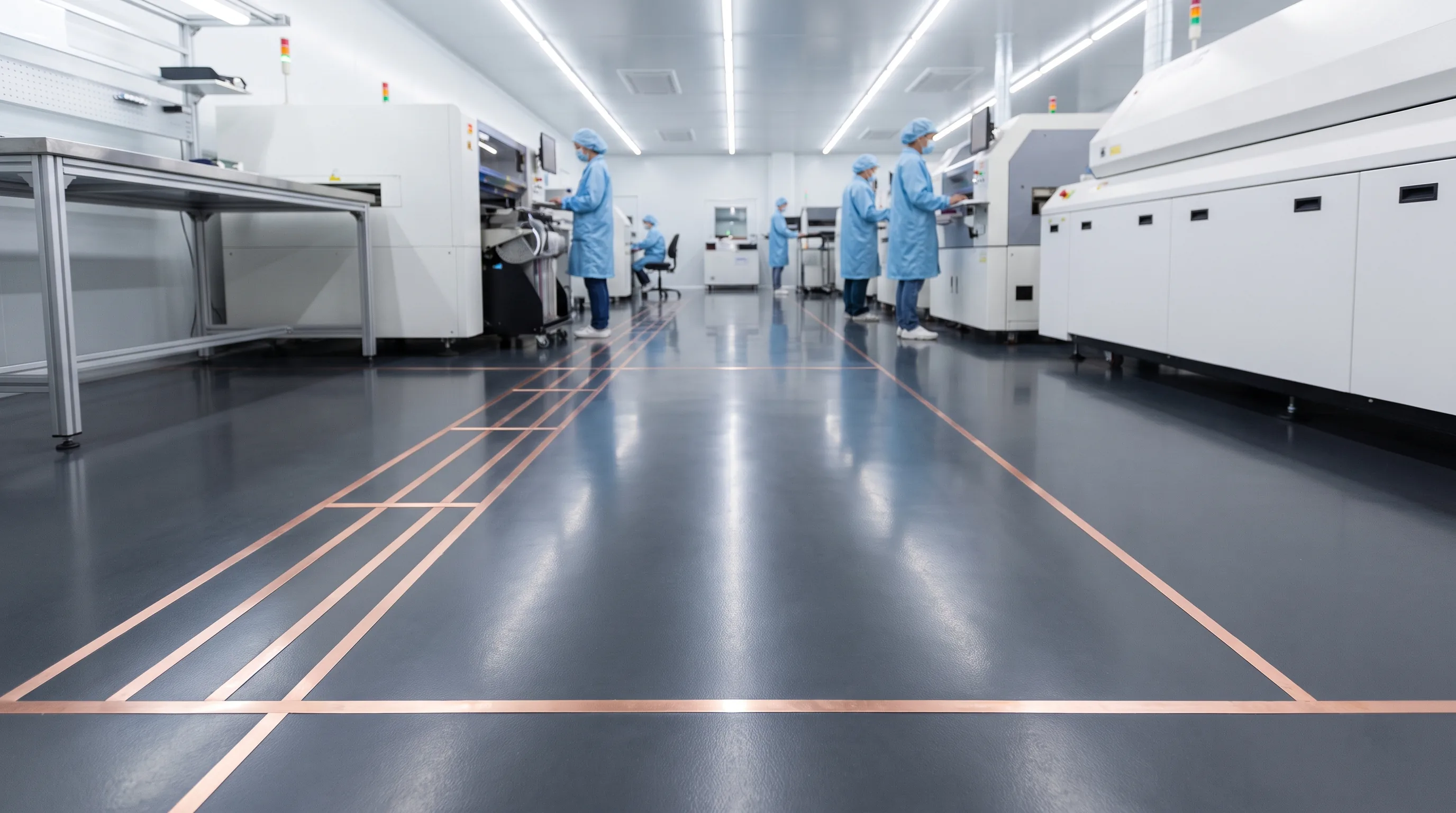
Electronics manufacturing and defense contract facilities in San Antonio run on equipment that a single static discharge can destroy. A spark most people would never notice - under 100 volts, invisible, silent - is enough to kill a circuit board, corrupt a sensor, or void a government contract's quality requirements. ESD epoxy flooring is the baseline control most facilities build their static-safe program around, and getting the spec wrong is expensive twice: once in damaged product, and again in a failed audit.
This guide covers what ESD epoxy actually does, how it's specified for electronics and defense work, and what San Antonio facilities need to verify before signing off on an installer.
Why Standard Flooring Fails in Electronics and Defense Facilities
Ordinary epoxy, sealed concrete, and vinyl tile are all electrical insulators. That's fine almost everywhere - but in a facility handling static-sensitive devices (SSDs), an insulating floor lets static charge build up on people and equipment with nowhere to go. The charge discharges the moment it finds a path to ground, and that path is often a component pin.
- Static buildup on personnel walking the floor is the single most common ESD event source in electronics assembly.
- Rolling carts and equipment with standard casters generate triboelectric charge on non-conductive floors.
- Defense and aerospace contracts frequently require documented compliance with ANSI/ESD S20.20, which specifies flooring resistance ranges as part of the facility's static control program.
- A single undetected ESD event can cause latent damage - a component that fails weeks or months after assembly, with no clear cause.
How ESD Epoxy Flooring Works
ESD epoxy is formulated with conductive additives - typically carbon or metallic particles - that give the cured floor a controlled electrical resistance, rather than acting as a pure insulator or a pure conductor. Paired with copper grounding strips embedded in the floor and tied into the building's ground system, the floor gives static charge a continuous, safe path to dissipate before it reaches sensitive components.
- Conductive systems (CDS): Resistance in the 104–106 ohm range, used where the fastest possible static dissipation is required.
- Static dissipative systems (SDS): Resistance in the 106–109 ohm range, the more common spec for general electronics assembly - fast enough to prevent buildup, controlled enough to protect personnel from shock hazards.
- Both systems require grounding straps or floor-to-earth ground connections installed as part of the system, not as an add-on.
Need an ESD Floor That Passes Audit?
We install and test ESD epoxy systems to ANSI/ESD S20.20 resistance specs, with documentation your compliance team can hand to an auditor.
Get a Free Facility AssessmentANSI/ESD S20.20 Compliance Basics
ANSI/ESD S20.20 is the industry standard most electronics and defense facilities are held to, either by internal quality policy or by contract requirement. For flooring specifically, the standard covers:
| Requirement | Typical Spec |
|---|---|
| Resistance to ground (Rtg) | < 3.5 × 10⁷ ohms |
| System resistance (person + footwear + floor) | < 3.5 × 10⁷ ohms |
| Testing frequency | Installation, then periodic re-verification |
| Documentation | Test results retained for audit |
A floor that isn't tested and documented at install doesn't actually meet the standard, even if the material specification is correct. Ask your installer for resistance test results as a deliverable, not a verbal assurance.
What San Antonio Electronics and Defense Facilities Should Specify
- Confirm whether your product handling calls for a conductive (CDS) or static dissipative (SDS) system - this is usually dictated by your existing ESD control program, not a flooring preference.
- Require grounding strip layout as part of the installation drawing, not an afterthought.
- Get resistance testing results in writing at handover.
- Ask about topcoat wear rating if the floor sees rolling cart or forklift traffic - ESD properties can degrade if the topcoat wears through before the base coat does.