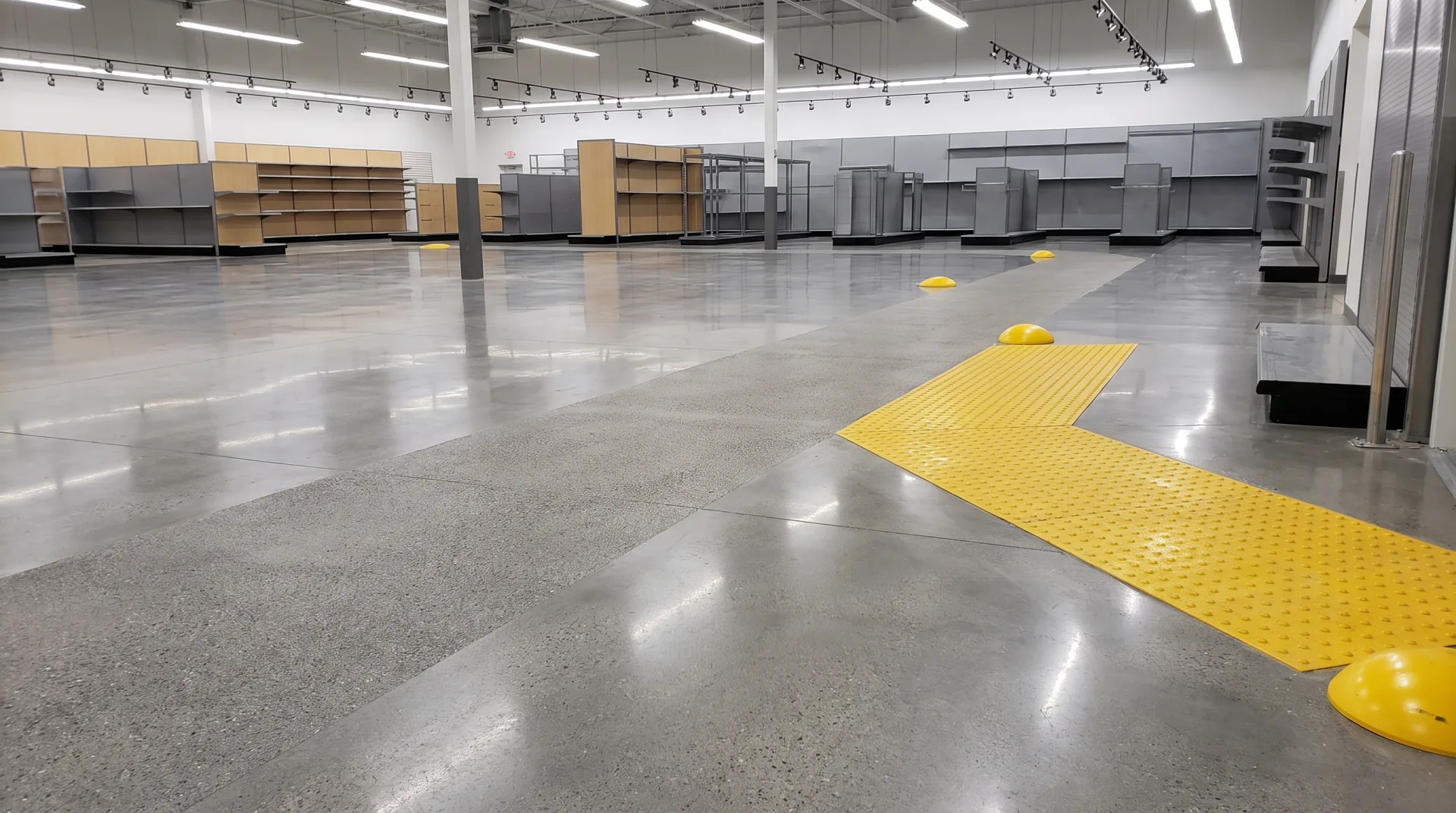
Polished concrete can meet commercial slip resistance requirements in San Antonio when specified correctly - the polish level and gloss alone don't determine slip risk, and a slip-resistant sealer or guard tested to current industry standards can be applied without sacrificing the polished aesthetic businesses want. Getting this right at the specification stage avoids a costly retrofit later if a floor fails a slip resistance evaluation after installation.
Why Polished Concrete Gets a Reputation for Being Slippery
The assumption that polished concrete is inherently slippery comes from confusing gloss level with actual traction. A high-gloss finish reflects light dramatically and looks smooth, which visually reads as "slippery" to most people, but the coefficient of friction - the actual measurable traction a surface provides - depends on the sealer or guard applied, not the polish grind level itself. A properly specified polished floor with the right topical treatment can meet the same slip resistance standards as a matte or textured surface, while a poorly specified matte floor can still fail a slip test if the wrong sealer was used.
The Relevant Slip Resistance Standard
Commercial slip resistance in the U.S. is generally evaluated against ANSI A326.3, the current industry standard for measuring the dynamic coefficient of friction (DCOF) of hard-surface flooring materials. Building codes and ADA accessibility guidance typically point to this standard, or an equivalent, when addressing walkway surface safety, particularly in wet or high-traffic areas. A DCOF value of 0.42 or higher is a commonly referenced benchmark for level interior spaces, though specific local code requirements and use-case (a wet area like an entryway versus a dry retail floor) can affect what value actually applies to a given space.
Slip Resistance Options for Polished Concrete
| Treatment | Effect on Gloss | Best For |
|---|---|---|
| Standard penetrating sealer | No change | Low-moisture, low-traffic areas |
| Slip-resistant guard/sealer | Minimal, gloss-preserving | Most commercial spaces |
| High-traction additive | Slight matting/texture | Wet areas, entryways, ramps |
The right treatment depends on the specific space: a dry retail sales floor has different slip resistance needs than an entryway that regularly gets wet from rain or foot traffic tracking in moisture - specifying one blanket treatment across an entire facility can under- or over-treat certain zones.
Testing and Documentation for Compliance
For businesses that need to demonstrate code compliance - particularly in spaces open to the public or subject to specific occupancy classifications - requesting DCOF test documentation for the specific sealer or guard product being applied is worth doing before installation, not after a complaint or incident. Reputable coating manufacturers publish DCOF test results for their slip-resistant products, and a documented, tested product applied correctly gives a business a much stronger compliance position than an untested or generic sealer applied without verification. Our concrete polishing service page covers the slip-resistant treatment options we specify for San Antonio commercial projects.
Need a Polished Floor That Meets Code?
We'll specify a slip-resistant treatment tested to current standards without sacrificing your floor's polished look.
Request a Free QuoteZone-Specific Slip Resistance Planning
Larger commercial spaces often benefit from a zone-based approach to slip resistance rather than a single blanket treatment. Entryways and areas near exterior doors, where rain and moisture get tracked in regularly, typically warrant a higher-traction treatment than interior zones that stay consistently dry. Areas near water fountains, food service counters, or restrooms similarly deserve elevated attention. Planning these zones during the initial specification - rather than treating the entire floor identically - lets a business optimize for both appearance (keeping the most visible, dry areas at maximum polish and gloss) and safety (concentrating higher-traction treatment where moisture risk is actually highest).
Retrofitting an Existing Polished Floor
Businesses with an existing polished concrete floor that either wasn't originally treated for slip resistance, or that has worn down over years of foot traffic, don't necessarily need to regrind and repolish the entire surface to improve compliance. A slip-resistant sealer or guard can typically be applied as a topical treatment over an existing polished floor, provided the surface is properly cleaned and prepped for the new product to bond correctly. This makes addressing a compliance gap discovered after the fact considerably less disruptive and less expensive than a full floor redo, though the existing floor's overall condition should still be assessed to confirm a topical treatment is the right fix rather than a sign of deeper wear needing more comprehensive attention. Our guide on polished concrete San Antonio: the complete guide covers general maintenance and refresh options relevant to this kind of retrofit project.
Balancing Compliance With Aesthetic Goals
Business owners sometimes worry that meeting slip resistance requirements means giving up the sleek, reflective look that made them choose polished concrete in the first place. In practice, modern slip-resistant sealers are specifically formulated to preserve gloss and optical clarity while still delivering the required traction improvement, so most commercial spaces can meet code without a visually obvious compromise. Our related post on epoxy floor slip resistance in San Antonio covers a comparable consideration for coated rather than polished surfaces, useful context for businesses weighing polished concrete against an epoxy alternative partly on slip resistance grounds.
Occupancy Type and Slip Resistance Expectations
Different commercial occupancy types carry different practical slip resistance expectations, even where a single blanket code number technically applies across a jurisdiction. A restaurant kitchen or food service back-of-house area sees regular grease and liquid exposure that warrants a more aggressive slip-resistant treatment than a retail sales floor that stays dry under normal conditions. Healthcare facilities and senior living spaces often specify slip resistance above the minimum code requirement given the population's higher fall risk, even in areas that would otherwise be considered low-risk for a general retail tenant. Understanding your specific occupancy type's realistic risk profile - not just the bare minimum code number - helps in specifying a treatment that actually protects visitors and staff, rather than one that merely satisfies a technical compliance checkbox.
Insurance and Liability Considerations Beyond Code Minimums
Meeting the letter of a slip resistance code requirement is the baseline, but businesses should also consider how their flooring choice affects liability exposure and insurance considerations beyond bare compliance. A documented, tested slip-resistant treatment - with manufacturer DCOF data on file - gives a business a stronger position if a slip-and-fall incident ever occurs and liability is questioned, since it demonstrates a proactive, documented effort rather than a floor installed with no specific attention to slip resistance at all. Some commercial insurance policies and underwriters also look favorably on documented safety measures like this when assessing premiums for businesses in higher foot-traffic or higher-risk categories, making the modest upfront cost of proper specification and documentation a reasonable investment beyond just avoiding a building code violation.
Working With a Contractor on Slip Resistance Specification
When getting quotes for a polished concrete project with slip resistance requirements, ask contractors directly what specific product they plan to use for slip treatment, whether they can provide DCOF test documentation for that product, and how they'll verify the finished floor meets the required threshold before calling the project complete. A contractor experienced with commercial compliance projects should be able to answer these questions specifically and confidently, rather than offering a vague assurance that "polished concrete can be made slip-resistant" without naming an actual tested product or verification method. This level of specificity in the proposal stage is one of the clearest signals of a contractor who understands commercial code requirements versus one primarily experienced with residential polishing work where these standards rarely come into play.
Ongoing Maintenance to Preserve Slip Resistance
Slip resistance isn't a one-time installation attribute - it can degrade over time if the floor isn't maintained with the right products and routine. Using cleaning chemicals not compatible with the specific slip-resistant sealer applied can strip or dull the treatment faster than expected, effectively undoing the compliance work done at installation. Facilities should confirm with their installer which cleaning products are safe to use on the specific treated surface, and build that into their janitorial team's routine rather than leaving it to general-purpose floor cleaning products that may not be appropriate. Periodic re-testing or reapplication of the slip-resistant treatment, particularly in the highest-traffic zones identified during initial planning, helps ensure the floor continues meeting its intended compliance level years after the original installation rather than only on day one.